
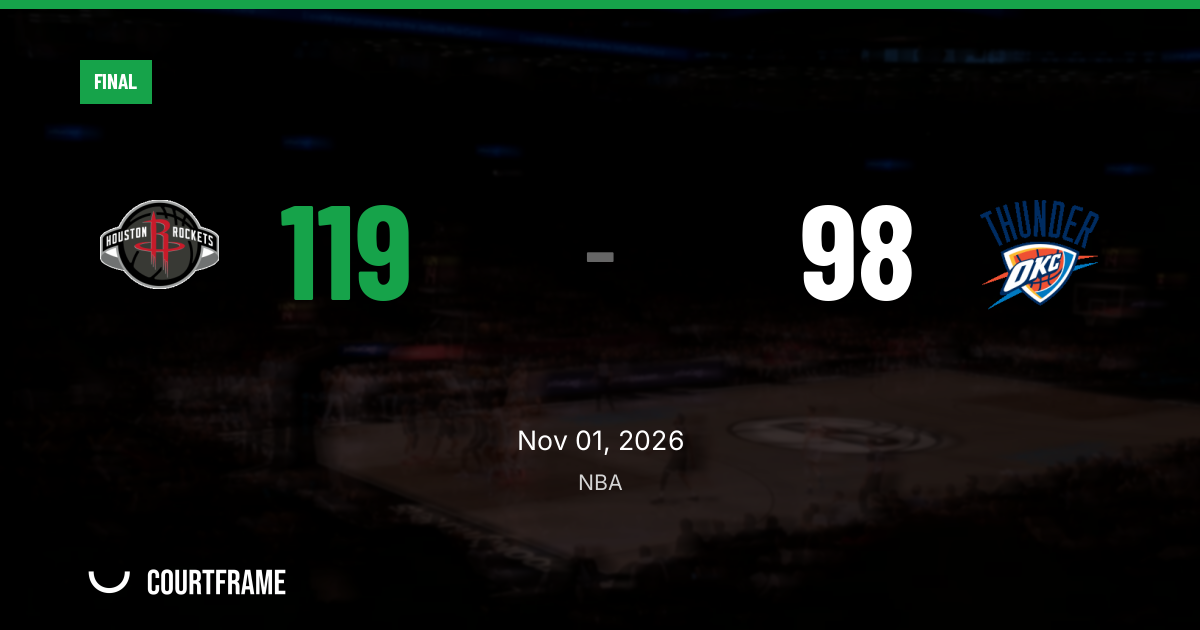
The Houston Rockets entered Sunday at Toyota Center with the stronger early-season profile, and the matchup played out that way in a 119-98 win over the Oklahoma City Thunder in the regular season.
Houston improved to 6-1 and stayed unbeaten at home, where it has opened 3-0. Oklahoma City fell to 4-2 and dropped to 1-2 on the road.
The Rockets created immediate separation with a 35-26 first quarter and never lost control. They won every quarter, scoring 27, 30 and 27 points after the opening period while holding the Thunder to a descending quarter-by-quarter line of 26, 25, 24 and 23.
Houston’s shooting profile decided the game
The Rockets’ offensive identity has been built on efficiency and ball movement, and both showed up against Oklahoma City. Houston made 18 of 41 from 3-point range, compared with Oklahoma City’s 10 of 32. That 24-point advantage from beyond the arc matched the shape of the game: Houston generated cleaner volume, stretched the floor and forced the Thunder to chase.
The Rockets also turned possession quality into a clear advantage. They finished with 29 assists and only 10 turnovers, a strong reflection of the same passing structure that had produced a 71.8 assist rate through seven games. Oklahoma City had 20 assists and 14 turnovers, a gap that made it difficult to keep pace once Houston’s perimeter shooting created an early cushion.
Houston entered averaging 120.7 points with a 67 true shooting percentage, 56.8 effective field goal percentage and 114.5 offensive rating across seven games. The 119-point output was almost exactly in line with that scoring level, even with the Rockets playing on one day of rest and in a back-to-back spot during a stretch of four games in seven days.
Thunder injuries narrowed the margin for error
Oklahoma City came in short-handed, with Alex Caruso, Chet Holmgren, Thomas Sorber, Nikola Topic, Cason Wallace and Jalen Williams all out. That mattered against a Houston team that already had the better early statistical indicators, including a 55.95 CourtFrame Power Index, ranked eighth, compared with Oklahoma City’s 46.07, ranked 13th.
The Thunder were missing major pieces of their defensive and connective infrastructure. Holmgren had averaged 11.3 points and 9 rebounds in three games, while Jalen Williams had averaged 13.7 points, 4.7 rebounds and 3.3 assists in three games. Without them, Oklahoma City had fewer answers for Houston’s frontcourt spacing and fewer secondary creators to relieve pressure from Shai Gilgeous-Alexander.
Oklahoma City entered with a 92.4 defensive rating across six games, but Houston’s shot profile stressed that defense in ways the Thunder could not fully absorb. The Rockets’ 18 made 3s and 29 assists forced Oklahoma City into longer defensive possessions, and the Thunder’s 14 turnovers prevented them from consistently setting their half-court defense.
Rockets’ depth held despite absences
Houston was also dealing with injuries. Steven Adams and Reed Sheppard were out, Fred VanVleet was out for right knee injury management, and Alperen Sengun and Marcus Smart were listed as questionable. VanVleet’s absence removed a guard who had averaged 13 points and 6.2 assists in five games, but the Rockets still protected the ball and generated offense through collective passing.
That was the most important part of the win for Houston. The Rockets did not need to lean on one possession type or one creator to maintain control. Their 29 assists aligned with a season profile that included 27.3 assists per game, and their 10 turnovers were well below their 15.3 average entering the night.
The rebounding margin was narrow, with Houston holding a 44-42 edge, but the Rockets’ efficiency advantage and possession discipline mattered more. Houston also added seven blocks, compared with four for Oklahoma City, giving the Rockets enough rim resistance to complement their perimeter shot-making.
Result matched the pregame indicators
Houston entered with a 59.9 percent implied win probability and a 9.9-point CourtFrame Power Index differential. The final margin was larger than that gap, but the underlying matchup pointed toward a Rockets advantage: better offensive efficiency, stronger net rating, stronger home form and a Thunder roster missing several key contributors.
The Rockets’ 18.1 net rating through seven games had been driven by balance, with a 114.5 offensive rating and 96.4 defensive rating. Against Oklahoma City, that balance was visible in the final score: 119 points on one end, 98 allowed on the other.
For Oklahoma City, the offensive concerns from the opening stretch continued. The Thunder entered averaging 106.5 points with a 52.8 true shooting percentage and 46.9 effective field goal percentage. They finished with 98 points and only 10 made 3s, a difficult formula against a Houston team that has been one of the league’s most efficient early offenses.
Houston’s win was not just about a hot shooting night. It was a continuation of the Rockets’ early-season profile: high assist volume, efficient perimeter scoring, controlled turnovers and enough defensive activity to keep opponents from matching their pace. Oklahoma City’s injuries reduced its counters, and Houston punished that shortage from the opening quarter through the final possession.