
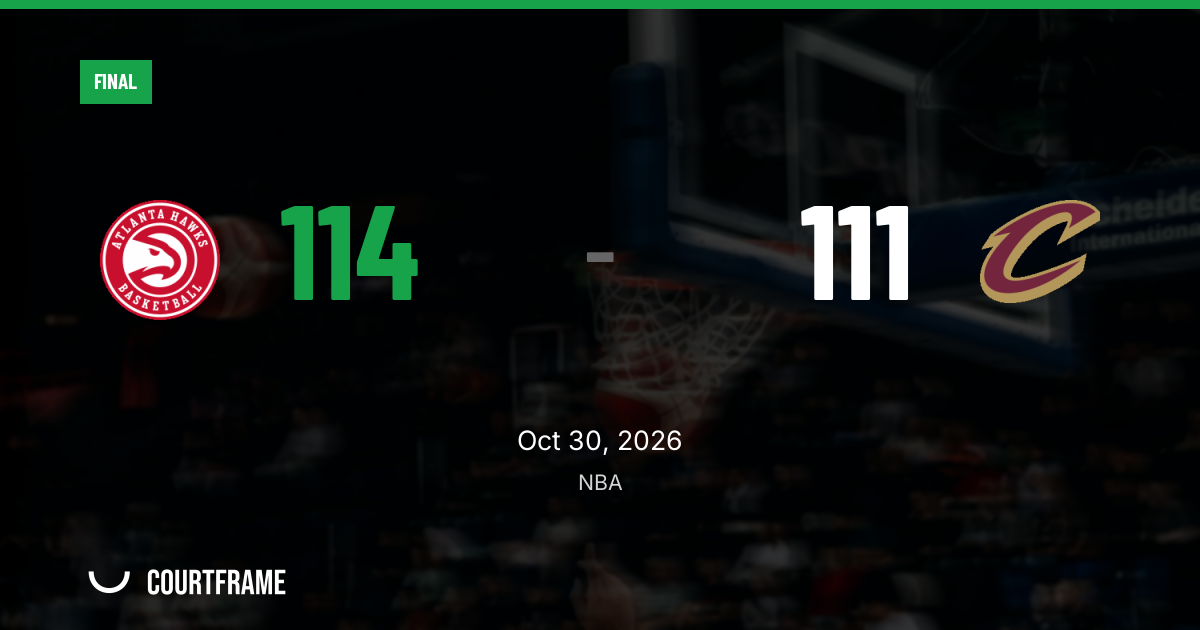
The Atlanta Hawks beat the Cleveland Cavaliers 114-111 on October 30, 2026, at State Farm Arena, turning a poor opening quarter into a narrow regular season win built on ball movement and a decisive third-quarter surge.
Cleveland led 28-16 after the first quarter, but Atlanta answered with a 30-16 second quarter to take back control before the break. The game opened up after halftime, with the Hawks scoring 43 points in the third quarter and the Cavaliers responding with 38, creating the offensive stretch that ultimately decided a three-point finish.
Atlanta’s passing created the separation
The clearest statistical edge for Atlanta came in the assist column. The Hawks finished with 34 assists, compared with 26 for the Cavaliers, and that advantage matched their pre-game profile as a team averaging 32 assists across six games.
That distribution mattered because Atlanta did not win through volume at the foul line. Cleveland made 22 free throws on 29 attempts, while Atlanta went 13-for-18. The Hawks instead generated enough half-court quality to offset that free-throw gap, matching Cleveland with 13 made 3-pointers while needing six fewer attempts from beyond the arc.
Atlanta shot 13-for-36 from 3-point range, while Cleveland went 13-for-42. In a game decided by one possession, the Hawks’ ability to get to the same number of made threes on fewer attempts was one of the defining offensive differences.
The middle quarters flipped the game
Cleveland’s first quarter reflected the profile of a 3-1 team with multiple shot creators. Donovan Mitchell entered averaging 24.2 points, 5.4 rebounds and 4.8 assists, while James Harden entered averaging 17.6 points and 6.2 assists. The Cavaliers’ 28-point opening period put immediate pressure on an Atlanta team playing on one day of rest and its fourth game in seven days.
The Hawks’ response was sharper in the second quarter. Atlanta outscored Cleveland 30-16 in the period, then followed with its 43-point third quarter. That two-quarter stretch produced 73 points for the Hawks and erased the early damage from Cleveland’s opening run.
Cleveland still had enough shot-making to stay attached. The Cavaliers scored 38 in the third and 29 in the fourth, but their 16-point second quarter left them chasing the game after Atlanta’s offense settled into its spacing and passing rhythm.
Rebounding margin stayed tight
Atlanta finished with 46 rebounds, one more than Cleveland’s 45. That narrow margin was notable because Cleveland entered with the stronger rebounding profile, averaging 44.6 rebounds compared with Atlanta’s 42.2.
Evan Mobley entered averaging 17.2 points and 8.2 rebounds, and Jarrett Allen entered averaging 12.6 points and 8.6 rebounds, giving Cleveland a frontcourt foundation that had supported its early 3-1 start. Atlanta, playing without Mouhamed Gueye and Henri Veesaar, still held its ground on the glass.
Onyeka Okongwu entered averaging 12.8 points and 6.7 rebounds, while Jalen Johnson entered averaging 19.2 points, 9.3 rebounds and 8.7 assists. Atlanta needed that type of multi-positional rebounding and playmaking to survive a game in which Cleveland had more free-throw production and fewer turnovers.
Cleveland protected the ball but not the result
The Cavaliers committed only nine turnovers, compared with 11 for the Hawks. Cleveland also finished with five blocks to Atlanta’s three, matching its early-season identity as a team averaging 6.6 blocks.
Those defensive events were not enough to overcome Atlanta’s assist volume and shot profile. The Hawks had four steals to Cleveland’s three and used their passing advantage to keep the Cavaliers from fully capitalizing on the turnover margin.
The result also extended an early split trend. Atlanta entered 1-2 at home while averaging 115 points in home games, and this 114-point performance landed almost exactly on that scoring level. Cleveland entered 0-2 on the road while averaging 108.5 points away from home, and its 111 points were not enough to change that road record.
Pre-game indicators pointed toward an Atlanta edge
The matchup carried a clear CourtFrame Power Index gap, with Atlanta at 85.23 and ranked second, while Cleveland was at 40.05 and ranked 14th. Atlanta also entered with a positive trend of 3.3, while Cleveland entered with a negative trend of -5.9.
The final margin was far tighter than that gap suggested, but the game still followed several of the pre-game indicators. Atlanta’s assist-heavy offense translated directly into 34 assists, and the Hawks’ 46-45 rebounding edge neutralized one of Cleveland’s strengths.
Both teams were on one day of rest and playing the second night of a back-to-back. Atlanta was also playing its fourth game in seven days, compared with Cleveland’s third. Under that workload, the Hawks’ ability to recover from a 16-point first quarter and still produce 114 points was the central reason they left State Farm Arena with a three-point win.