
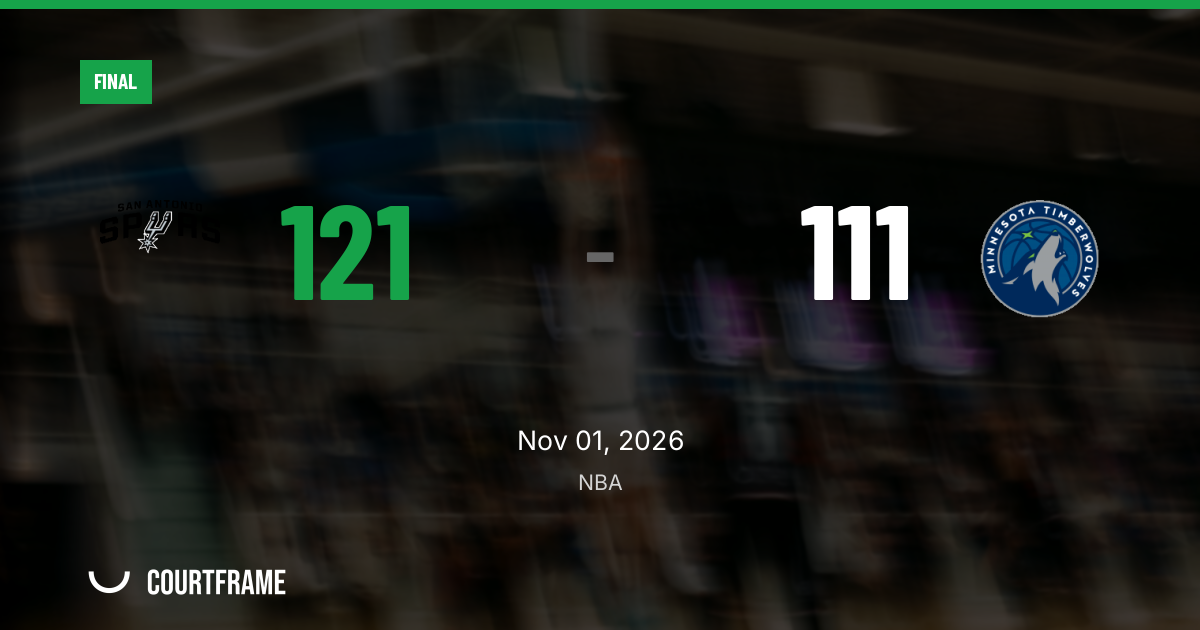
The San Antonio Spurs defeated the Minnesota Timberwolves 121-111 on November 1, 2026, at Frost Bank Center, improving to 4-2 in the regular season while Minnesota fell to 4-3.
San Antonio won the game through size, free throws and late-game defensive control. The Spurs outrebounded Minnesota 49-38, blocked 9 shots to the Timberwolves’ 2 and made 25 free throws on 31 attempts. Minnesota stayed within range by forcing 16 turnovers and collecting 11 steals, but the Timberwolves shot 9-for-33 from 3-point range and scored only 23 points in the fourth quarter.
San Antonio’s frontcourt edge decided the possession battle
The clearest separation came on the glass. San Antonio’s 49 rebounds were 11 more than Minnesota’s 38, a meaningful gap in a game the Spurs won by 10. That advantage aligned with San Antonio’s early-season profile: the Spurs entered with a 51.4 rebound percentage and 44.7 rebounds per game through six games.
Victor Wembanyama entered averaging 27.3 points, 10.7 rebounds and 2.8 assists, and the matchup again tilted toward San Antonio’s interior structure. The Spurs’ 9 blocks reflected the rim deterrence that has defined their start; they came in averaging 6.3 blocks. Minnesota finished with only 2 blocks, leaving San Antonio with the stronger defensive presence near the basket.
The Spurs also created pressure at the foul line. Their 25 made free throws were three more than Minnesota’s 22, and San Antonio attempted 31 free throws compared with Minnesota’s 26. That margin mattered on a night when the Timberwolves generated more steals and committed fewer turnovers.
The third quarter reset the game
San Antonio opened with 34 points in the first quarter, but Minnesota answered with 33 in the second and took a 61-60 halftime lead. The Spurs regained control in the third quarter, outscoring the Timberwolves 33-27, then held Minnesota to 23 points in the fourth.
That closing defensive stretch matched San Antonio’s broader early-season identity. The Spurs entered with a 97.3 defensive rating, an 8.8 steals average and a 6.3 blocks average through six games. Against Minnesota, the steals were not the separator, but the rim protection and rebounding were.
Minnesota’s offensive profile coming in included 120 points per game and 26.9 assists per game, but the Timberwolves finished with 111 points and 23 assists. Their 9-for-33 shooting from 3-point range limited the spacing impact around LaMelo Ball, Jaden McDaniels, Ayo Dosunmu and Jonathan Kuminga.
Injuries shaped Minnesota’s shot creation burden
The Timberwolves played without Anthony Edwards, who entered averaging 33.3 points, 4.8 rebounds and 3.3 assists in four games, and without Donte DiVincenzo. Edwards’ absence removed Minnesota’s top listed scorer from a group that still came in averaging 120 points per game.
Without Edwards, Minnesota needed more creation from Jaden McDaniels, Ayo Dosunmu, LaMelo Ball and Jonathan Kuminga. The Timberwolves still reached 111 points and made 22 free throws, but the 9-for-33 mark from beyond the arc and 23-point fourth quarter showed the cost of playing without their highest-volume offensive engine.
San Antonio was also short-handed, with Tobias Harris out because of a left calf strain and Jayden Quaintance out following right knee surgery. The Spurs still had enough ball movement to finish with 24 assists, close to their pregame average of 26.7, with De'Aaron Fox, D. Harper, Stephon Castle and Devin Vassell forming the perimeter support around Wembanyama.
Result matched the game context more than the team index gap
The matchup carried conflicting indicators. Minnesota entered with the higher CourtFrame Power Index at 58.42, ranked sixth, while San Antonio was at 47.28, ranked 11th. But the Timberwolves were also on the second night of a back-to-back and playing their fourth game in seven days. San Antonio had two days of rest and was playing its third game in seven days.
The pregame market implied San Antonio as the stronger side at 81.8 percent, and the final score followed that expectation. The Spurs were 2-2 at home entering the night with 116.3 points per game in those games, then scored 121. Minnesota was 2-2 away with 120.5 points per game on the road, but finished at 111 while missing Edwards.
San Antonio did not play a clean possession game. The Spurs committed 16 turnovers, two more than Minnesota, and allowed 11 steals. But their advantages in rebounds, blocks and free throws created enough margin to withstand those mistakes.
What the win says about San Antonio
The Spurs’ 121-111 win was built on areas that appear sustainable for this roster: defensive length, rebounding and enough playmaking balance to avoid relying on one creator. San Antonio entered with a 70.2 assist rate and finished with 24 assists, continuing to distribute offense across its core.
For Minnesota, the loss was less about effort than offensive structure under difficult conditions. The Timberwolves played on one day of rest, were on a back-to-back, and were without a 33.3-point scorer in Edwards. They still forced 16 turnovers and generated 26 free-throw attempts, but the fourth-quarter offense and 3-point shooting were not enough to overcome San Antonio’s physical advantages.