
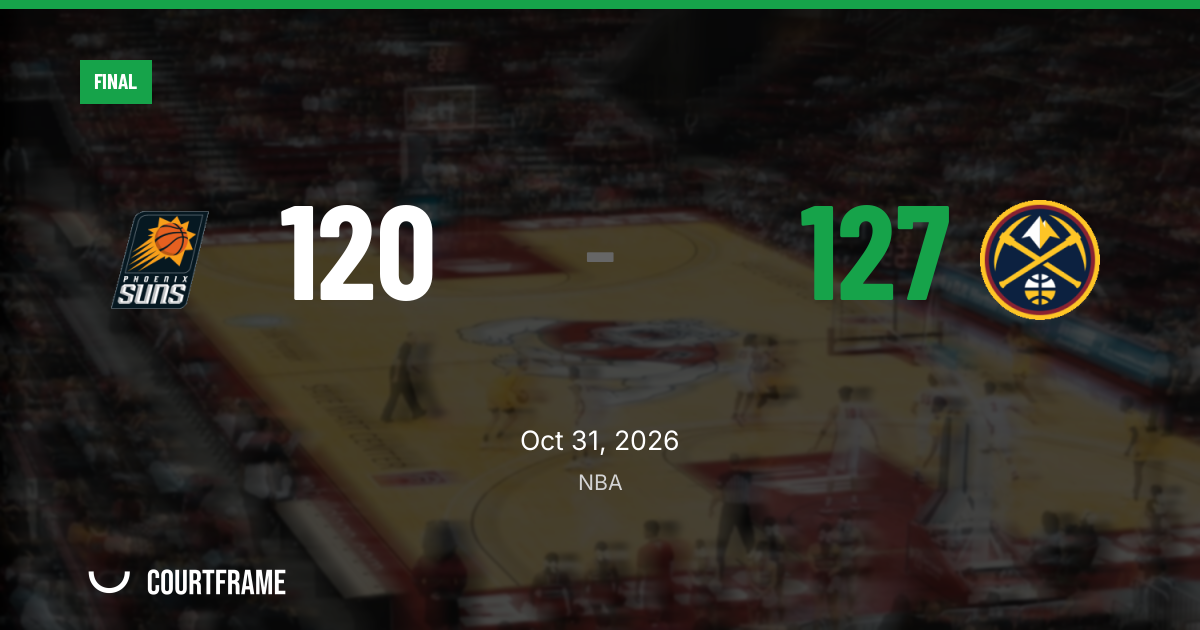
The Denver Nuggets beat the Phoenix Suns 127-120 on October 31, 2026, at Mortgage Matchup Center, using a 39-point second quarter and elite perimeter shot-making to control the middle of the game. Denver moved to 3-2 in the regular season, while Phoenix dropped to 1-3.
Phoenix opened with a 37-32 first quarter, but Denver answered with the game’s decisive stretch before halftime. The Nuggets outscored the Suns 39-30 in the second quarter and 32-26 in the third, turning a five-point deficit after one quarter into a 10-point lead entering the fourth.
The final margin reflected Denver’s pregame profile more than Phoenix’s home-court rest advantage. The Nuggets entered with a 3-2 record, a 39.33 CourtFrame Power Index, a No. 14 rank and a positive trend of 0.6, while the Suns entered at 1-3 with a 34.50 CPI, No. 17 rank and a trend of minus-2.4. Denver also carried a 61.5 percent implied win probability across nine bookmakers.
Denver’s spacing decided the game
The Nuggets’ offense separated because of 3-point accuracy and free-throw volume. Denver shot 20-for-37 from 3-point range and 23-for-30 at the foul line, giving the Nuggets enough scoring efficiency to overcome 19 turnovers.
Phoenix made 18 3-pointers on 42 attempts and shot 46-for-94 overall, but the Suns generated only 11 free-throw attempts. Denver’s 19-point advantage in made free throws was the clearest statistical separation in a seven-point game.
The Nuggets finished 42-for-80 from the field, a cleaner shot diet than Phoenix’s higher-volume approach. Denver’s 30 assists also aligned with its early-season identity: the Nuggets entered the night averaging 26.8 assists with a 69.9 assist rate through five games.
Phoenix moved the ball but could not offset Denver’s efficiency
The Suns had enough offensive organization to win many games. They recorded 34 assists, committed 15 turnovers and outrebounded Denver 42-40. Phoenix also had 10 steals and five blocks, giving the home team multiple paths to create extra possessions.
The issue was conversion value. Phoenix took 94 shots to Denver’s 80, but Denver’s 20 made 3s and 23 made free throws outweighed the Suns’ extra field-goal volume. The Suns entered the game averaging 112 points and scored 120, yet their defense allowed Denver to exceed its 114-point scoring average.
That defensive slippage matched Phoenix’s early-season concern. Through four games, the Suns had allowed a 108.7 defensive rating and carried a minus-10.8 net rating. Because Phoenix had fewer than five games entering the night, the broader takeaway rests less on the exact rate profile and more on the recurring pattern: the Suns have had offensive production, but opponents have found enough efficiency to win.
Murray-Jokic structure held up around Denver’s depth questions
Denver entered with Jamal Murray averaging 25.8 points, 5.6 assists and 5.6 rebounds, while Nikola Jokic was averaging 21.2 points, 9.2 assists and 9.6 rebounds. Their presence gave Denver the most stable offensive foundation in the matchup, particularly against a Phoenix team still searching for defensive consistency.
The Nuggets were without Spencer Jones because of bilateral hamstring injury management and Julian Strawther because of a left knee sprain. Alpha Diallo was questionable for personal reasons, and Cameron Johnson was questionable with a right ankle sprain. Even with those availability concerns, Denver produced 127 points, 30 assists and 20 made 3s.
Phoenix was without Mark Williams after left shoulder surgery, while Oso Ighodaro was questionable with a right oblique strain. The Suns still won the rebounding column 42-40, but Denver’s free-throw pressure and perimeter efficiency mattered more than the narrow glass result.
The second quarter changed the game state
The Suns’ best stretch came immediately. Phoenix scored 37 in the first quarter, matching its home scoring profile after entering with an average of 125.5 points across two home games. Denver’s response was more sustainable: 39 points in the second quarter, followed by 32 more in the third.
That 71-point middle-half burst forced Phoenix into a chase game. The Suns won neither the turnover category by enough nor the rebounding category by enough to compensate for Denver’s shot quality and foul-line edge.
Denver’s fourth quarter was its lowest-scoring period at 24 points, but the cushion built in the second and third quarters was sufficient. Phoenix scored 27 in the fourth and never fully erased the gap.
What the result means
For Denver, the win reinforced the indicators that favored the Nuggets before tipoff: a stronger record, higher CourtFrame Power Index, better early-season trend and a more reliable offensive hierarchy led by Murray and Jokic. The Nuggets also improved their away record to 2-1.
For Phoenix, the loss sharpened the early-season split between offensive creation and defensive results. Devin Booker entered averaging 22.3 points and 5.3 assists, with Dillon Brooks, Miles Bridges, Jalen Green and Luke Kennard giving the Suns multiple scoring options. Phoenix’s 34 assists showed that the offense generated connected possessions, but allowing 127 points at home left too little margin.
The Suns had four days of rest and only two games in the previous seven days, while Denver had two days of rest and three games in that span. The rest edge did not translate into defensive control. Denver’s execution from 3-point range and at the foul line overrode the schedule context and delivered the road win.