
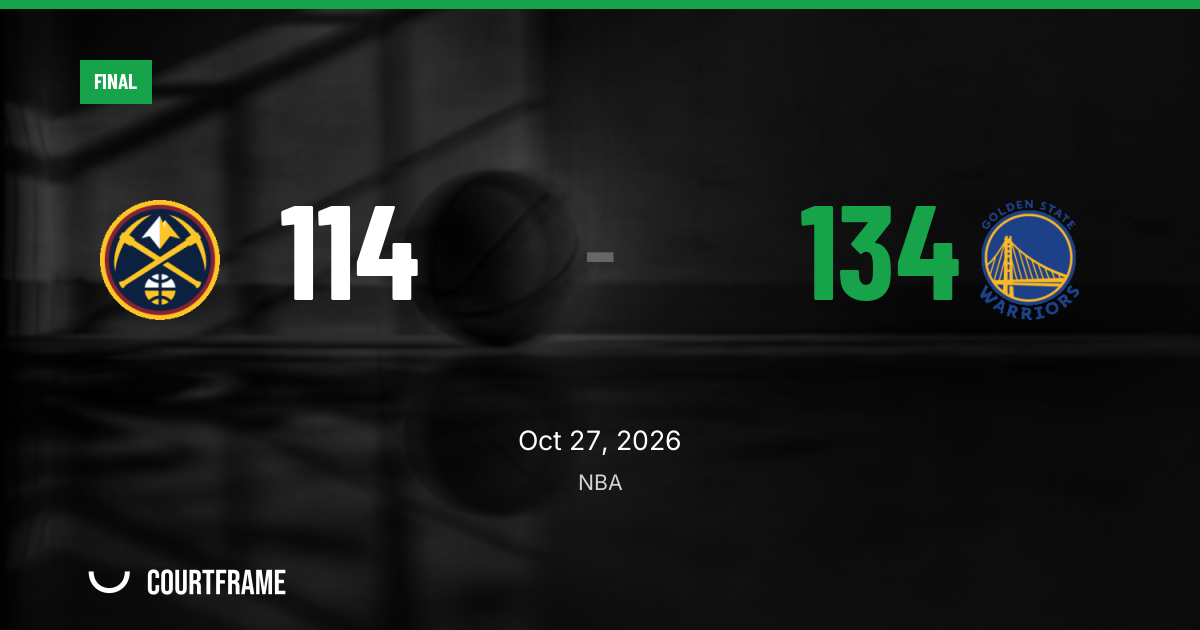
Golden State Warriors beat Denver Nuggets 134-114 on October 27, 2026, at Ball Arena, using a 40-point third quarter and elite perimeter shooting to hand Denver its second loss of the regular season.
The Nuggets led 32-28 after the first quarter, but Golden State controlled the next three periods by scores of 32-24, 40-28 and 34-30. The Warriors finished with 134 points on 46-for-85 shooting, including 22-for-44 from 3-point range, while Denver scored 114 on 42-for-84 shooting and 10-for-29 from deep.
Golden State’s 3-point volume changed the game
The defining separation came behind the arc. Golden State made 12 more 3-pointers than Denver while attempting 15 more, creating a 36-point advantage from 3-point range. That margin outweighed Denver’s strong free-throw night, as the Nuggets went 20-for-23 at the line and the Warriors went 20-for-21.
Golden State entered the night with a heavy 3-point profile, carrying a 46.3 three-point rate and 38.1 percent 3-point shooting through four games. That identity translated directly to the floor at Ball Arena, where half of the Warriors’ field-goal attempts came from deep and half of those attempts went in.
Denver also moved the ball well enough to sustain offense, matching Golden State with 31 assists. The issue was not creation volume. It was shot value and shot conversion. The Nuggets produced 10 made 3s; the Warriors produced 22.
The third quarter broke Denver’s defensive structure
The game pivoted in the third quarter, when Golden State scored 40 points after taking a 60-56 halftime lead. Denver had already shown it could score efficiently enough to stay attached, but the Nuggets could not keep the Warriors out of rhythm after the break.
Golden State’s third-quarter burst turned a four-point halftime edge into a 16-point lead entering the fourth. The Warriors then added 34 more points in the final period, preventing Denver from building any sustained comeback despite another 30-point quarter from the Nuggets.
Denver forced 18 turnovers and recorded 13 steals, which usually gives the Nuggets enough extra possessions to stabilize a game. The Warriors absorbed those mistakes because they dominated the glass 45-32 and shot 46-for-85 from the field.
Rebounding margin erased Denver’s pressure defense
Denver’s defensive activity was real: 13 steals, six blocks and 18 forced turnovers. But Golden State’s 45-32 rebounding advantage limited the impact of those plays. The Warriors entered with a 50.3 rebound percentage across four games, while Denver had been at 49.1 through three games, and Golden State won that physical category decisively.
The Nuggets had averaged 45 rebounds through their first three games, but finished with 32 against Golden State. That drop mattered because Denver did not create enough 3-point volume to trade possessions evenly once the Warriors got hot.
Golden State also committed more turnovers than Denver, 18 to 12, but the Warriors’ shooting efficiency and rebounding edge gave them enough margin to survive the possession loss.
Pre-game indicators did not match the result
Denver entered the matchup at 1-1, while Golden State came in at 0-3. The market implied Denver had a 70.4 percent chance to win, and CourtFrame Power Index favored the Nuggets as well: Denver carried a 45.25 CPI, ranked 13th, while Golden State entered at 26.62, ranked 23rd.
The result cut sharply against those indicators. Golden State’s 20-point win was built less on a broad statistical advantage than on two decisive categories: 3-point shooting and rebounding. Denver had the same assist total, fewer turnovers, more steals and more blocks, but the Warriors’ 22 made 3s and 13 extra rebounds controlled the scoreboard.
The schedule did not create a clear rest excuse. Both teams had two days of rest. Denver had played two games in the previous seven days, while Golden State had played three.
Injuries shaped the rotation context
Golden State won without Jimmy Butler III, Moses Moody and Kristaps Porzingis, while Gui Santos was listed as questionable with left knee tendinitis. The Warriors still generated 134 points and 31 assists, a notable offensive outcome given those absences.
Denver was without Spencer Jones and Julian Strawther, while Alpha Diallo and Cameron Johnson were listed as doubtful. The Nuggets still had their primary creation structure available around Nikola Jokic and Jamal Murray, who both entered averaging 22.3 points per game, with Jokic also averaging 8.7 assists and 9.3 rebounds.
Golden State’s top pre-game scoring profile centered on Stephen Curry at 23.7 points per game and Y. Lendeborg at 21.8 points and 9.3 rebounds per game. The Warriors’ team-level production in Denver reflected that broader offensive burden being met collectively, especially from 3-point range.
What the result means
Golden State’s first win came in a building where Denver had averaged 127.5 points across its home split. Holding the Nuggets to 114 while scoring 134 gave the Warriors a result that was both efficient and corrective after an 0-3 start.
Denver’s record moved to 1-2, and the loss highlighted an early-season concern: the Nuggets can generate assists and force turnovers, but they are vulnerable when opponents win the 3-point math and the rebounding battle at the same time.
For Golden State, the win was a clear example of its preferred offensive formula. High 3-point volume, strong ball movement and enough rebounding support turned a slow start into a comfortable road victory in the regular season.