
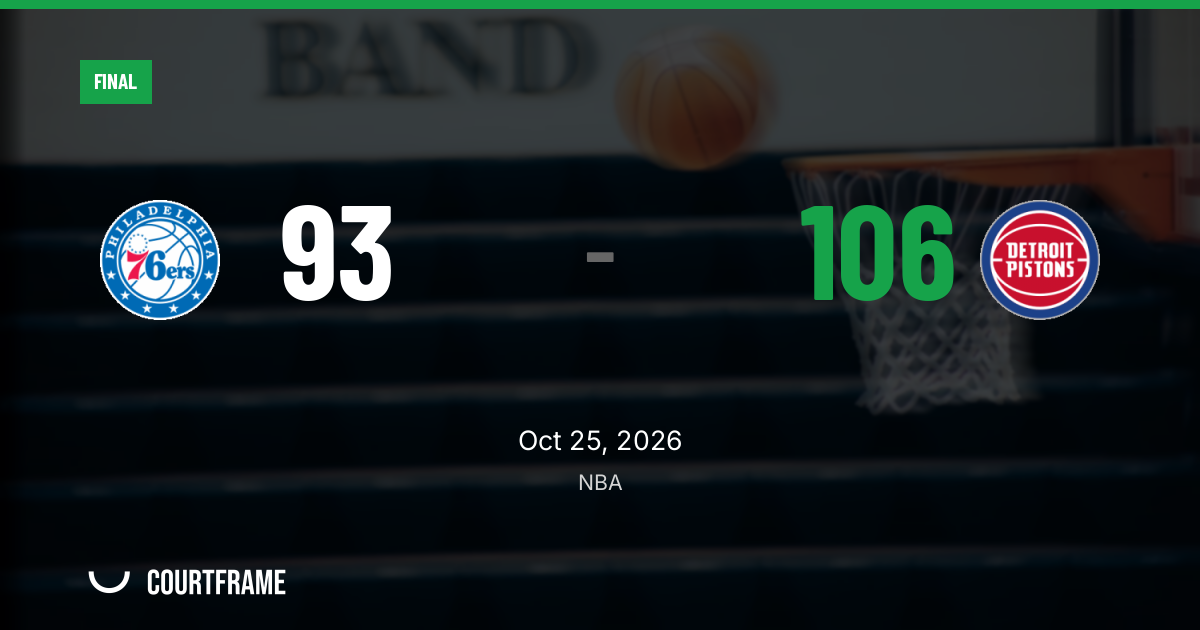
The Detroit Pistons kept their unbeaten start intact with a 106-93 win over the Philadelphia 76ers on October 25, 2026, at Xfinity Mobile Arena, using a decisive first quarter and a major rebounding edge to control the regular season matchup.
Detroit led 34-22 after the opening period, and that 12-point margin effectively shaped the rest of the night. Philadelphia played the Pistons even in the second quarter, 22-22, and trimmed only slightly into the deficit in the third, 25-23. Detroit then closed the game with a 27-24 fourth quarter, preventing the 76ers from turning pressure defense into a sustained comeback.
Detroit’s Size and Rim Protection Decided the Game
The Pistons won the rebounding battle 54-37, a 17-board advantage that mattered even more with Jalen Duren out because of a right hamstring strain. Detroit still generated enough frontcourt presence to control possessions, with John Collins entering the night averaging 15 points and 7.7 rebounds and the team already averaging 52 rebounds through its first three games.
The Pistons also blocked 11 shots, doubling down on the interior advantage created by Philadelphia’s frontcourt absences. Joel Embiid was out for right plantar fasciitis management, while Dominick Barlow, Tacko Fall, Ariel Hukporti and Jabari Walker were also unavailable. That left the 76ers without their primary interior scorer and rebounder, and Detroit turned that absence into a structural advantage rather than a marginal one.
Philadelphia finished with 37 rebounds and eight blocks, but the 76ers could not match Detroit’s volume on the glass or its ability to challenge shots at the rim. The Pistons’ 11 blocks helped compress Philadelphia’s half-court options, forcing more responsibility onto perimeter creation.
The First Quarter Created the Game Script
Detroit’s 34-point first quarter was the only period in which either team reached 30 points, and it gave the Pistons enough separation to withstand a less efficient offensive night by their early-season standards. Detroit entered averaging 118.3 points, but 106 was enough because Philadelphia never reached its own early scoring level of 110 points per game.
The 76ers scored 22, 22, 25 and 24 points by quarter. That consistency kept them from collapsing, but it also showed the problem: without Embiid and LeBron James, who was out with a low back/sciatica issue, Philadelphia lacked the kind of scoring burst needed to erase a double-digit deficit against a team controlling the boards.
Tyrese Maxey entered as Philadelphia’s leading available engine at 28.8 points and 4.8 assists per game, with Jaylen Brown averaging 20.8 points, 5.8 rebounds and 4.8 assists. The matchup required those perimeter creators to carry a heavier burden than usual, especially with Embiid’s 21.7 points, 9.7 rebounds and 5.7 assists unavailable.
Pistons’ Perimeter Shooting Gave Them Separation
Detroit shot 14-for-34 from 3-point range, while Philadelphia went 7-for-27. That seven-make difference from deep matched the broader shape of the game: the Pistons had more size, more rim pressure defensively and more perimeter payoff.
Duncan Robinson entered averaging 19.7 points while Detroit had opened the season shooting 42 percent from 3-point range. The Pistons did not need an extreme shooting night to win; they needed enough spacing around Cade Cunningham, who came in averaging 21.3 points and eight assists, to keep Philadelphia from loading up on the ball.
Philadelphia’s 10 steals and Detroit’s 17 turnovers gave the 76ers chances to change the game defensively. But the Pistons offset those mistakes with 54 rebounds, 25 assists and 14 made 3s. Philadelphia committed only 11 turnovers, yet the cleaner ball security did not translate into enough scoring because the 76ers lacked finishing efficiency and second-chance volume.
Result Cut Against the Power Profile
The pregame team profile favored Philadelphia by CourtFrame Power Index, with the 76ers at 75.03 and ranked fourth, compared with Detroit at 39.12 and ranked 16th. The 35.9-point differential suggested Philadelphia had the stronger overall profile, but the available roster changed the matchup sharply.
The market was much closer than the power gap, with Detroit carrying a 51 percent implied probability and Philadelphia at 49 percent. That narrow lean toward the Pistons better reflected the immediate conditions: both teams were on one day of rest and playing a back-to-back, but Philadelphia was missing Embiid and LeBron James, while Detroit’s primary absence was Duren.
Detroit also entered with the stronger scoring start, averaging 118.3 points to Philadelphia’s 110, and had been better on the road, going 2-0 away from home while averaging 117 points. The Pistons did not hit those scoring marks in Philadelphia, but their defense, rebounding and shot blocking gave them a lower-scoring path to a 13-point win.
What the Win Means
Detroit moved to 3-0 by winning a game that tested its depth without Duren and its ability to defend without relying only on scoring pace. The Pistons’ 106 points were below their early average, but their 54 rebounds and 11 blocks showed a defensive foundation that traveled.
Philadelphia dropped to 3-1 after a game defined by absences as much as execution. The 76ers generated 10 steals and took care of the ball with 11 turnovers, but they were outrebounded by 17 and made only seven 3-pointers. Against an unbeaten Detroit team with Cunningham organizing the offense and enough shooting around him, that margin was too large to overcome.