
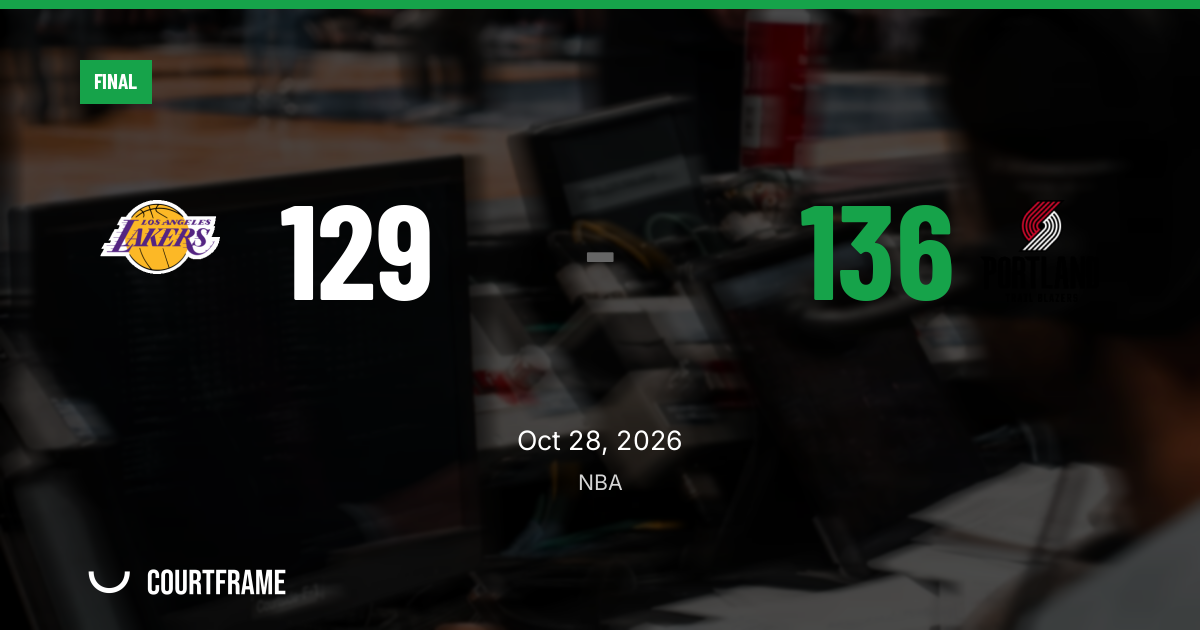
Portland Trail Blazers handed Los Angeles Lakers their first loss of the regular season on October 28, 2026, winning 136-129 at Crypto.com Arena in a matchup between two unbeaten teams. Portland improved from 2-0, while Los Angeles moved from 3-0 after failing to protect a 73-68 halftime lead.
The game turned on Portland’s steadier second-half shot profile and possession work. The Trail Blazers scored 32 points in the third quarter and 36 in the fourth, while the Lakers dropped from 38 points in the first quarter and 35 in the second to 30 and 26 after halftime.
Portland’s spacing decided the margins
Portland made 18 of 36 from 3-point range, one more make than Los Angeles on six fewer attempts. The Lakers hit 17 of 42 from deep, which kept them in control early but became less efficient as the game tightened.
The Trail Blazers also created more pressure at the foul line. Portland went 26 of 41 on free throws, while Los Angeles finished 22 of 30. Even with missed opportunities at the stripe, Portland’s volume mattered in a seven-point road win.
That combination was especially important because the Lakers entered the night with one of the league’s sharpest early-season shooting profiles, averaging 128 points and shooting 41.6 percent from 3 across their first four games. Portland did not stop Los Angeles from scoring, but it forced the Lakers into a higher-volume perimeter game while winning enough of the secondary categories to survive.
The fourth quarter flipped the game
Los Angeles led 38-32 after the first quarter and 73-68 at halftime, but Portland’s offense stayed consistent across all four periods. The Trail Blazers scored 32, 36, 32 and 36 by quarter, never falling below 32 in any period.
The Lakers’ offensive rhythm faded late. After scoring 73 points in the first half, Los Angeles scored 56 after halftime. Portland’s 36-26 fourth quarter was the only double-digit quarter margin of the game, and it supplied the separation in a matchup that had been shaped by shot-making rather than defensive control.
Portland finished with 30 assists against 14 turnovers, while Los Angeles had 28 assists and 15 turnovers. The difference was small, but in a game decided by seven points, Portland’s extra ball movement and slightly cleaner possession count aligned with its late-game control.
Rebounding and depth pressure favored Portland
The Trail Blazers won the rebounding battle 38-31, an important swing against a Lakers team that entered with Walker Kessler averaging 8 rebounds and Luka Doncic averaging 6.5. Portland’s collective rebounding helped support an offense that did not rely only on first-option creation.
Portland came in with Deni Avdija averaging 22.3 points, 6.3 assists and 6.7 rebounds, Damian Lillard averaging 21.7 points, and Ja Morant averaging 16.3 points with 6.3 assists. That distribution mattered against a Lakers team built around Doncic’s 35.5 points and 8.3 assists per game and Austin Reaves’ 26.5 points and 6.5 assists.
The Lakers’ top-end creation showed up in the final score, but Portland’s broader playmaking base was reflected in the 30-assist total and the sustained scoring across all four quarters.
Pre-game indicators pointed to a tight matchup
The result fit the narrow pre-game gap. Los Angeles carried a 54.8 percent implied probability at home, and CourtFrame Power Index had the Lakers at 54.96, ranked sixth, compared with Portland at 52.67, ranked eighth. The 2.3 CPI differential suggested a close game rather than a clear separation point.
Portland also entered with a rest advantage: four days off and two games in the previous seven days, compared with two days of rest and three games in seven days for Los Angeles. The fourth-quarter split, with Portland outscoring Los Angeles by 10, matched that context without reducing the outcome to fatigue alone.
The injury report shaped the rotation context. Los Angeles was without Cameron Carr because of a right oblique strain and Adou Thiero because of left knee effusion and swelling. Portland was without Shaedon Sharpe after right meniscus surgery, while Branden Carlson and Scoot Henderson were questionable entering the game.
What the result means
Portland’s 136-129 win was not a defensive game, but it was a disciplined offensive road performance. The Trail Blazers produced 30 assists, made half of their 3-point attempts, won the glass by seven and closed with their best scoring quarter.
For Los Angeles, the concern is not the overall offensive output. Scoring 129 points with 28 assists and 17 made 3s is enough to win most nights. The issue was the late-game decline: the Lakers allowed 68 points in the second half and could not match Portland’s shot quality, foul pressure or rebounding over the final 24 minutes.