
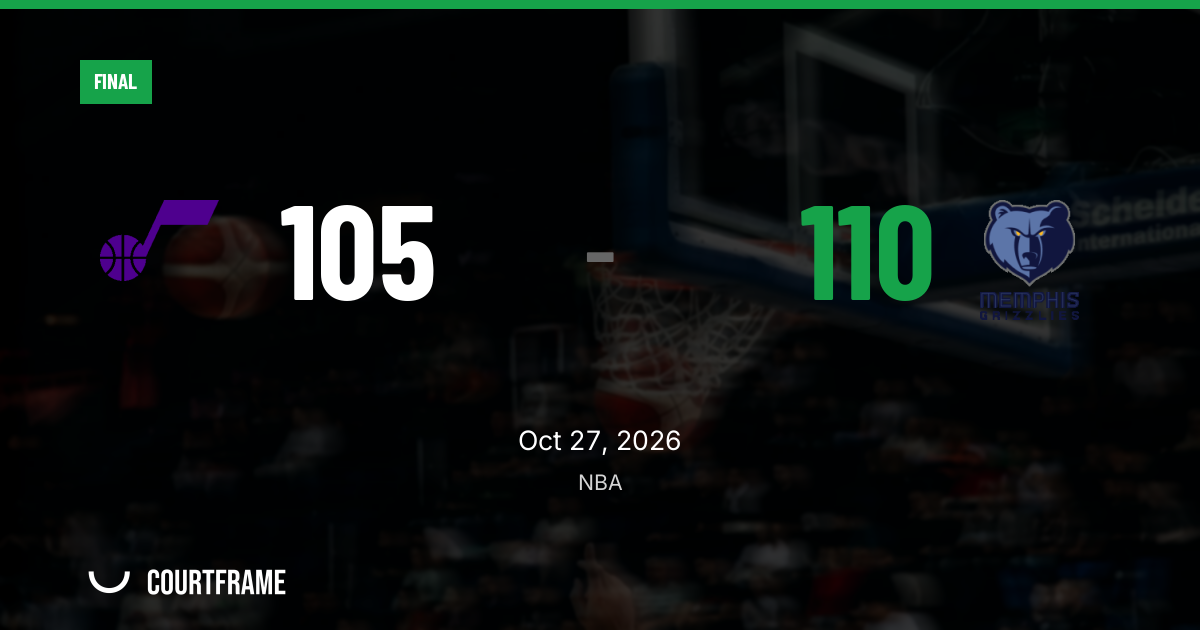
The Memphis Grizzlies remained unbeaten in the regular season with a 110-105 win over the Utah Jazz on October 27, 2026, at Delta Center, a result that matched the broader pregame indicators more than the narrow market lean toward Utah.
Memphis entered at 3-0 with a stronger CourtFrame Power Index profile, ranking ninth at 55.55 compared with Utah’s 34.74 and 19th-place standing. That gap showed up most clearly in shot quality and execution: the Grizzlies made 16 of 37 from 3-point range and 20 of 22 at the free-throw line, while Utah finished 10 of 33 from deep and 19 of 25 at the stripe.
The Jazz fell to 1-2 despite a 49-42 rebounding edge and eight blocks. Utah generated enough possessions to stay within one shot in the fourth quarter, but Memphis’ combination of spacing, free-throw accuracy and one fewer turnover gave the Grizzlies the cleaner closing profile.
Memphis built the game through the arc
The Grizzlies’ 110 points came on 37-of-85 shooting, and the difference was their volume and accuracy from 3. Memphis outscored Utah by 18 points from beyond the arc, a margin that outweighed Utah’s advantages on the glass and at the rim defensively.
That perimeter outcome aligned with Memphis’ early-season identity. The Grizzlies had entered the night shooting 39.2 percent from 3 across four games, while Utah had been at 32.6 percent. On Tuesday, Memphis again created separation through the 3-point line, making six more 3s than the Jazz on only four additional attempts.
The first quarter established the matchup’s pressure points. Memphis opened with 30 points while holding Utah to 21, forcing the Jazz to play from behind for most of the night. Utah answered with a 31-point second quarter to cut into the deficit, but Memphis restored control with a 31-point third quarter before surviving Utah’s 29-point fourth.
Utah’s interior activity kept it close
Utah’s best work came through possession pressure and interior resistance. The Jazz outrebounded Memphis 49-42 and blocked eight shots, doubling the Grizzlies’ four blocks. Those numbers mattered with Jusuf Nurkic out due to a right 2nd plantar plate tear, leaving Utah without a key frontcourt piece.
Even without Nurkic, Utah created enough volume to attempt 92 field goals compared with Memphis’ 85. The Jazz also committed 14 turnovers, only one more than the Grizzlies’ 13, so the game did not get away from them through ball security. The issue was conversion: Utah shot 38 of 92 from the field and 10 of 33 from 3, leaving too many empty possessions in a five-point game.
Keyonte George entered as Utah’s leading offensive engine at 22.8 points and 7.8 assists per game, and the Jazz’s 25 assists reflected a team that continued to move the ball. Lauri Markkanen and Jaren Jackson also entered as double-figure scorers, but Utah’s overall shooting profile could not match Memphis’ efficiency from the perimeter and the line.
Grizzlies handled absences and late-game pressure
Memphis played without Zach Edey, who was out for left ankle injury management, while C. Coward had been questionable with a left wrist sprain. The Grizzlies still maintained enough frontcourt balance to withstand Utah’s rebounding edge, with C. Boozer entering the game averaging 10 rebounds and C. Coward averaging 8.7 rebounds across three games.
Ty Jerome’s early-season scoring form remained central to the matchup context. He entered averaging 28.3 points and 6 assists, and Memphis’ 26 assists against Utah showed that the Grizzlies’ offense did not rely only on isolation scoring. Their 16 made 3s came within a broader structure that produced one more assist than Utah and one fewer turnover.
The closing difference was at the foul line. Memphis went 20 of 22, while Utah went 19 of 25. In a five-point game, the Grizzlies’ ability to protect points at the stripe was decisive, especially after Utah won the fourth quarter 29-21.
Result followed the deeper team profile
The market implied Utah at 52.2 percent and Memphis at 47.8 percent before tipoff, but the team indicators favored Memphis. The Grizzlies entered unbeaten, averaging 119 points, with a higher CourtFrame Power Index and a top-10 rank. Utah entered at 1-2, averaging 115.3 points, and was also dealing with Nurkic’s absence on the second night of a back-to-back.
Both teams were on one day of rest and playing their third game in seven days, so the fatigue context was even. The separation came from the areas that had already defined their early seasons: Memphis’ shooting efficiency and Utah’s difficulty converting enough half-court possessions despite strong passing volume and rebounding.
For Memphis, the win pushed the Grizzlies to 3-0 and reinforced their early profile as a team capable of winning on the road through spacing and late-game execution. For Utah, the 1-2 start now includes a narrow home loss in which the Jazz did several possession-based things well but could not overcome the 3-point gap.