
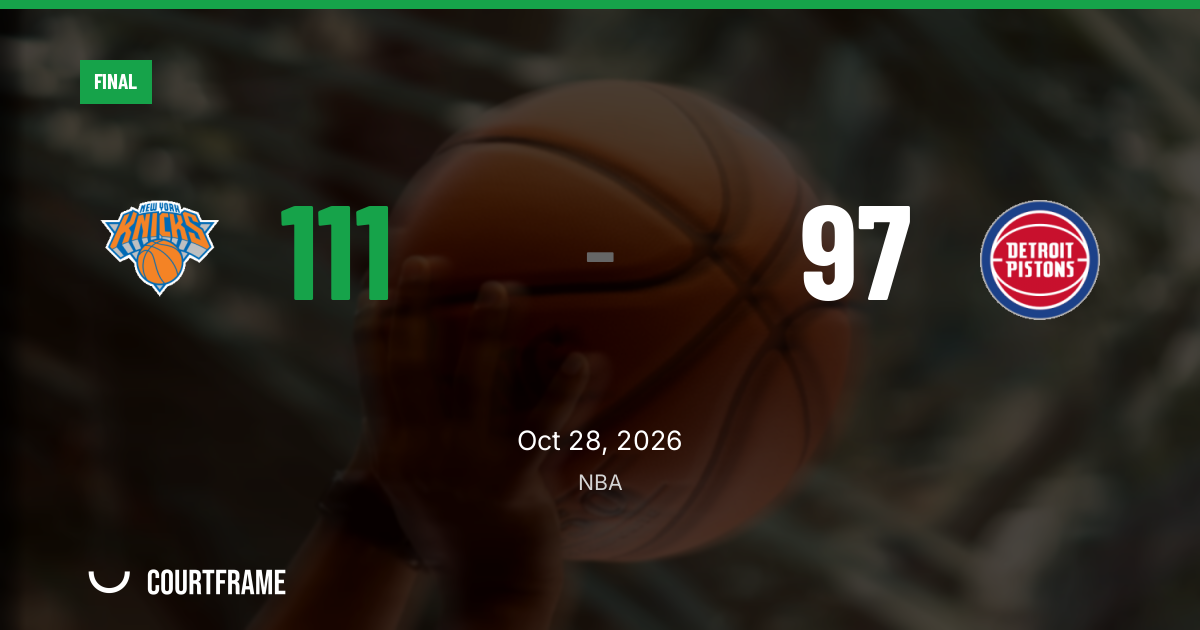
The New York Knicks beat the Detroit Pistons 111-97 on October 28, 2026, at Madison Square Garden, using a dominant middle stretch to flip a game that initially tilted hard toward Detroit.
Detroit led 38-25 after the first quarter, but New York held the Pistons to 12 points in the second and 13 in the third. The Knicks outscored Detroit 63-25 across those two quarters, entered the fourth with an 88-63 lead and absorbed a 34-point Pistons fourth quarter without letting the result tighten.
The win moved New York to 1-3, while Detroit fell to 3-1. It also ran against several pregame indicators: Detroit entered averaging 113 points, compared with New York’s 104, and held the stronger CourtFrame Power Index profile at 38.86, ranked 14th, while the Knicks were at 3.19, ranked 29th.
New York won the game at the line and on the glass
The Knicks created the cleaner scoring math despite committing more turnovers. New York went 23-for-28 at the free-throw line, while Detroit finished 14-for-24. That nine-point advantage in made free throws mattered in a game decided by 14.
New York also won the rebounding battle 49-45, a significant result against a Detroit team that entered averaging 50.3 rebounds. Karl-Anthony Towns came in averaging 22.5 points and 14 rebounds, and the Knicks’ frontcourt presence helped offset Detroit’s shot-blocking edge.
The Pistons blocked 11 shots to New York’s two, but that rim protection did not translate into enough half-court stability after the first quarter. Detroit’s offense stalled for two full periods, and the Knicks’ ability to keep getting to the stripe prevented the blocks from becoming the defining statistic.
The second and third quarters changed the matchup
Detroit’s 38-point first quarter matched the profile of a team that entered with more early-season scoring pop. Cade Cunningham came in averaging 20.8 points, 8 assists and 5.8 rebounds, while Duncan Robinson entered averaging 17.8 points and giving Detroit a high-volume perimeter scoring outlet.
After that opening burst, the Pistons scored only 25 total points over the next 24 minutes. New York’s defense generated 10 steals, and Detroit committed 14 turnovers. The Knicks did not play a clean possession game themselves, finishing with 18 turnovers, but their defensive activity helped cut off Detroit’s rhythm before the fourth-quarter push.
New York’s 37-point third quarter was the decisive offensive segment. The Knicks had 28 assists, three more than their early-season average of 25.5, and shot 12-for-36 from three-point range. Detroit made 9 of 37 from deep, leaving the Pistons with too little perimeter efficiency after their opening quarter.
Injury context favored New York’s interior pressure
Detroit played without Jalen Duren, who was out with a right hamstring strain. Duren had appeared in two games and was averaging 13 points and 7.5 rebounds, and his absence removed one of the Pistons’ primary interior rebounders and finishers.
Paul Reed entered averaging 13.8 points and 8.5 rebounds, and Detroit still produced 45 rebounds and 11 blocks, but the Pistons could not keep New York off the line. The Knicks’ 28 free-throw attempts were one of the clearest signs that New York found pressure points inside despite Detroit’s shot blocking.
New York was without Jose Alvarado because of a left ankle sprain, but the Knicks still produced 28 assists and 10 steals. Jalen Brunson entered as New York’s leading scorer at 22.8 points per game with 4.5 assists, and the Knicks’ guard play held up well enough to survive the turnover count.
Result diverged from the early-season profile
The market implied New York as the more likely winner at 60.1 percent, but the broader team form leaned toward Detroit. The Pistons entered 3-1 and averaging 113 points, with an away split of 2-1 and 110.3 points per game. The Knicks entered with one win, a 1-2 home split and 104.3 points per game at home.
Both teams were on equal rest, with two days off and two games in the previous seven days, so fatigue did not create a clear scheduling edge. The difference came from New York’s ability to compress Detroit’s offense in the middle quarters while manufacturing points at the free-throw line.
For the Knicks, the 111-97 win offered a more stable template than their opening record suggested: win the glass, move the ball and let Brunson, Towns, Ogugua Anunoby and Josh Hart anchor a more balanced possession game. For Detroit, the loss exposed how thin the offense can become when the initial pace and perimeter rhythm fade, particularly with Duren unavailable in the middle.