
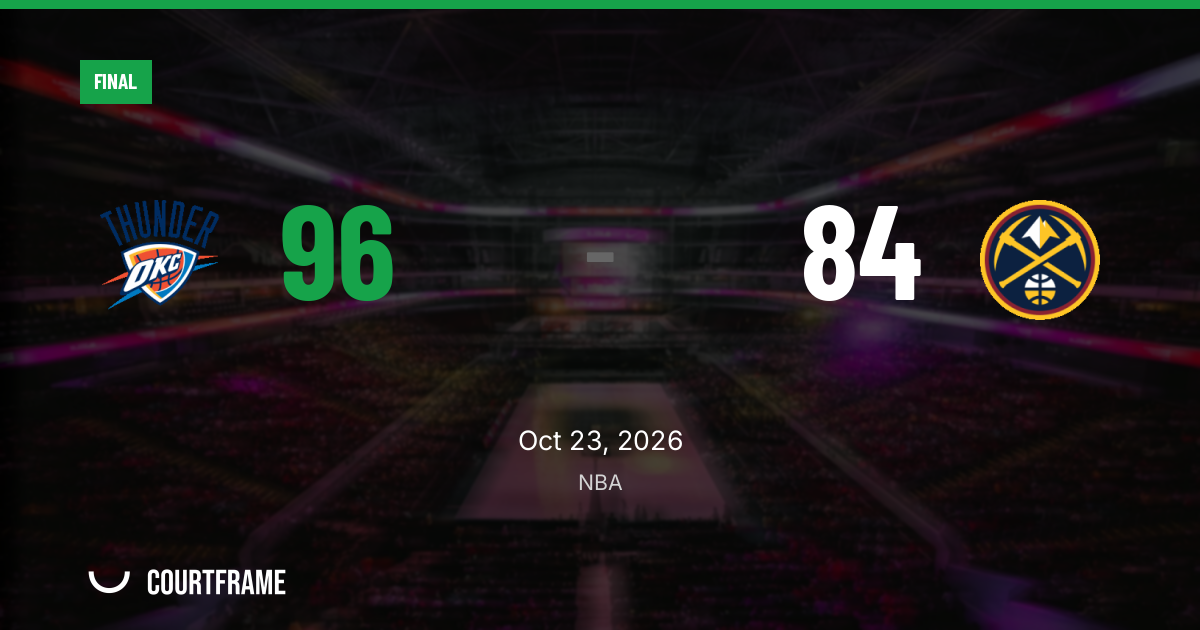
Oklahoma City Thunder opened its home account in the regular season with a 96-84 win over Denver Nuggets on October 23, 2026, at Paycom Center. Oklahoma City improved to 1-0, while Denver dropped its first game of the season.
The game turned after halftime. Denver led 27-24 after the first quarter and 48-44 at the break, but Oklahoma City outscored Denver 26-16 in the third quarter and 26-20 in the fourth. That 52-36 second half reflected the central difference in the game: Oklahoma City’s pressure created extra possessions, while Denver’s offense never stabilized against length at the point of attack and around the rim.
Oklahoma City’s defense dictated the second half
Denver finished with 22 turnovers against 17 assists, a ratio that made it difficult to sustain half-court rhythm. Oklahoma City turned that pressure into 12 steals and supported it with 9 blocks, giving the Thunder defensive activity at multiple levels.
The Nuggets shot 31-for-82 from the field and 8-for-30 from 3-point range. Oklahoma City did not need an efficient shooting night to win because its defense repeatedly interrupted Denver possessions before they could become quality attempts. The Thunder’s 12 turnovers also gave them a 10-turnover advantage, a decisive margin in a 12-point game.
Denver’s rebounding kept the game from getting away earlier. The Nuggets finished with 53 rebounds to Oklahoma City’s 46, and that edge helped offset some of the turnover damage. But the extra boards could not fully compensate for the Thunder’s defensive playmaking and rim protection.
Thunder survive inefficient shooting with volume and free-throw control
Oklahoma City shot 36-for-95 from the field and 11-for-43 from 3-point range, so this was not a game won through clean shot-making. The Thunder instead built their margin through possession control, defensive events and a near-perfect night at the foul line.
The Thunder went 13-for-14 on free throws, while Denver finished 14-for-22. In a game where neither team cleared 100 points, Oklahoma City’s ability to convert nearly every free throw mattered. The Thunder also attempted 13 more field goals than Denver, a product of the turnover gap despite losing the rebounding battle.
Oklahoma City finished with 22 assists on 36 made field goals, while Denver had 17 assists on 31 makes. The Thunder’s ball movement was not overwhelming, but it was steadier than Denver’s offense, especially after halftime when Oklahoma City scored 26 points in each of the final two quarters.
Pre-game indicators matched the result
Oklahoma City entered with a 1-0 record and had scored 116 points in its opener. Denver entered 0-0 for the regular season after a limited early sample that included an 84-point scoring output. The final score landed exactly on Denver’s prior 84-point mark, with the Nuggets again struggling to generate efficient offense.
The matchup also aligned with Oklahoma City’s early defensive profile. Through two games before this result, the Thunder were averaging 10 steals and 9.5 blocks, and they exceeded or matched that activity level with 12 steals and 9 blocks against Denver. That defensive identity carried the night more than shooting efficiency.
The market leaned strongly toward Oklahoma City before tipoff, with a 71.5 percent implied probability for the Thunder compared with 28.5 percent for Denver across nine bookmakers. The 12-point final margin validated that expectation, though the path was defensive rather than offensive.
Injuries and rotation context
Oklahoma City remained without Otega Oweh, Thomas Sorber and Nikola Topic, all listed out following surgery-related designations. Denver was without Julian Strawther because of a left knee sprain, while Spencer Jones was listed questionable with bilateral hamstring injury management.
The Thunder still had their primary early-season structure intact, led by Shai Gilgeous-Alexander, Jalen Williams and Chet Holmgren. Gilgeous-Alexander entered averaging 24.5 points through two games, Williams averaged 16.5 points and 6 rebounds, and Holmgren averaged 13 points and 12 rebounds. Denver’s key group entered with Aaron Gordon at 20 points in one game, Nikola Jokic at 13 points, 5 assists and 7 rebounds, and Jamal Murray at 6 points, 3 assists and 10 rebounds.
Denver had five days of rest compared with Oklahoma City’s two, and both teams had played one game in the previous seven days. The rest edge did not translate into cleaner execution for the Nuggets, whose 22 turnovers became the defining number of the night.
What the result means
Oklahoma City’s 96-84 win was built on defensive disruption more than offensive flow. The Thunder overcame 36-for-95 shooting by forcing mistakes, protecting the rim and keeping Denver from finding a consistent second-half rhythm.
For Denver, the rebounding edge and first-half lead showed enough physical presence to compete, but the turnover count and 8-for-30 shooting from 3-point range left too little margin. For Oklahoma City, the win reinforced a profile that can travel across shooting variance: pressure defense, shot blocking and enough late-game offensive organization to close at home.