
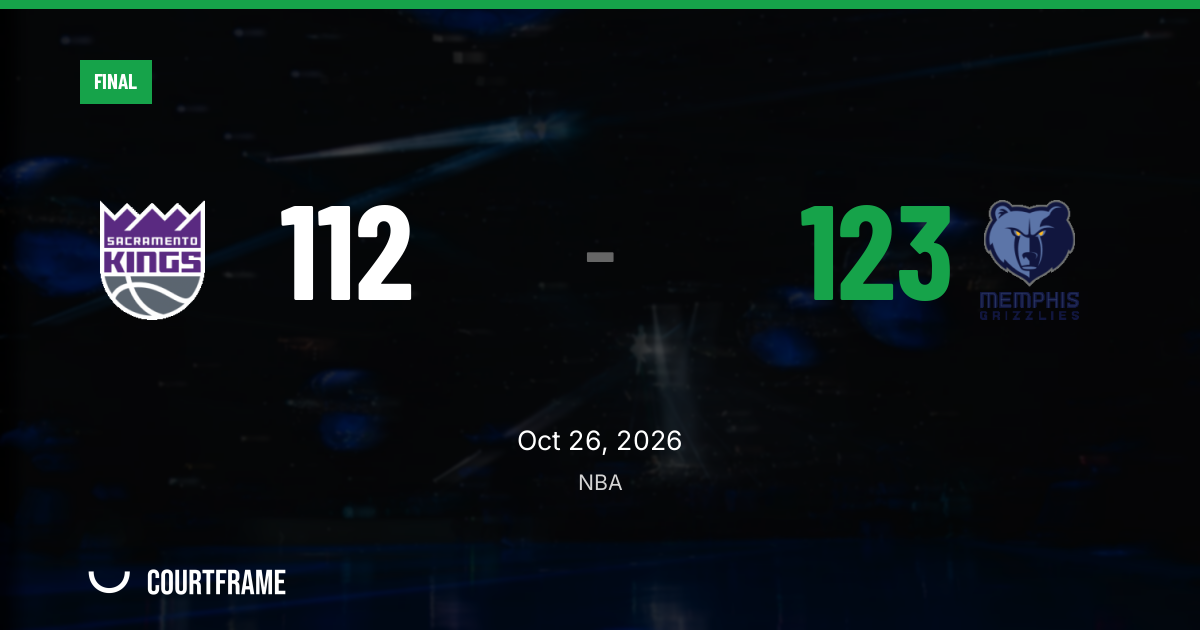
The Memphis Grizzlies arrived in Sacramento with the stronger early-season profile, and the result followed that direction. Memphis defeated the Sacramento Kings 123-112 on October 26, 2026 at Golden, improving to 3-0 while Sacramento dropped to 0-3 in the regular season.
The Kings led 28-25 after the first quarter and stayed within reach through three quarters, but Memphis created the game’s defining separation with a 42-point second quarter. That burst gave the Grizzlies a 67-59 halftime lead, and Sacramento never fully recovered despite scoring 31 points in the third quarter.
Memphis closed the game with a 27-22 fourth quarter, turning a competitive road game into an 11-point win. The Grizzlies finished with 123 points, their third straight game scoring at least 117 points to open the season.
Memphis’ shot profile and free-throw edge decided the night
The Grizzlies generated more value from the arc and the line. Memphis made 14 3-pointers on 38 attempts, while Sacramento went 10-for-32 from deep. The four-make difference from 3-point range accounted for 12 points in an 11-point final margin.
The foul line widened the gap further. Memphis shot 22-for-25 on free throws, while Sacramento finished 13-for-21. The Grizzlies gained nine points at the line and converted at a much higher rate, a critical separator in a game where Sacramento matched stretches of Memphis’ scoring rhythm.
Memphis also won the possession margins. The Grizzlies outrebounded the Kings 46-42 and committed 13 turnovers to Sacramento’s 14. Neither gap was overwhelming, but together they helped Memphis sustain its second-quarter run and protect the lead in the fourth.
The second quarter matched the pregame indicators
Memphis entered at 2-0 with an average of 117 points, while Sacramento entered 0-2 despite averaging 108 points. The Grizzlies’ offensive balance had been stronger through the opening games, with Ty Jerome averaging 32.7 points and 5.3 assists, C. Boozer averaging 14.7 points, 11 rebounds and 5 assists, and J. Wells adding 13.7 points.
That offensive structure translated into the box score. Memphis finished with 24 assists, four more than Sacramento, and produced enough perimeter volume to withstand the Kings’ first- and third-quarter scoring. The Grizzlies’ 42-point second quarter was the clearest expression of their early-season advantage: multiple scoring avenues, enough passing to keep the ball moving, and efficient free-throw production when Sacramento was forced into defensive recovery.
Sacramento’s pregame concerns also showed up. The Kings had relied heavily on Zach LaVine, J. D. Acuff and Domantas Sabonis through the first three games, with LaVine averaging 27.7 points, Acuff averaging 22.3 points and Sabonis averaging 18.7 points, 17.3 rebounds and 7 assists. Against Memphis, Sacramento finished with 20 assists and 14 turnovers, numbers that reflected a team still searching for cleaner half-court flow around its primary creators.
Depth and availability tilted toward Memphis
Sacramento played with a thinner frontcourt and wing rotation. Dylan Cardwell was out with a left calf strain, Maxime Raynaud was out with a right patella subluxation, and Ben Simmons remained out after right Achilles tendon repair surgery. Keegan Murray entered questionable with left ankle capsulitis after averaging 7 points and 3 rebounds across two games.
Memphis was also not whole, with Zach Edey out for left ankle injury management and Cedric Coward questionable with a left wrist sprain. Still, the Grizzlies handled the frontcourt minutes well enough to win the rebounding battle 46-42 and record six blocks to Sacramento’s five.
The absence of Edey did not prevent Memphis from controlling the glass, and the Grizzlies’ 22 made free throws helped offset any interior limitations. Sacramento, meanwhile, needed more efficiency from its available rotation after going 13-for-21 at the line and 10-for-32 from 3-point range.
Market and power profile pointed the same way
Memphis entered with a 60.6 percent implied win probability across nine bookmakers, compared with 39.4 percent for Sacramento. CourtFrame Power Index also favored the Grizzlies, with Memphis at 51.71 and ranked 11th, while Sacramento entered at 26.28 and ranked 20th.
The 123-112 final aligned with those indicators. Memphis had the stronger early record, the higher scoring baseline and the better power profile, then validated that edge with a road win built on a 42-point quarter, a 14-made-3 night and a plus-nine advantage in made free throws.
For Sacramento, the 0-3 start now includes another game in which the offense produced enough points to compete but not enough efficiency at the line or from deep to finish. For Memphis, the 3-0 start has a clear identity: high scoring, multiple contributors and enough defensive activity to close games without needing a perfect shooting night.