

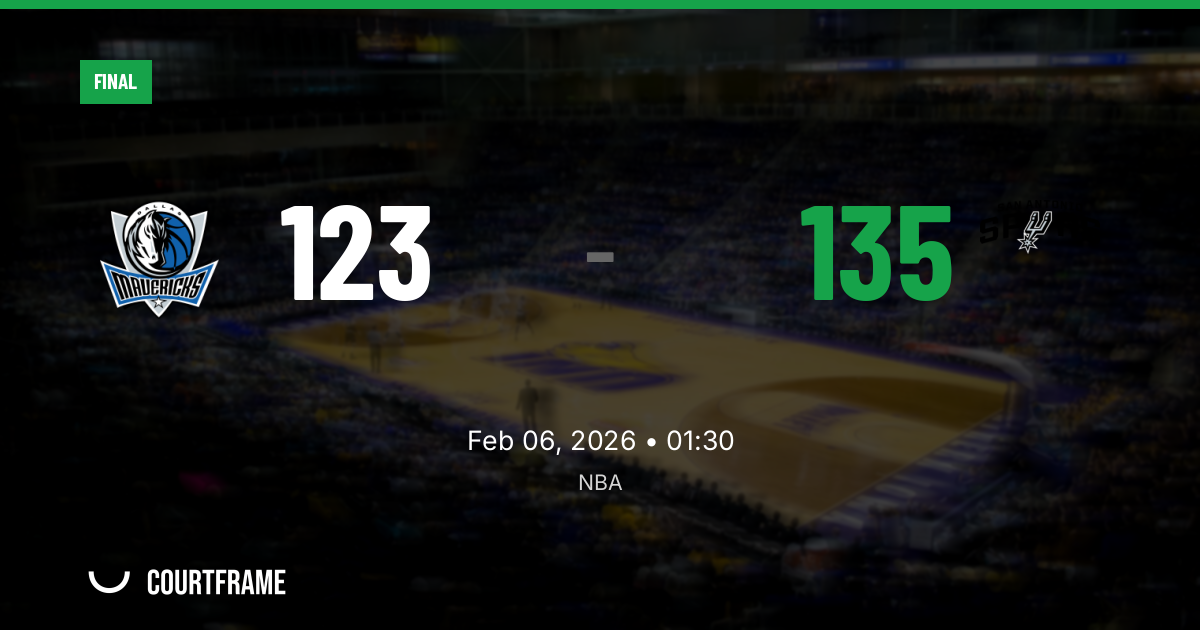
San Antonio came to Dallas with a contender’s profile and played like it from the opening tip. Behind a 74-point first half and a steady closing kick, the Spurs beat the Mavericks 135-123 on Feb. 6, 2026 at American Airlines Center, pushing past Dallas in a game that repeatedly threatened to swing but never fully turned.
How the game flipped early
The decisive stretch was the first 24 minutes. San Antonio scored 38 in the first quarter and 36 in the second, building a 74-63 halftime lead by consistently winning the possession game with pace, spacing, and quick decisions. Dallas hung 35 in the opening period to keep contact, but the Mavericks couldn’t sustain the same offensive rhythm in the second, managing 28 as the Spurs kept stacking efficient trips.
Dallas’ third-quarter push — and San Antonio’s answer
Dallas made its best move coming out of the break, taking the third quarter 33-25 to cut into the deficit and put real pressure on the Spurs’ execution. That was the window for a full momentum shift, especially with the Mavericks’ recent skid (LLLLL) and a home crowd looking for a spark.
San Antonio responded like a team that’s been there. The Spurs regained control with a 36-point fourth quarter, re-separating behind clean offense and timely stops to finish the night with a 12-point win.
Ball movement told the story
The clearest statistical separator was playmaking. San Antonio posted 34 assists, a number that speaks to advantage creation and shot quality across the floor. Dallas finished with 23 assists, leaving less margin for error in a game that demanded constant scoring to keep up with the Spurs’ pace and shot volume.
By the numbers
Final: Spurs 135, Mavericks 123
Quarter scores: SA 38-36-25-36 (135), DAL 35-28-33-27 (123)
Assists: Spurs 34, Mavericks 23
What it means going forward
For San Antonio (34-16), the win reinforces a formula that travels: win early with tempo, keep the ball moving, and close with composure when the opponent makes a run. For Dallas (19-31), the loss extends a difficult stretch and underscores the challenge of surviving shootouts without matching the opponent’s connectivity — especially when the game turns into a fourth-quarter execution test.