

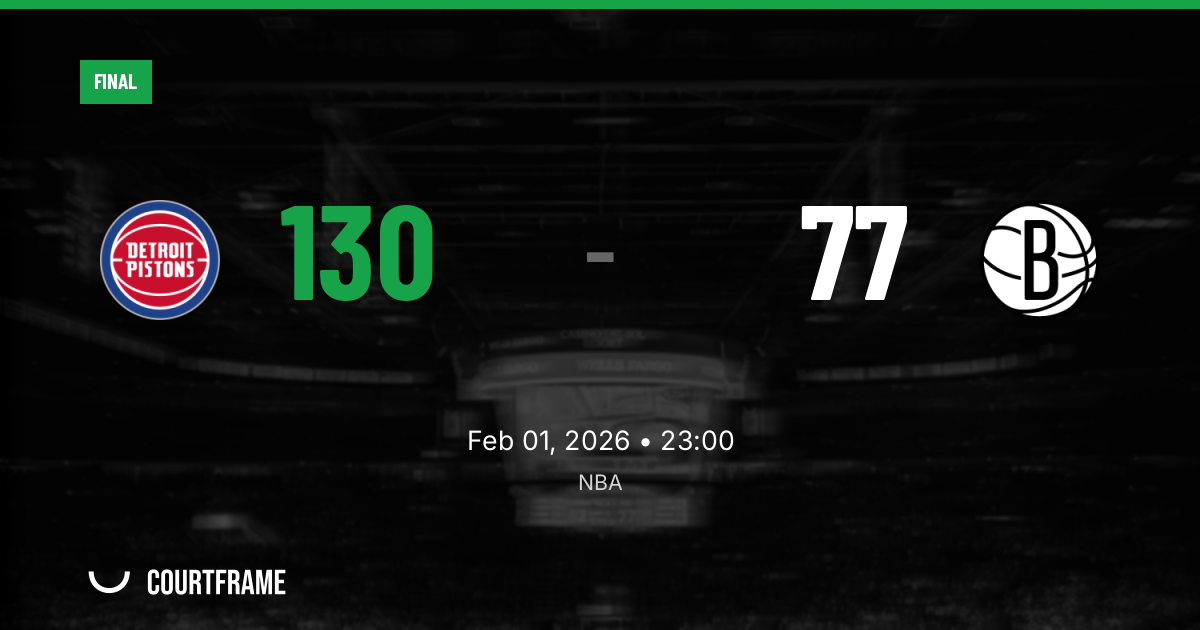
Detroit didn’t flirt with drama. The Pistons ripped open Saturday’s matchup from the opening tip and never looked back, throttling the Brooklyn Nets 130-77 on Feb. 1, 2026 at Little Caesars Arena.
For a Detroit team that entered at 35-12, this was a statement of control — not just a win over a 13-34 opponent, but a complete four-quarter performance. The Pistons won each period (33-24, 34-20, 33-18, 30-15), turning the second half into extended garbage time.
The game in one line
Detroit’s offense stayed connected all night — 33 assists on 130 points — while Brooklyn couldn’t generate enough organized creation to keep pace, finishing with 17 assists in a 53-point loss.
How it swung early
Brooklyn hung around briefly in the first quarter, but Detroit’s edge was immediate: cleaner spacing, quicker decisions, and a pace that kept the Nets defending for full possessions. The Pistons’ 33-point opening quarter set the tone, and the game effectively snapped in the second when Detroit poured in 34 more to take a 67-44 halftime lead.
Any hope of a Nets response disappeared after the break. Detroit matched its first-quarter output with 33 in the third, pushing the margin beyond reach and allowing the fourth to play out as a formality.
Ball movement was the separator
Detroit’s 33 assists weren’t window dressing — they were the engine. The Pistons consistently turned advantages into quality looks, keeping Brooklyn in rotation and forcing late-clock breakdowns. On the other end, the Nets’ 17 assists reflected a night where possessions stalled, reads came late, and the offense rarely created easy chances.
What it means going forward
Detroit’s recent form (WLWWL entering the night) has included some turbulence, but this was the kind of wire-to-wire dominance that reinforces why the Pistons own one of the league’s best records. The process was clean: win the possession battle with execution, build separation early, and keep the intensity through three quarters.
For Brooklyn (WLLLL entering the night), the margin underscores how thin the path is without consistent offensive organization. Against a connected, physical Detroit group, the Nets couldn’t sustain scoring, couldn’t string stops together, and never found a stretch that changed the game’s direction.