
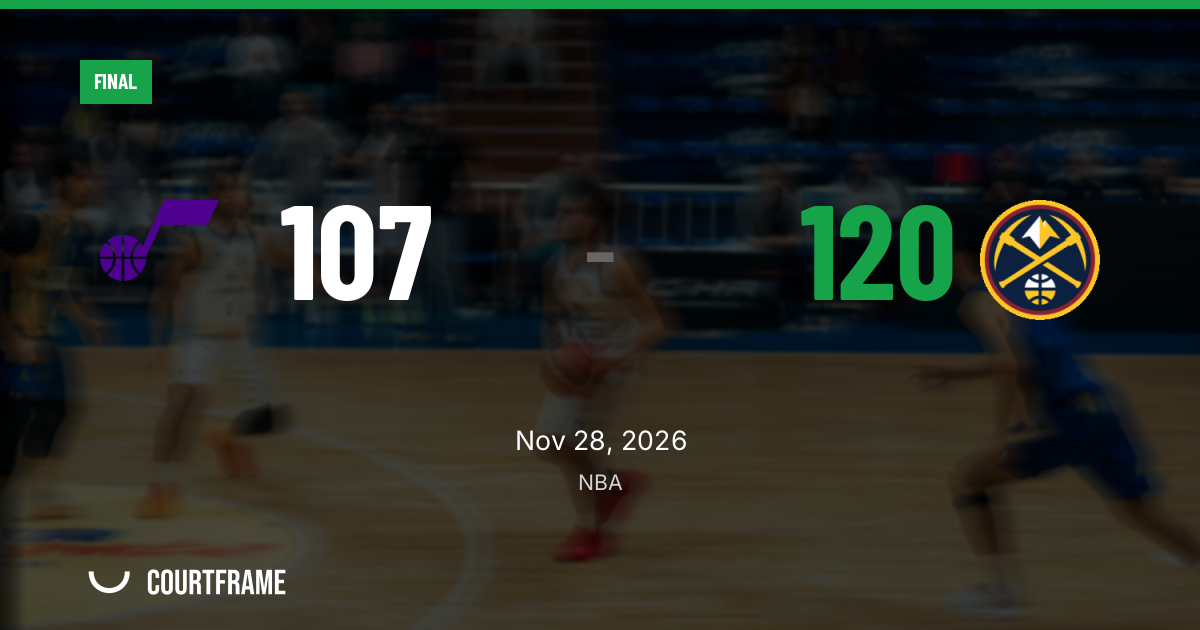
The Denver Nuggets defeated the Utah Jazz 120-107 on November 28, 2026, at Delta Center, extending the contrast between a 10-6 team with top-five CourtFrame Power Index standing and a 3-16 Utah group still searching for stability in the regular season.
Denver entered with a 10-6 record, a 7-2 road mark and an 81.19 CourtFrame Power Index that ranked fifth. Utah came in 3-16 overall, 1-10 at home and 23rd in CourtFrame Power Index at 56.52. The final margin reflected that separation, but the game required Denver to solve a third-quarter push before controlling the final period.
The Nuggets led 27-22 after the first quarter, but Utah answered with a 31-point second quarter and took a 53-52 lead into halftime. Denver then scored 33 in the third and 35 in the fourth, closing the game with 68 second-half points. Utah matched Denver’s third-quarter output with 32 points, but its 22-point fourth quarter left no room to absorb Denver’s late execution.
Denver’s turnover edge defined the game
The cleanest separation came in possession quality. Denver committed nine turnovers, while Utah had 18. That gap aligned with the teams’ recent profiles: Denver entered with a 10.9 turnover rate across its last 10 games, while Utah entered at 15.6.
The Nuggets paired that ball security with 32 assists on 43 made field goals. Utah also moved the ball well, finishing with 29 assists on 40 made field goals, but the Jazz could not offset giving Denver nine extra turnovers to work with. Denver also had nine steals to Utah’s six, turning the game’s pressure points toward the visitors.
Nikola Jokic and Jamal Murray entered as Denver’s central offensive engines, with Jokic averaging 24.1 points, 10.8 rebounds and 9.2 assists and Murray averaging 26.3 points and 5.4 assists. The team context around them showed up in the box score: Denver’s 32 assists were above its recent average of 27.5, and its nine turnovers were below its recent average of 11.9.
Utah’s shooting volume could not cover the personnel losses
Utah played without Lauri Markkanen because of a right hand fracture and Jaren Jackson Jr. because of a right MCL tear. Those absences removed two of the Jazz’s top scoring options, with Markkanen averaging 18 points and 6.6 rebounds in eight games and Jaren Jackson averaging 16.3 points and five rebounds in four games.
Keyonte George entered as Utah’s leading available scorer at 20.5 points and 6.6 assists per game, with D. Peterson averaging 16.2 points and four assists and A. Bailey averaging 13.1 points and six rebounds. Utah still generated enough passing to finish with 29 assists, but the missing frontcourt scoring and size mattered in a game Denver controlled late.
The Jazz attempted 44 3-pointers and made 14. That volume was consistent with a team that entered with a 47.8 three-point rate across its last 10 games. Denver was more selective from deep, making 10 of 24 from 3, and created a larger advantage at the foul line.
The free-throw line and fourth quarter tilted toward Denver
Denver shot 24 of 26 at the free-throw line, while Utah shot 13 of 17. That 11-point difference at the stripe was central in a 13-point game. The Nuggets entered with an 82.9 free-throw percentage across their last 10 games, and that strength carried into the road win.
Utah’s 13 free throws were not enough to balance the shot profile. The Jazz made four more 3-pointers than Denver, but the Nuggets made 11 more free throws, grabbed 42 rebounds to Utah’s 38 and finished with a 43-40 edge in made field goals.
The fourth quarter was the decisive stretch. Denver scored 35 points in the final period, its highest-scoring quarter of the night, while Utah scored 22. After Utah had stayed within range through three quarters, the Nuggets’ combination of free throws, ball security and passing created the closing separation.
Result followed the pre-game indicators
The matchup carried a clear pre-game lean toward Denver. The Nuggets had a 76.9 percent implied win probability across nine bookmakers, while Utah was at 23.1 percent. Denver also entered averaging 116 points per game compared with Utah’s 107.8, and the final score landed close to those offensive baselines: Denver scored 120, Utah scored 107.
The CourtFrame Power Index gap was also substantial, with Denver at 81.19 and Utah at 56.52. Denver’s CPI trend was 7.1, while Utah’s was 5.3, and the Nuggets’ stronger road profile carried into Delta Center.
Utah had the rest advantage, with three days off compared with Denver’s two, and both teams were playing their third game in seven days. That edge did not overcome the roster imbalance or the possession gap. Denver had no significant injuries reported, while Utah’s injury report included Markkanen and Jaren Jackson Jr. out, plus Jaxson Hayes, Jusuf Nurkic and Mo Bamba listed as questionable.
For Denver, the win reinforced the traits that have supported its strong start: efficient shot creation, low turnovers and late-game offensive organization. For Utah, the loss continued a difficult home trend and highlighted how narrow the margin becomes when its available scorers must carry a high-volume perimeter attack without two major frontcourt pieces.