
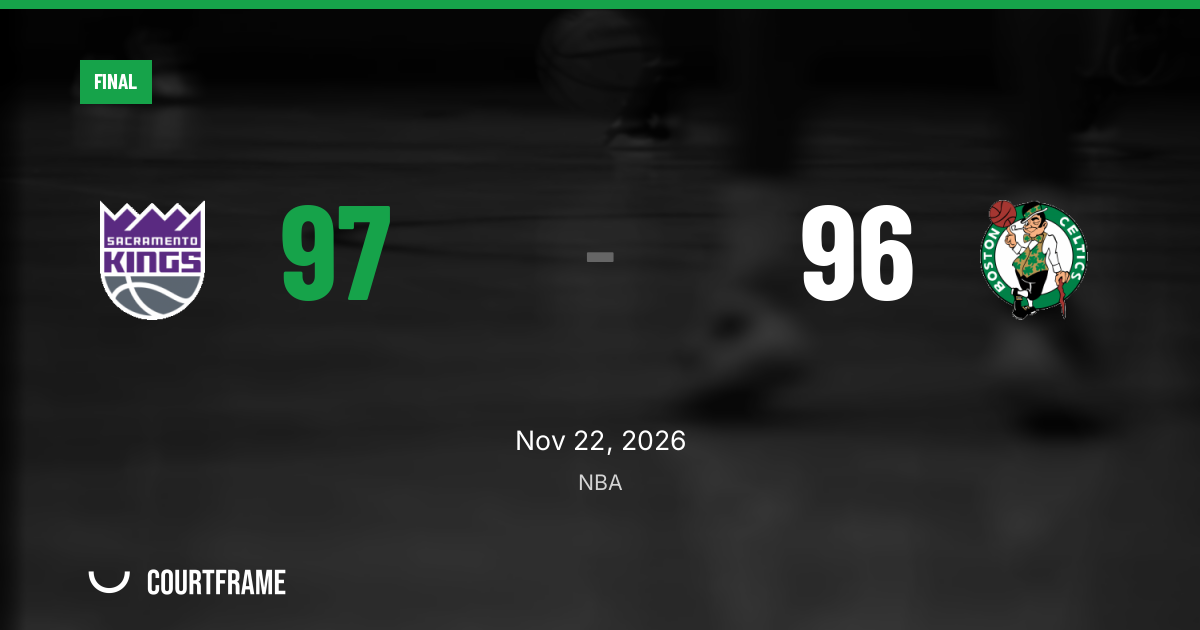
The Sacramento Kings entered November 22 with a 1-14 record, a 1-9 home mark and the No. 28 CourtFrame Power Index profile. They left Golden with the most jarring result of their season: a 97-96 win over a Boston Celtics team that came in 11-4, ranked No. 1 in CourtFrame Power Index and carrying an 81.6 percent market implied probability.
The final score reflected a game decided less by shot volume than by shot value. Boston attempted 101 field goals to Sacramento’s 78 and made 13 3-pointers to the Kings’ seven, but Sacramento went 26-for-32 at the line while Boston finished 15-for-25. That 11-point free-throw scoring edge was decisive in a one-point game.
The third quarter flipped the game
Boston controlled the first half with 27 points in each of the first two quarters, building a 54-41 lead by halftime. Sacramento’s offense had produced only 16 points in the second quarter, and the matchup was tracking toward the pregame gap between Boston’s 11-4 record and Sacramento’s 1-14 start.
The game changed in the third quarter. Sacramento outscored Boston 34-13, turning a 13-point halftime deficit into a 75-67 lead entering the fourth. That stretch was the only quarter in which either team created real separation, and it mattered more than Boston’s 29-22 closing push in the fourth.
For Sacramento, the third quarter also represented a reversal of its season-long profile. The Kings had averaged 107.5 points per game entering the night and 105.3 points over their most recent 10-game statistical sample, but their path in this game was not built on overall offensive rhythm. They finished with 16 assists against 18 turnovers and made only 7 of 26 from 3-point range. Their comeback instead came through pressure, free throws and enough half-court execution to survive Boston’s late response.
Boston’s shot diet became the central issue
The Celtics took 58 3-pointers and made 13, leaving them at 22.4 percent from deep. That volume aligned with a team that had carried a 48.2 percent 3-point rate across its recent 10-game profile, but the accuracy did not follow. Boston entered with a 35.8 percent 3-point mark over that span and finished well below it.
Boston’s overall shooting line was 34-for-101 from the field. The Celtics created more attempts than Sacramento by forcing 18 Kings turnovers while committing only 11 of their own, but the extra possessions did not translate into enough efficiency. Their 15-for-25 free-throw night also left points available in a game decided by one.
The Celtics still had structural advantages that usually travel. They finished with 52 rebounds, matching Sacramento on the glass, and recorded 22 assists to the Kings’ 16. They also had eight steals and four blocks. But the combination of poor 3-point conversion, missed free throws and a 13-point third quarter erased those edges.
Sacramento won the margins it had to win
Sacramento’s 32-for-78 field-goal line gave the Kings a cleaner shooting night than Boston despite fewer attempts. The Kings did not win the possession battle, and their 18 turnovers were consistent with a team that had averaged 17.5 turnovers across its recent 10-game profile. They survived because their offensive trips produced more free throws and because Boston’s perimeter volume failed to punish those mistakes.
The Kings’ 52 rebounds were also essential. Domantas Sabonis entered averaging 14.1 points, 13.6 rebounds and 5.3 assists, and Sacramento needed its frontcourt presence with Maxime Raynaud out, Ben Simmons out and Precious Achiuwa doubtful on the injury report. The Kings did not create a rebounding advantage, but they prevented Boston from turning its 101-shot night into a decisive board edge.
Sacramento’s available scoring burden remained concentrated. J. D. Acuff entered averaging 25.4 points and 7.3 assists, while Zach LaVine came in at 20.2 points per game. De'Andre Hunter, listed questionable with left hip soreness/tightness, had been averaging 15.3 points. Against a Boston team that arrived with Jayson Tatum and Derrick White both questionable, Sacramento’s ability to keep the game within one-possession range through the fourth quarter was as significant as the third-quarter burst itself.
Why the result defied the matchup
Nearly every pregame indicator favored Boston. The Celtics entered 11-4 overall and 5-4 away from home, while Sacramento was 1-14 overall and 1-9 at home. Boston also had three days of rest, while Sacramento was on one day of rest and a back-to-back, with both teams playing their third game in seven days.
The CourtFrame Power Index gap was even wider: Boston at 100.00 and ranked first, Sacramento at 49.06 and ranked 28th. The differential of minus-50.9 for Sacramento framed this as a severe mismatch before tipoff.
Instead, the game narrowed to execution in specific areas. Sacramento’s free-throw advantage, Boston’s 13-point third quarter and the Celtics’ 13-for-58 3-point shooting outweighed the larger season profiles. The Kings did not solve every weakness — the turnover count remained high, and the assist total was modest — but they turned Boston’s misses into a one-point window and closed it.
What it means
For Sacramento, the win moves the Kings to 2-14 and gives them a rare home result after opening 1-9 at Golden. It also gives them a concrete example of how they can stay competitive when the offense is imperfect: defend without losing the glass, attack the foul line and keep the game from becoming a pure 3-point math problem.
For Boston, the loss drops the Celtics to 11-5 and exposes the risk in a shot profile that leaned heavily into the arc without the corresponding accuracy. The Celtics had enough possession volume, enough defensive disruption and enough fourth-quarter scoring to win, but their third-quarter collapse and missed free throws made the margin too thin.
In the regular season, one November result does not rewrite either team’s identity. It does, however, count the same in the standings, and Sacramento’s 97-96 win was built on specific, measurable advantages against the league’s top CourtFrame Power Index team.