
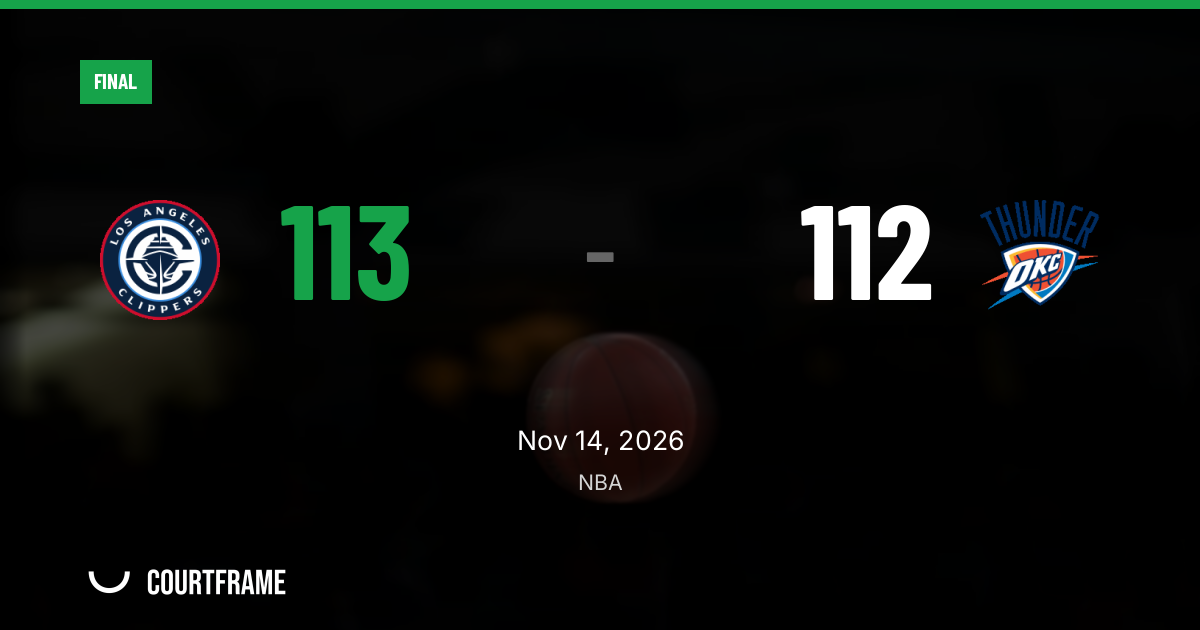
The Los Angeles Clippers beat the Oklahoma City Thunder 113-112 on November 14, 2026, at Intuit Dome, a one-point result that cut against the pregame indicators in the regular season. Oklahoma City entered 8-4 with a 78.63 CourtFrame Power Index, ranked seventh, while Los Angeles came in at 2-8 with a 24.62 CPI, ranked 22nd.
The Clippers won the game through shot profile and possession control. Los Angeles made 15 of 39 from three, while Oklahoma City finished 10 of 34. The Clippers also committed 11 turnovers to the Thunder’s 13, a small margin that mattered in a one-possession game.
Oklahoma City had the better work on the glass, finishing with 43 rebounds to the Clippers’ 37, and moved the ball well enough to generate 27 assists. But the Thunder’s 11-for-17 night at the free-throw line left points unclaimed, while Los Angeles converted 16 of 20.
How the Clippers built enough separation
Los Angeles controlled the first half 57-44, winning the first quarter 33-27 and the second quarter 24-17. That opening stretch aligned with the Clippers’ season-long emphasis on volume from the arc: they entered with a 43.6 three-point rate and a 38.1 percent mark from three through 10 games.
The Clippers’ offense has not been efficient overall this season, carrying a 98 offensive rating and a minus-11.4 net rating through 10 games before this matchup. Against Oklahoma City, the difference was not a broad statistical domination; it was the precision of the margins. Los Angeles made five more threes, four more free throws and had two fewer turnovers.
Darius Garland entered as the Clippers’ leading scorer at 20.2 points per game with 6.7 assists, and Los Angeles needed that kind of guard-led structure against a Thunder team that had allowed a 102.8 defensive rating through 10 games. The Clippers finished with 25 assists, continuing a pattern from a group that entered with a 67.7 assist rate and 26.3 assists per game.
Thunder surge in the third, but the math narrowed
Oklahoma City’s best stretch came in the third quarter, when it scored 40 points and flipped the game’s rhythm after a 13-point halftime deficit. The Thunder won the period 40-25, turning a 57-44 halftime hole into an 84-82 lead entering the fourth.
That burst reflected the profile of a team that entered with a 113 offensive rating, a 64.8 true shooting percentage and a plus-10.2 net rating through 10 games. Oklahoma City also protected the ball reasonably well with 13 turnovers, close to its season average of 12.8.
The issue was that the Thunder could not fully punish Los Angeles’ smaller rebounding total or convert enough at the line. Oklahoma City’s 43-37 rebounding edge and 27-25 assist advantage were not enough to overcome the Clippers’ three-point and free-throw gaps.
Injuries shaped Oklahoma City’s margin for error
Oklahoma City played without Chet Holmgren, Thomas Sorber, Cason Wallace, Jalen Williams and Jaylin Williams. Ajay Mitchell entered questionable with a left ankle sprain, adding another pressure point to a rotation already missing size, defense and secondary creation.
Holmgren had averaged 11.3 points and 9 rebounds in three games, while Jalen Williams had averaged 13.7 points, 4.7 rebounds and 3.3 assists in three games. Their absences were particularly relevant against a Clippers team that finished with seven blocks and forced Oklahoma City to rely heavily on perimeter creation.
Shai Gilgeous-Alexander entered averaging 30.2 points, 4.5 assists and 4.2 rebounds, and the Thunder’s overall offensive structure still generated 112 points. But without multiple rotation players, Oklahoma City had less room to absorb a poor free-throw night and a five-made-three deficit.
Result versus pregame profile
The result was a clear departure from the pregame outlook. Oklahoma City carried an implied win probability of 70.6 percent across nine bookmakers, while Los Angeles was at 29.4 percent. The Thunder also entered with the stronger record, better CPI rank and a positive net rating, while the Clippers came in with a negative net rating and a 15.6 turnover rate through 10 games.
Los Angeles also had a rest edge, with three days off and two games in the previous seven days. Oklahoma City had two days of rest and three games in the previous seven days. In a one-point game, that scheduling context mattered alongside the Clippers’ cleaner turnover total and superior shooting efficiency from the foul line.
The Clippers improved to 2-8 with a win that leaned on their clearest offensive strength: three-point volume and accuracy. The Thunder fell to 8-4 after producing enough passing, rebounding and third-quarter offense to win, but not enough late-game efficiency to survive the Clippers’ 31-28 fourth quarter.