
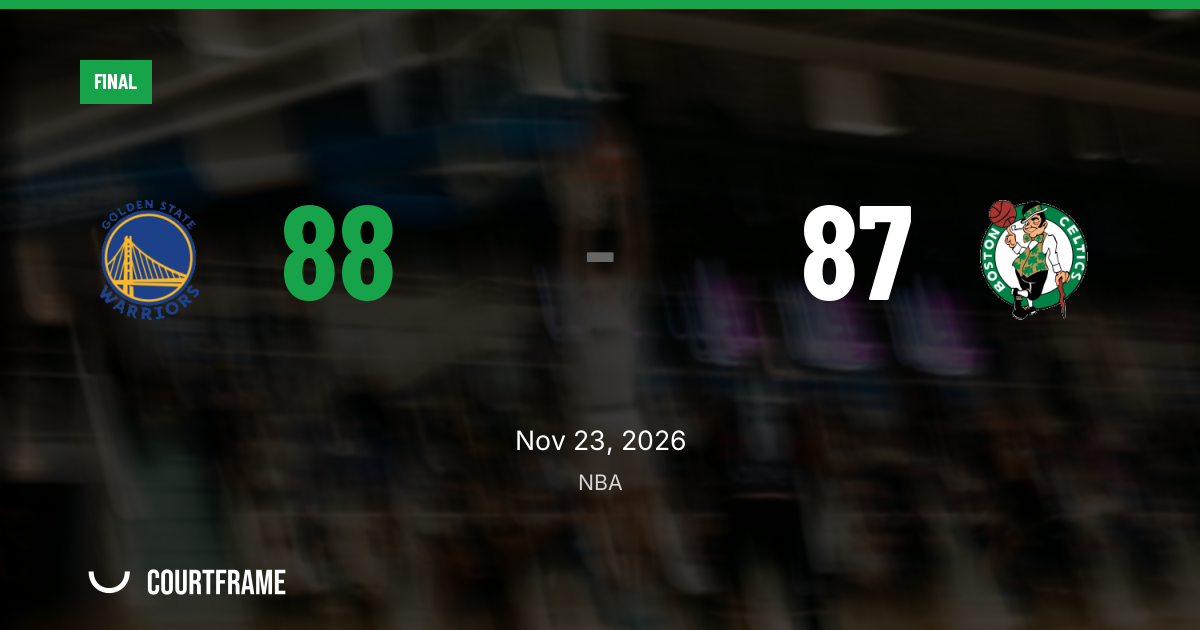
Golden State Warriors entered Monday night without Stephen Curry, Jimmy Butler III, Moses Moody, Kristaps Porzingis and Brandon Williams, then spent 48 minutes playing the kind of low-margin game that usually punishes a short-handed roster. Instead, the Warriors beat the Boston Celtics 88-87 at Chase Center in the regular season, turning a game shaped by missed creation and half-court friction into a one-point win.
The result moved Golden State to 8-8 and dropped Boston to 11-5. It also cut against the pregame profile: Boston carried a 73.6 percent market implied probability, a better CourtFrame Power Index mark at 84.72 compared with Golden State’s 74.55, and the stronger overall record. The Warriors still found enough structure without Curry’s 27.8 points per game and Brandon Williams’ 10.4 points per game, while Boston could not convert a 33-point third quarter into control of the game.
Golden State’s defense won the fourth quarter
Boston’s best stretch came in the third quarter, when the Celtics scored 33 points after posting 20 in the first quarter and 22 in the second. That surge gave Boston a path to take the game away from a Warriors team missing its primary offensive engine, but Golden State answered by holding the Celtics to 12 points in the fourth quarter.
That final-period defense mattered because Golden State’s offense was not clean. The Warriors committed 20 turnovers, four more than Boston’s 16, and did not create separation at the foul line, going 8-for-10 compared with Boston’s 9-for-12. The Warriors instead survived through possession work and shot volume from the perimeter, finishing with 45 rebounds to Boston’s 41 and matching the Celtics with 14 made 3-pointers.
The fourth quarter also reflected a matchup trend from Golden State’s recent profile. Over its previous 10-game sample, the Warriors had been better defensively than offensively, with a 95.2 defensive rating and a 93.8 offensive rating. That imbalance showed up again: Golden State did not reach 90 points, but it kept Boston below 90 and forced the game into a possession-by-possession finish.
Boston’s 3-point volume was not enough
The Celtics attempted 47 3-pointers and made 14. Golden State attempted 45 and also made 14. In a game decided by one point, that parity from deep removed one of Boston’s clearest routes to separation.
Boston entered with a high 3-point rate of 46.0 percent over its previous 10 games, and that perimeter emphasis carried into Chase Center. The Celtics also had 26 assists, consistent with their recent 70.3 assist rate and 26.0 assists per game. The ball moved, but the shot profile did not produce enough efficiency to offset the fourth-quarter drought.
Paul George, Jayson Tatum, Derrick White, Payton Pritchard and Neemias Queta formed the key offensive context entering the night, with Tatum averaging 26.3 points, 6.7 assists and 6.9 rebounds. Tatum and White had both been questionable, and Boston’s late-game offense lacked the scoring stability expected from a team averaging 112.8 points per game on the season.
Warriors overcame the Curry absence through distribution
Golden State’s most important offensive number was 27 assists. Without Curry, the Warriors did not have their usual advantage in off-ball gravity or late-clock shot creation, but they still produced one more assist than Boston and maintained enough movement to keep the game within reach.
Y. Lendeborg entered as Golden State’s top available scorer among its key players at 19.2 points per game, with 7.2 rebounds and 3.6 assists. Brandin Podziemski, averaging 15.8 points, 4.9 rebounds and 3.5 assists, also carried a larger creation burden in a rotation stripped of Curry and Williams. De'Anthony Melton’s two-way profile mattered as well, with Golden State needing guard defense and secondary playmaking against a Boston team that came in averaging 26.0 assists.
The Warriors’ 20 turnovers showed the cost of playing without their usual hierarchy. Their season context made that risk predictable: Golden State had averaged 16.4 turnovers across its previous 10 games, with a 14.4 turnover rate. The difference Monday was that those mistakes did not become a decisive Boston advantage, because Golden State won the glass and kept the Celtics from building a late scoring run.
Rest and location tilted toward Golden State
The venue mattered. Golden State entered 7-1 at home with an average of 116.5 points at Chase Center, while Boston came in 5-5 away from home with an average of 105.5 points on the road. The Warriors did not come close to their home scoring average, but their defensive performance fit the kind of home-court edge that can show up most clearly in physical, low-scoring games.
The schedule also favored Golden State. The Warriors had three days of rest and were playing their third game in seven days. Boston had no rest and was also playing its third game in seven days. That gap was visible late, when the Celtics followed their 33-point third quarter with only 12 points in the fourth.
Boston’s broader profile still suggested a team with advantages. The Celtics entered 11-5, had a higher CourtFrame Power Index, and had been cleaner with the ball recently, averaging 13.6 turnovers compared with Golden State’s 16.4. But on Monday, the Warriors turned the game into a defensive test, and Boston’s advantages in record, pregame expectation and ball security were not enough.
What the result means
For Golden State, the win was less about offensive fluency than proof of functional depth under difficult roster conditions. Beating an 11-5 Boston team while missing Curry, Butler, Moody, Porzingis and Williams required the Warriors to win the margins that remained available: rebounding, fourth-quarter defense and collective passing.
For Boston, the loss will sit on the contrast between the third quarter and the final 12 minutes. The Celtics scored 33 in the third, made 14 3-pointers, recorded 26 assists and still finished with 87 points. Against a Warriors team missing multiple rotation anchors, that offensive drop-off turned a favorable pregame setup into a narrow road loss.