
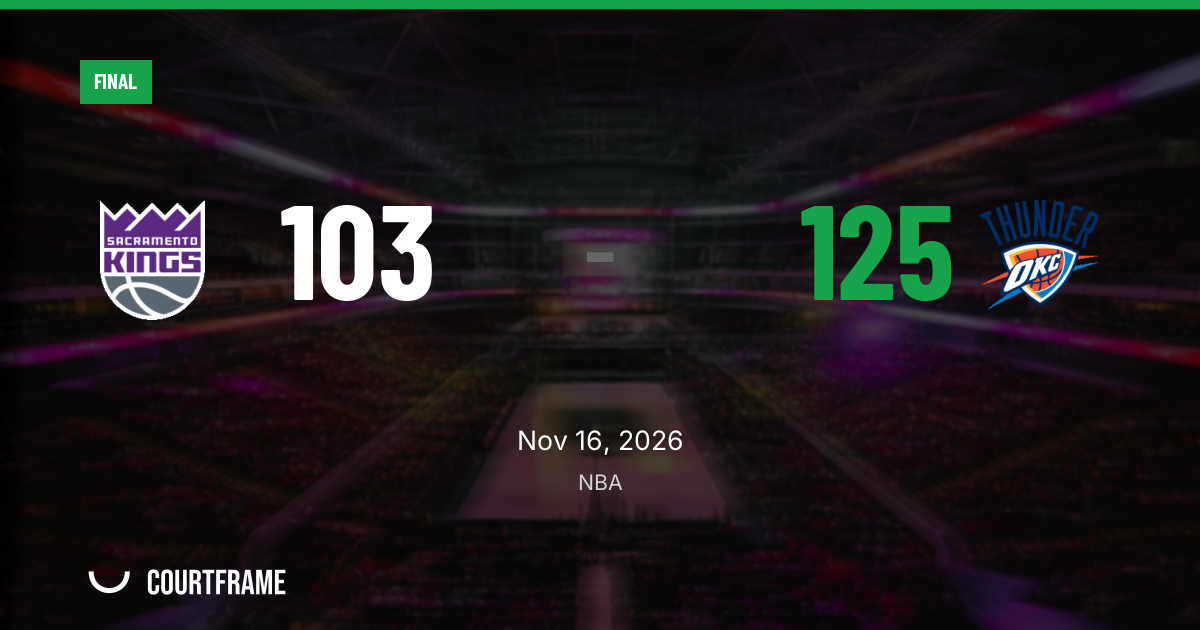
Oklahoma City Thunder defeated Sacramento Kings 125-103 on November 16, 2026, at Golden, extending the contrast between a Thunder team positioned in the top third of the league by CourtFrame Power Index and a Kings team still searching for stability in the regular season.
The Thunder entered at 8-5 and ranked ninth with a 70.72 CourtFrame Power Index. Sacramento entered at 1-11, ranked 28th with a 9.49 CPI, and the gap showed in the possession battle. Oklahoma City forced 22 turnovers, recorded 15 steals and generated enough pressure to keep Sacramento from turning its 27 assists and 14 made 3s into a competitive fourth quarter.
Oklahoma City controlled the game early
The Thunder won every quarter except the third, opening with a 32-24 first quarter and adding a 30-26 second to take a 62-50 halftime lead. Sacramento scored 30 in the third, but Oklahoma City still matched it with 32 and entered the fourth up 94-80. The Thunder then closed the game with a 31-23 final period.
That consistency reflected Oklahoma City’s pregame profile. Over its previous 10-game sample, the Thunder had a 110.7 offensive rating, 101.9 defensive rating and plus-8.8 net rating. Sacramento came in with a 99.5 offensive rating, 107.3 defensive rating and minus-7.8 net rating over the same span. The final margin closely followed that underlying separation.
Oklahoma City shot 46-for-88 from the field and 23-for-28 at the free-throw line. Sacramento shot 37-for-82, made 14 of 43 from 3-point range and went 15-for-20 at the line. The Kings produced volume from deep, but Oklahoma City’s rim pressure and foul-line edge gave the Thunder a cleaner scoring base.
Turnovers defined Sacramento’s night
Sacramento’s biggest issue was not ball movement. The Kings finished with 27 assists, slightly above their 26.3 average across the previous 10 games. The problem was how often those possessions ended before a shot. Their 22 turnovers were above their already high 18-turnover average, and Oklahoma City’s 15 steals amplified every mistake.
The Thunder entered with a 12.4 turnover rate and averaged 12.6 turnovers over their previous 10 games. They committed 14 in this game, still far below Sacramento’s total. That eight-turnover gap gave Oklahoma City more control over pace and shot quality, especially in the first half when the Thunder built the lead.
Sacramento’s offensive profile already carried volatility. The Kings entered with a 46.7 three-point rate and a 16.7 turnover rate, a combination that can create scoring bursts but also long empty stretches. Against Oklahoma City’s pressure, the tradeoff leaned heavily toward the Thunder.
Thunder depth held despite injuries
Oklahoma City played without Chet Holmgren, Thomas Sorber, Cason Wallace, Jalen Williams and Jaylin Williams, while Ajay Mitchell was listed as questionable with a left ankle sprain. The absence list removed major frontcourt size and secondary creation, but the Thunder still outrebounded Sacramento 40-37 and held the Kings to 103 points.
That rebounding result mattered because Sacramento’s interior foundation runs through Domantas Sabonis, who entered averaging 14.2 points, 13.2 rebounds and 5.6 assists. Oklahoma City entered with a 51.4 rebound percentage and 44.8 average rebounds over its previous 10 games, and even without Holmgren and multiple rotation pieces, it maintained enough physical balance to prevent Sacramento from controlling the glass.
Shai Gilgeous-Alexander entered as Oklahoma City’s clear offensive anchor at 30.7 points per game, with J. McCain averaging 13.2 points and A. Mitchell averaging 17.8. Even with Jalen Williams unavailable after appearing in only three games, the Thunder’s structure held because the defense created offense and the team reached the free-throw line 28 times.
Kings remain winless at home
Sacramento fell to 1-11 overall and 0-8 at home. The Kings entered averaging 107.8 points at home and scored 103, while Oklahoma City entered averaging 111.4 points on the road and scored 125. The result deepened Sacramento’s home-court issues despite both teams playing on one day of rest and both navigating three games in the previous seven days.
J. D. Acuff entered averaging 25.5 points and 7 assists, while Zach LaVine entered at 21.1 points per game. Sacramento had enough perimeter scoring on paper to challenge an Oklahoma City team missing several rotation pieces, but the Kings’ offensive efficiency could not survive the turnover volume.
The injury report also left Sacramento short of certainty. Maxime Raynaud and Ben Simmons were out, while Precious Achiuwa and Keegan Murray were questionable. Achiuwa entered averaging 10.4 points and 6.3 rebounds, and Murray’s illness designation added another variable to a roster already struggling to stabilize its rotation.
Result matched the pregame indicators
The market implied Oklahoma City at 78.9 percent to win, and the game followed that expectation. The Thunder were the stronger team by record, CourtFrame Power Index, net rating, defensive efficiency and turnover profile. Sacramento’s path required cleaner possessions and a stronger home performance than it had shown through its first eight home games.
Instead, Oklahoma City imposed its defensive pressure, won the turnover margin and scored at least 30 points in every quarter. For the Thunder, the 125-103 win reinforced a profile built on efficient offense, controlled mistakes and disruptive defense. For the Kings, the loss again centered on the same structural issue: too many possessions lost before their scoring talent could matter.