
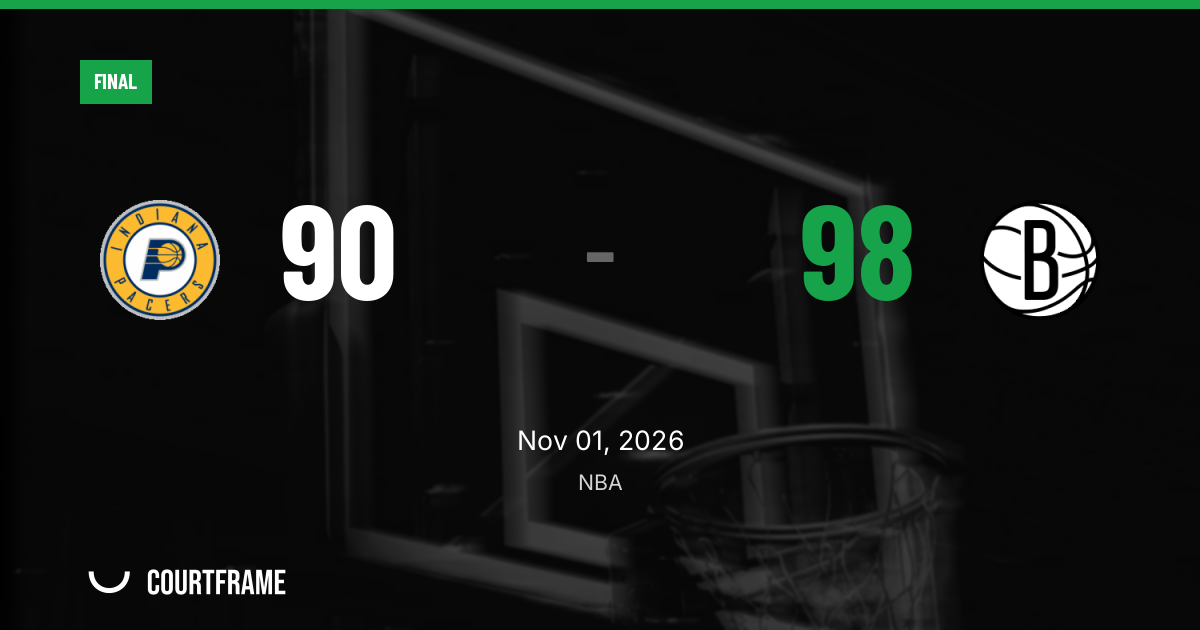
The Brooklyn Nets entered Gainbridge Fieldhouse at 0-5 and left with their first win of the regular season, beating the Indiana Pacers 98-90 on November 1, 2026. Brooklyn won each of the first three quarters by narrow margins, then matched Indiana’s late push with a 27-point fourth quarter.
The result cut against the pregame indicators. Indiana came in as the 60.1 percent implied favorite, carried the stronger CourtFrame Power Index profile at 24.56 compared with Brooklyn’s 1.92, and had a 22.6-point CPI differential. Brooklyn still controlled enough of the possession game and late-clock execution to win a low-scoring road game.
Brooklyn’s third quarter created the cushion
The Nets led 20-19 after the first quarter and 43-40 at halftime, but the decisive stretch came after the break. Brooklyn scored 28 points in the third quarter while holding Indiana to 22, turning a three-point halftime edge into a 71-62 lead entering the fourth.
Indiana produced its best offensive quarter in the fourth with 28 points, but Brooklyn answered with 27. That response mattered because the Nets had been averaging 110.2 points through five games and did not need a high-output night to close this one. Their defense set the terms by keeping Indiana 26.7 points below its season scoring average of 116.7.
For a Brooklyn team that had been carrying a 0-5 record, the shape of the win was notable. The Nets arrived with a season profile built around pressure plays, averaging 9.4 steals and 4.8 blocks, but also with a major ball-security issue at 19.4 turnovers per game. In this game, the scoreboard reflected a more controlled version of that identity: enough defensive resistance to keep the Pacers out of rhythm, and enough scoring balance to survive the final quarter.
Indiana’s absences showed in the half-court
Indiana’s injury list framed the game before tipoff. Tyrese Haliburton was out with a left hamstring strain, T.J. McConnell was out with a right hamstring strain, Ben Sheppard was out after left meniscus surgery, Johnny Furphy was out after right ACL repair surgery, and Ivica Zubac was out with a left ankle sprain. Obi Toppin was questionable with low back soreness.
Haliburton’s absence removed a 21.8-point, 9.5-assist creator from the Pacers’ structure. McConnell’s absence further thinned the guard rotation. Indiana still had Pascal Siakam, who entered averaging 22.2 points and 7.8 rebounds, and Andrew Nembhard, who came in averaging 17.6 points and 8 assists, but the Pacers never reached their usual offensive level.
The Pacers had averaged 28.7 assists through six games, a marker of how much their offense depends on continuous advantage creation. Against Brooklyn, the final score reflected how difficult it became to sustain those advantages without two primary ball-handling pieces. Indiana scored 19, 21 and 22 points in the first three quarters, leaving too much work for a late comeback.
Brooklyn’s frontcourt scoring profile traveled
Brooklyn’s pregame scoring hierarchy pointed toward Julius Randle and Michael Porter as the central pressure points. Randle entered averaging 21 points, 7.6 rebounds and 5.2 assists, while Michael Porter came in averaging 20.2 points and 7 rebounds. Against an Indiana team missing Zubac, that frontcourt-oriented profile had a clear pathway to matter.
Indiana entered the night with a 46.8 rebound percentage, while Brooklyn came in at 51.7. That contrast aligned with the matchup conditions. The Nets did not need to overwhelm Indiana with pace or a high-scoring total; they needed enough size, shot-making and defensive rebounding presence to keep the Pacers from stacking runs.
Moritz Wagner, M. J. Brown and N. Traore rounded out a Nets group that had been searching for stability behind Randle and Michael Porter. Brooklyn’s 98 points were below its season average, but the Nets’ quarter-by-quarter consistency — 20, 23, 28 and 27 — was enough in a game where Indiana never scored more than 28 in any period.
Home-court issues continue for the Pacers
Indiana dropped to 2-4 overall and remained winless at home, where it had entered 0-3 while averaging 101.3 points. The 90-point finish continued that home scoring problem and marked another game at Gainbridge Fieldhouse in which the Pacers failed to approach their overall scoring average.
The schedule context did not offer either team a clear rest edge. Indiana had one day of rest, was playing its fourth game in seven days and was on a back-to-back. Brooklyn also had one day of rest and was on a back-to-back, though it was playing its third game in seven days.
Brooklyn improved from 0-5 by winning the possession-by-possession margins that matter most in a low-scoring game. Indiana, despite entering with the stronger record, stronger CPI and home-court advantage, did not have enough creation available to overcome Brooklyn’s third-quarter separation.