
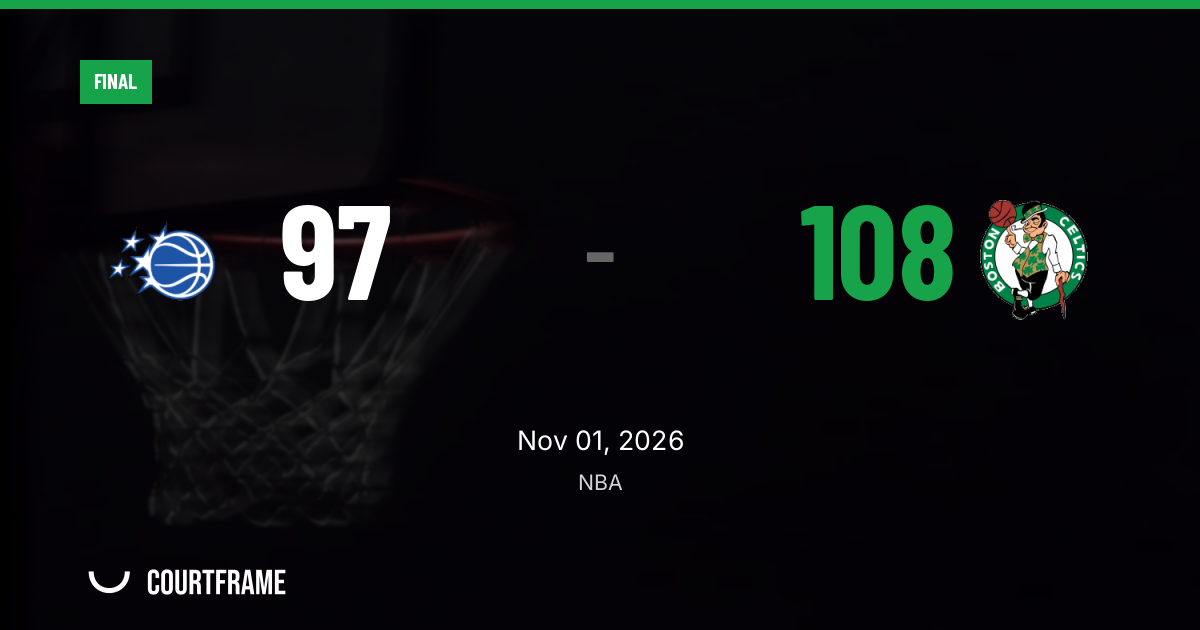
The Boston Celtics beat the Orlando Magic 108-97 on November 1, 2026, at Kia Center, using a cleaner offensive game and a more disruptive defensive profile to control the regular season matchup. Boston improved to 4-1, while Orlando dropped to 2-3.
The final margin matched the pregame shape of the matchup. Boston entered averaging 120.8 points, carrying a 50.49 CourtFrame Power Index that ranked ninth, and had the stronger advanced profile through six games with a 106.3 offensive rating, 98.0 defensive rating and plus-8.3 net rating. Orlando entered with a 32.50 CourtFrame Power Index ranked 18th and a minus-8.2 net rating, then played without Paolo Banchero, Jalen Suggs, Jonathan Isaac, Izaiyah Nelson and Noah Penda.
Boston won the possession game
The Celtics did not overwhelm Orlando with shooting accuracy, but they created the more stable possession environment. Boston shot 37-for-84 from the field and 12-for-44 from 3-point range, while Orlando finished 34-for-81 and 14-for-39 from deep. The Magic made two more 3s, but Boston offset that with pressure at the foul line, defensive events and fewer empty possessions.
Boston committed 13 turnovers compared with Orlando’s 18, a five-turnover gap that mattered in a game played with narrow quarter-to-quarter separation. The Celtics also finished with 29 assists to Orlando’s 24, continuing a pattern from their early-season profile: Boston entered averaging 27.8 assists with a 75.2 assist rate, and its half-court structure produced enough quality looks to withstand a lower 3-point conversion night.
Orlando’s 18 turnovers aligned with a pregame concern. The Magic entered with a 15.7 turnover rate and 17.2 turnovers per game, and Boston’s defense turned that weakness into a decisive lever. The Celtics recorded 9 steals and 7 blocks, while Orlando had 6 steals and 2 blocks.
The second and fourth quarters created separation
Boston led 24-23 after the first quarter, then created the first meaningful gap with a 31-27 second quarter. Orlando stayed within range by winning the third quarter 24-22, but the Celtics closed the game with another 31-point period while holding the Magic to 23 in the fourth.
The quarter scores reflected Boston’s ability to keep generating points late despite both teams playing on one day of rest and both entering the matchup in a back-to-back spot with three games in the previous seven days. Orlando’s offense, already missing its highest-usage frontcourt creator in Banchero and a primary defensive guard in Suggs, did not have the same late-game margin for error.
Orlando’s absences narrowed its creation options
Banchero’s absence removed 24.5 points, 7.5 assists and 6.0 rebounds per game from Orlando’s lineup. Suggs’ absence also stripped the Magic of a point-of-attack option against a Boston team built around multiple ball handlers and high-volume spacing.
Franz Wagner entered as Orlando’s leading available creator at 19.7 points, 7.8 assists and 6.7 rebounds per game, with Desmond Bane, Anthony Black and T. da Silva also carrying elevated offensive responsibility. Orlando still generated 39 3-point attempts and made 14, but the Magic’s 97 total points showed how difficult it became to sustain efficient offense when Boston could apply pressure without overcommitting.
The Magic did win the rebounding count 43-41, but that advantage did not overcome the turnover gap, the assist gap or Boston’s free-throw edge. Orlando went 15-for-19 at the line; Boston went 22-for-26.
Boston’s profile traveled
Boston entered with the stronger road context despite a 1-1 away split and 110.5 points per road game. The Celtics’ broader six-game profile was more convincing: 118.7 points per game, 61.5 true shooting percentage, 52.6 effective field goal percentage and a defense allowing a 98.0 defensive rating.
Jayson Tatum entered averaging 28.0 points, 7.7 assists and 6.0 rebounds, with Paul George adding 20.7 points, 5.0 assists and 5.8 rebounds. Payton Pritchard and Derrick White gave Boston additional guard creation, and Neemias Queta’s frontcourt minutes fit a team that finished with 7 blocks even with Mitchell Robinson out.
The Celtics’ 108 points were below their season scoring average entering the night, but the game was still played on their terms. Boston’s defense held Orlando under 100, forced 18 turnovers and closed with its best offensive quarter of the night.
What the result means
For Boston, the 108-97 win reinforced the gap between its early-season indicators and Orlando’s current injury-limited version. The Celtics’ 4-1 record now sits alongside a balanced statistical identity: efficient scoring, a positive net rating and enough defensive playmaking to win on a night when the 3-point shot did not define the game.
For Orlando, the loss continued a difficult home start. The Magic entered 0-3 at home with 105.0 points per game in those contests, then scored 97 at Kia Center against a Celtics team that entered with the league’s ninth-ranked CourtFrame Power Index. Until Banchero and Suggs return, Orlando’s margin depends heavily on limiting turnovers and creating enough half-court offense through Wagner, Bane, Black and T. da Silva.