
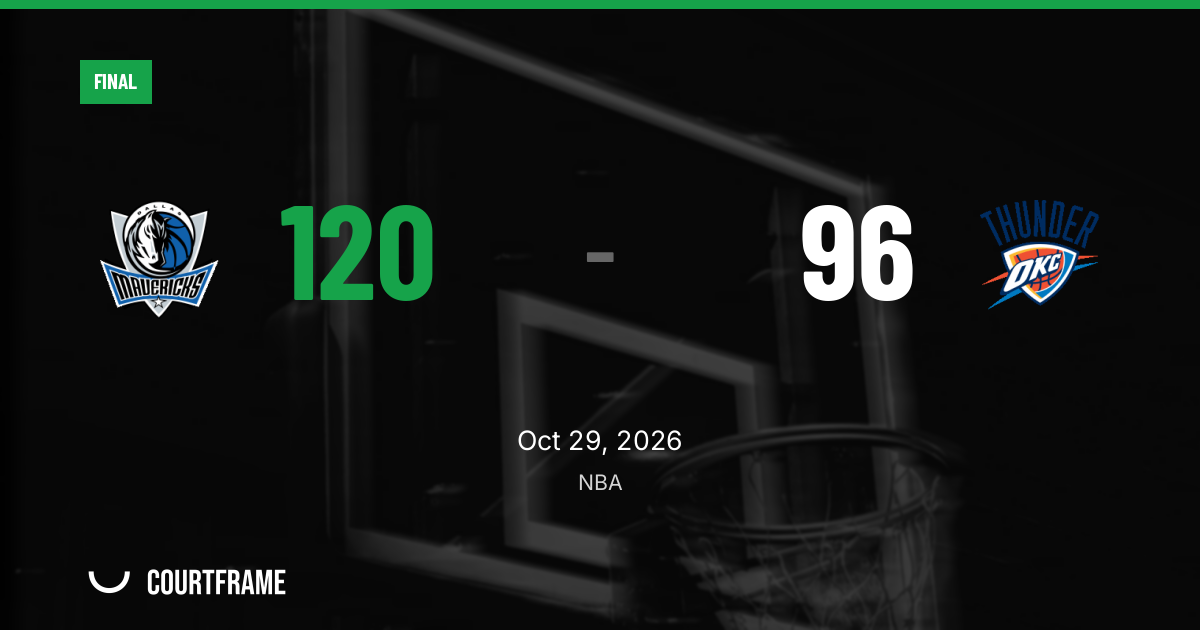
The Dallas Mavericks beat the Oklahoma City Thunder 120-96 on October 29, 2026, at American Airlines Center, delivering their most complete result of the regular season and ending Oklahoma City’s unbeaten start.
Dallas improved to 2-2, while Oklahoma City fell to 4-1. The result ran against the pregame indicators: Oklahoma City entered with a 64.7 percent implied win probability across nine bookmakers, a 55.45 CourtFrame Power Index, an eighth-place rank, and a plus-3.9 net rating through five games. Dallas entered with a 38.99 CourtFrame Power Index, a 15th-place rank, and a minus-4.5 net rating through five games.
Dallas controlled the shot profile and the ball
The Mavericks won this game with volume, spacing and decision-making. Dallas shot 46-of-97 from the field, made 16-of-45 from three and finished with 30 assists against 11 turnovers. Oklahoma City shot 36-of-87 overall and 5-of-32 from three, with 17 assists and 14 turnovers.
That gap in creation defined the night. Dallas generated 13 more field-goal attempts, made 11 more threes and produced 13 more assists. Oklahoma City got to the line more often, making 19-of-23 free throws compared with Dallas’ 12-of-15, but the Mavericks’ advantage from the floor overwhelmed that edge.
Dallas entered averaging 26.4 assists and 16.2 turnovers through five games. Against Oklahoma City, the Mavericks paired a higher-assist performance with a cleaner turnover game, a meaningful shift for a team that had been playing at a 120.3 pace with a 13.5 turnover rate.
The second half separated the teams
Oklahoma City scored 30 points in the first quarter and 29 in the second, but Dallas still led 65-59 at halftime. The Mavericks then tightened the game defensively, holding the Thunder to 22 points in the third quarter and 15 in the fourth.
The final 24 minutes were decisive: Dallas outscored Oklahoma City 55-37 after halftime. The Thunder’s fourth-quarter output was their lowest scoring period of the game, while the Mavericks scored at least 26 points in every quarter.
Dallas’ defensive finish was especially notable because Oklahoma City came in with the stronger defensive profile, carrying an 89.5 defensive rating through five games. The Mavericks, who entered with a 96.7 defensive rating, were the team that imposed the more disruptive half-court environment as the game progressed.
Thunder depth issues showed up
Oklahoma City played without Alex Caruso, Chet Holmgren, Thomas Sorber, Nikola Topic, Cason Wallace and Jalen Williams. Ajay Mitchell was listed as questionable entering the game. The absences removed multiple rotation options from a team that had opened 4-0 despite a crowded injury report.
The missing size and defensive versatility mattered against a Dallas team that finished with 49 rebounds, 30 assists and 16 made threes. Oklahoma City had 43 rebounds, 17 assists and three blocks. The Thunder entered averaging 45.2 rebounds and 6.8 blocks through five games, but Dallas controlled enough of the possession game to keep Oklahoma City from building stops into transition pressure.
Shai Gilgeous-Alexander entered averaging 26 points, 3.4 assists and 4.6 rebounds, while A. Mitchell entered averaging 18.6 points, 3.6 assists and 3.4 rebounds. With Jalen Williams and Chet Holmgren out, Oklahoma City needed efficient perimeter creation and secondary playmaking. Instead, the Thunder finished with only 17 assists and five made threes.
Mavericks got the version they needed
Dallas entered with several injury concerns of its own. Sergio Larrea and Dereck Lively II were out, Santi Aldama and Tarik Biberovic were doubtful, and Kyrie Irving, Naji Marshall and Caleb Martin were questionable.
The Mavericks’ available core still produced the cleaner collective game. C. Flagg entered averaging 25.3 points, 6.8 assists and 5.3 rebounds through four games, giving Dallas a primary engine capable of bending coverage. P. J. Washington entered averaging 15.6 points and 7.8 rebounds through five games, while Kyrie Irving had averaged 18 points through four games.
Dallas’ offensive balance showed in the team totals more than any single number: 97 field-goal attempts, 45 three-point attempts, 30 assists and only 11 turnovers. That combination allowed the Mavericks to play fast without letting the game become loose.
What the result says
This was Dallas’ first home win in its second home game, moving the Mavericks’ home split to 1-1. Oklahoma City entered with a 1-1 away split and an average of 106 points away from home, then finished with 96.
Both teams had two days of rest and were playing their third game in seven days, so the fatigue profile was even. The difference came from execution: Dallas protected the ball, created assisted shots and punished Oklahoma City’s poor three-point shooting.
The Mavericks’ 120-96 win does not erase the early-season gap in broader indicators, but it does show a path for Dallas when its spacing and passing hold together. For Oklahoma City, the first loss of the regular season exposed how thin the margin becomes when injuries remove defensive connectors and secondary creators from the rotation.