
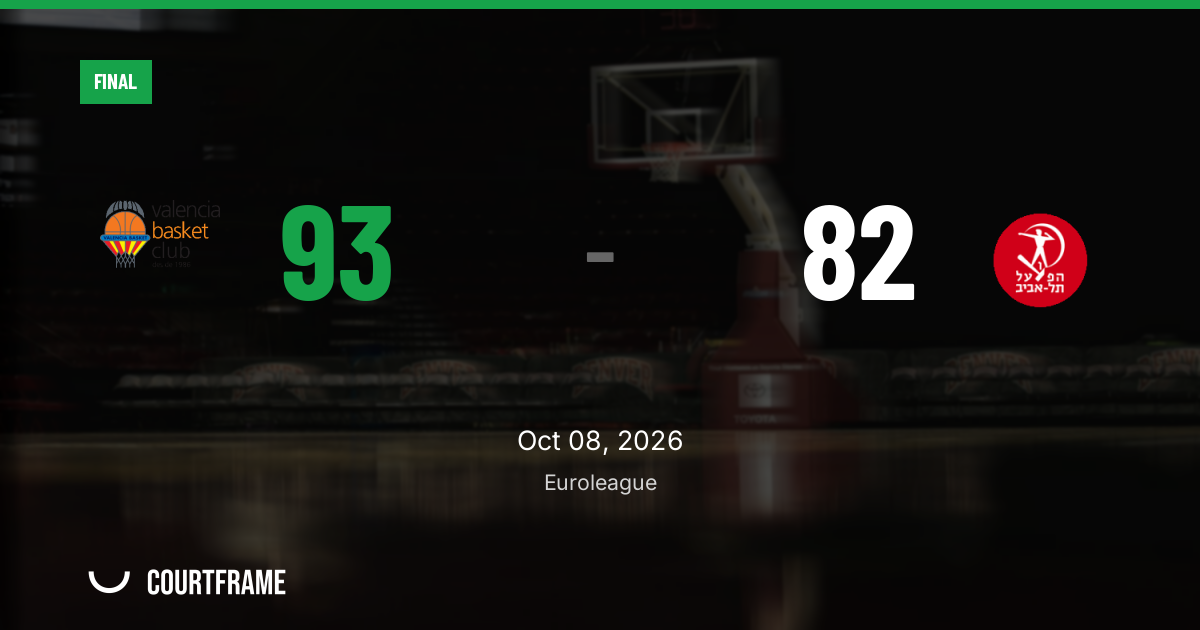
Valencia beat Hapoel Tel-Aviv 93-82 on October 8, 2026 at Roig Arena, preserving its unbeaten start in Euroleague Round 4 of the regular season and moving to 4-0. Hapoel Tel-Aviv fell to 2-2 after allowing Valencia to control the game’s most important stretches despite winning the rebounding battle.
The result followed the pre-game indicators more closely than the narrow market expectation suggested. Valencia entered with a 55 percent implied win probability, a 96.05 CourtFrame Power Index ranked second, and an offense averaging 101.3 points through four games. Hapoel Tel-Aviv arrived with a 39.53 CourtFrame Power Index ranked 10th and an even road profile at 1-1.
Valencia created the first separation early
Valencia’s 29-17 first quarter established the game’s terms. The hosts did not need a massive possession advantage or a rebounding edge to build the lead; they created cleaner offense, protected the ball and forced Hapoel Tel-Aviv to play from behind for most of the night.
Hapoel Tel-Aviv answered with a 23-18 second quarter, cutting into the deficit before halftime, but Valencia restored control immediately after the break. The third quarter, which Valencia won 27-17, was the decisive response. By the end of that period, Valencia had rebuilt enough margin to withstand Hapoel Tel-Aviv’s 25-point fourth quarter.
The quarter-by-quarter pattern mattered because Hapoel Tel-Aviv did produce enough offense to stay competitive in stretches. Valencia’s best two quarters, however, were its opening and post-halftime quarters, and those 56 combined points in the first and third periods framed the game.
Shot profile and ball security carried Valencia
Valencia shot 33-for-69 from the field and 12-for-26 from three-point range. Hapoel Tel-Aviv also made 12 threes, but needed 35 attempts to get there. That difference in perimeter efficiency was one of the clearest statistical dividers in an 11-point game.
Valencia also generated more at the foul line, going 15-for-22 compared with Hapoel Tel-Aviv’s 10-for-17. The hosts entered the night with a high free-throw rate and strong three-point accuracy, and those traits translated directly into the final box score.
Turnovers sharpened the contrast. Valencia committed only nine turnovers, while Hapoel Tel-Aviv had 11. In a game where Hapoel Tel-Aviv had more rebounds and more assists, Valencia’s lower turnover count and superior shooting efficiency gave the hosts the cleaner offensive ledger.
Hapoel Tel-Aviv won the glass but not the efficiency battle
Hapoel Tel-Aviv outrebounded Valencia 39-35 and finished with 19 assists to Valencia’s 17. The visitors also recorded three blocks to Valencia’s one. Those numbers reflected competitive physicality and enough ball movement to create chances, but they did not offset the shooting and free-throw gaps.
Hapoel Tel-Aviv shot 30-for-70 overall and 12-for-35 from three-point range. The volume from deep matched the team’s early-season tendency to take a high share of its shots from beyond the arc, but Valencia’s defense kept that approach from becoming efficient enough to flip the game.
Valencia’s defensive work was not about shutting off every avenue. Hapoel Tel-Aviv still reached 82 points and closed with its best offensive quarter. The difference was that Valencia limited the visitors’ efficiency during the first and third quarters, the two segments that decided the result.
Depth of scoring profile matched Valencia’s early identity
Valencia entered with multiple established scoring options: T.J. Shorts at 17 points per game, Nikola Mirotic at 14.3, Kameron Taylor at 11.8, Armoni Brooks at 9.5 and Jasiel Rivero at 8.5. The team’s broader offensive profile had been built on spacing, passing and accuracy, and the 93-point output fit that identity even without reaching its season scoring average.
Hapoel Tel-Aviv’s top options also came in with clear production markers, led by Antonio Blakeney at 16.3 points per game, Elijah Bryant at 15.5, Vasilije Micic at 12.8, Zach LeDay at 10.5 and Daniel Oturu at 9.5. The visitors had enough creation to avoid a one-sided scoreline, but they did not match Valencia’s shot quality or scoring balance over four quarters.
No injury excuse, no fatigue imbalance
Neither team reported significant injuries, so the matchup was not reshaped by missing rotation pieces. Rest also did not create a clear imbalance. Valencia had six days of rest and one game in the previous seven days, while Hapoel Tel-Aviv had seven days of rest and no games in that span.
That context makes the result more directly tied to execution. Valencia entered as the more efficient team, the stronger home side and the higher-rated team by CourtFrame Power Index. The 93-82 final reflected those advantages without requiring an outlier shooting night from the hosts.
Valencia is now 4-0 overall and 2-0 at home, where it has averaged 102 points. Hapoel Tel-Aviv is 2-2 overall and 1-1 away, with its road scoring average sitting at 81.5 points. On this night, both home and road trends held: Valencia’s offense traveled through every phase of the game at Roig Arena, while Hapoel Tel-Aviv could not turn its rebounding edge into enough efficient scoring.