
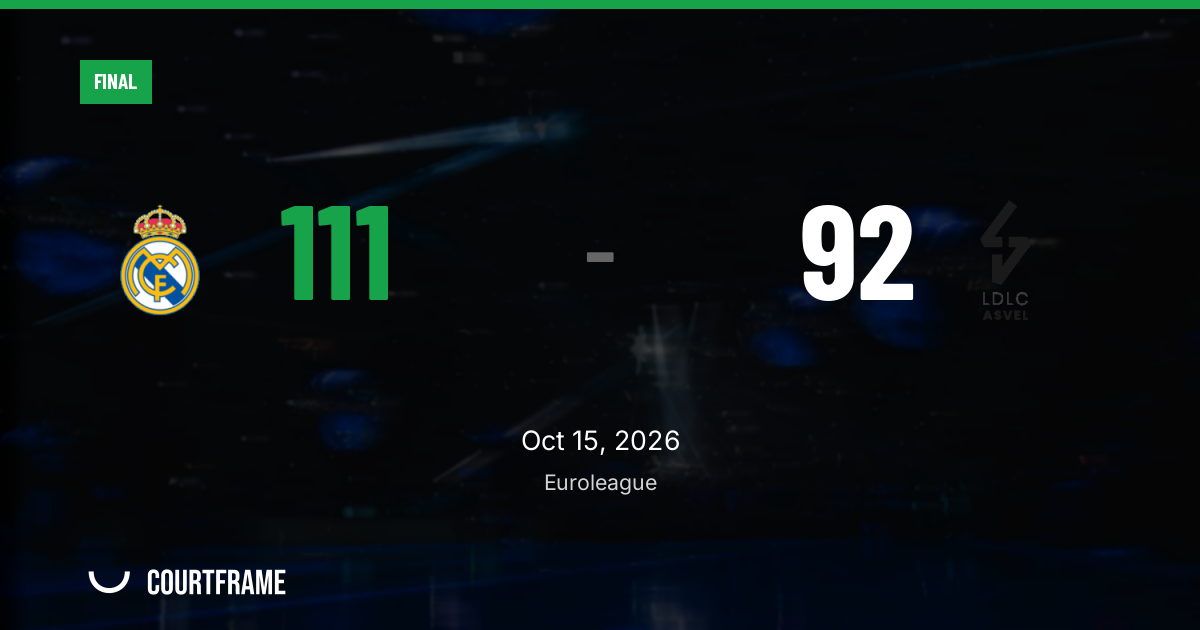
Real Madrid beat Lyon-Villeurbanne 111-92 on October 15, 2026, at Movistar Arena in Round 6 of the regular season, moving to 3-3 while Lyon-Villeurbanne fell to 2-4.
The result matched the pre-game indicators. Real Madrid entered with the stronger CourtFrame Power Index profile at 42.95, ranked 10th, compared with Lyon-Villeurbanne’s 22.78, ranked 15th. Madrid also carried a 20.2 CPI differential and had been perfect at home, where it was 2-0 and averaging 98.5 points. It exceeded that home scoring mark by a wide margin.
Madrid’s 3-point volume shaped the game
Real Madrid’s offense reached 111 points by leaning heavily into perimeter volume. Madrid shot 42-for-79 from the field and 19-for-45 from 3-point range, turning 45 attempts from deep into the defining shot profile of the game. Lyon-Villeurbanne made 10 of its 25 3-point attempts, but the nine-make gap from beyond the arc created a major scoring separation.
That approach fit Madrid’s season profile. Through six games, Real Madrid had a 42.9 percent 3-point rate, a 56.1 effective field goal percentage and a 104.2 offensive rating. Against Lyon-Villeurbanne, the shot diet was even more perimeter-heavy, and the execution gave Madrid enough cushion to withstand Lyon-Villeurbanne’s own efficient stretches.
The decisive surge came before halftime. Real Madrid led 27-25 after the first quarter, then won the second quarter 34-23 to take control. Lyon-Villeurbanne stayed productive offensively, scoring 23 points in the third quarter and 21 in the fourth, but Madrid closed with another 34-point quarter to remove any pressure from the final minutes.
Rebounding and possession control tilted toward Real Madrid
The 36-22 rebounding margin was as important as the shooting gap. Real Madrid entered with a 53.6 rebound percentage and an average of 33.2 rebounds, while Lyon-Villeurbanne entered at 43.7 percent on the glass and 26.7 rebounds per game. That contrast carried into the matchup, where Madrid’s 14-rebound advantage limited Lyon-Villeurbanne’s ability to match the home team’s shot volume.
Madrid attempted 79 field goals to Lyon-Villeurbanne’s 63. That 16-shot gap came alongside Madrid’s rebounding edge and Lyon-Villeurbanne’s 16 turnovers. Real Madrid committed 13 turnovers, but its extra possessions and perimeter accuracy gave it a cleaner offensive runway.
Edy Tavares’ season profile — 9.5 points and 7.2 rebounds per game entering the night — framed one of Madrid’s key structural advantages. Even without a major injury gap on either side, Madrid had the more reliable interior rebounding base, and that showed in the team totals.
Lyon-Villeurbanne moved the ball but could not defend enough possessions
Lyon-Villeurbanne finished with 28 assists on 32 made field goals, a strong continuation of a team identity built on passing. It entered with a 72.4 assist rate and 21.8 assists per game, and its ball movement was not the problem at Movistar Arena.
The issue was the other end. Lyon-Villeurbanne came in with a 105.3 defensive rating and a minus-4.7 net rating, and Madrid punished that defensive profile with 111 points. Lyon-Villeurbanne also entered with a 16.8 turnover rate and 14.7 turnovers per game; its 16 turnovers against Madrid gave the home side too many chances to extend runs.
Patty Mills entered as Lyon-Villeurbanne’s leading scorer at 15.6 points per game, with Hugo Besson at 12.3 and Jae Crowder at 10.6. The visitors had enough perimeter creation to score 92 points, but they did not have enough defensive resistance or rebounding support to keep Madrid out of its preferred offensive rhythm.
Madrid’s guard depth matched the matchup
Real Madrid’s season scoring balance was evident in the context of this result. Theo Maledon entered averaging 15.2 points and 5.8 assists, Andres Feliz 11.8 points and 4.0 assists, and Facundo Campazzo 8.8 points and 4.3 assists. Madrid’s 29 assists against Lyon-Villeurbanne reflected that multi-guard creation structure.
Madrid’s assist total also exceeded its season average of 20.2, and the 29 assists paired with 42 made field goals showed how often the home team generated connected looks rather than relying only on isolation shot-making. Lyon-Villeurbanne matched the passing volume with 28 assists, but Madrid’s shot quality and shot volume separated the teams.
What the result means
Both teams had two days of rest and one game in the previous seven days, and neither side entered with significant injuries reported. That made the outcome less about availability and more about the matchup fundamentals: Madrid’s rebounding, perimeter volume and stronger efficiency profile against a Lyon-Villeurbanne team that could pass and score but struggled to finish defensive possessions.
Real Madrid’s 111 points pushed it above its season average of 92.3 points, while Lyon-Villeurbanne’s 92 points also cleared its 87.8-point average. The difference was that Madrid paired scoring with control of the glass and a lower turnover total. In a game with two capable offenses, those margins turned a competitive first quarter into a 19-point home win.