
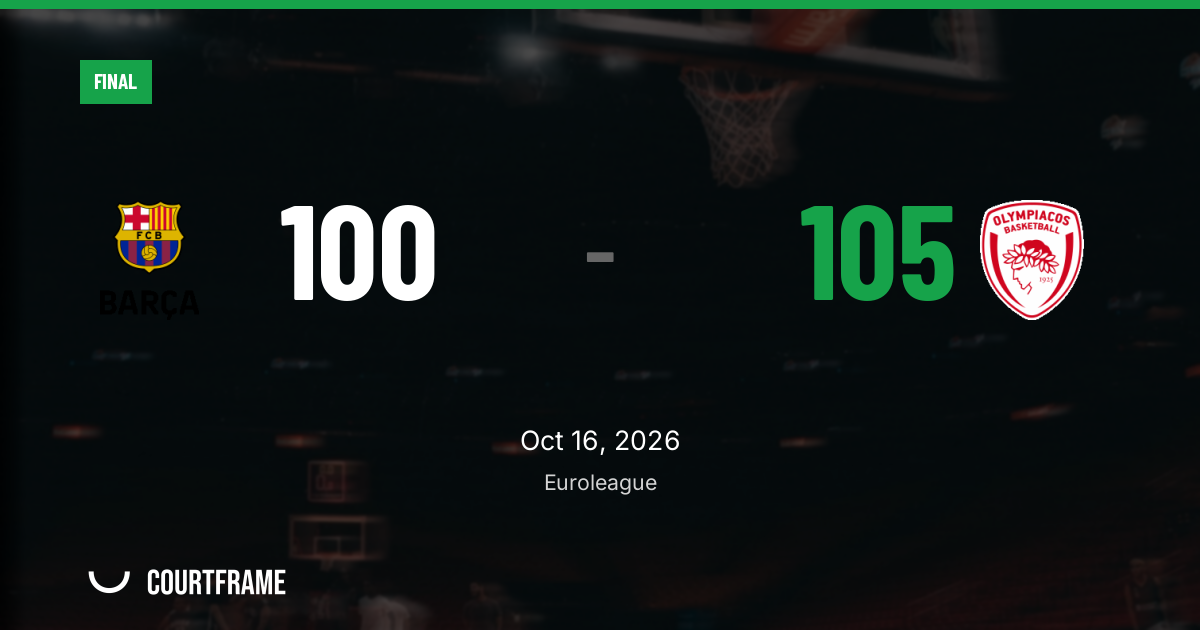
Olympiacos left Palau Blaugrana with a 105-100 overtime win over Barcelona on October 16, 2026, in Round 6 of the regular season, a result that tightened the contrast between the Euroleague’s top-ranked CourtFrame Power Index team and a Barcelona side still searching for defensive stability.
Olympiacos improved to 5-1, while Barcelona dropped to 3-3. The game reached overtime after Barcelona closed regulation with a 26-15 fourth quarter, but Olympiacos answered with a 13-8 overtime period to finish the road win.
The final score aligned with the pre-game indicators. Olympiacos entered with a 100.00 CourtFrame Power Index, ranked No. 1, with a positive trend of 28.3. Barcelona entered at 39.98, ranked No. 12, with a negative trend of 9.5. Market pricing also leaned toward Olympiacos, with an implied probability of 62.8 percent compared with Barcelona’s 37.2 percent.
Olympiacos’ efficiency outweighed Barcelona’s volume
Barcelona generated more total field-goal attempts and made 16 3-pointers, but Olympiacos created the cleaner scoring profile. Barcelona shot 37-for-83 from the field and 16-for-39 from three. Olympiacos shot 22-for-37 from the field, 12-for-28 from three and 18-for-23 at the free-throw line.
The free-throw gap was one of the clearest separators. Olympiacos made 18 free throws, while Barcelona made five. Barcelona attempted only 10 free throws despite scoring 100 points, and that limited the value of its perimeter-heavy attack once the game moved into overtime.
That pattern reflected the broader pre-game profile. Olympiacos entered averaging 98.2 points with a 67.1 true shooting percentage, an 85.3 free-throw percentage and a 35.9 free-throw rate. Barcelona entered with strong shooting indicators of its own, including a 65.1 true shooting percentage and 39.1 percent from three, but its defensive rating of 120.5 remained a concern against an Olympiacos offense that came in with a 112.9 offensive rating.
Barcelona controlled the glass but lost the possession battle in key areas
Barcelona finished with a 41-33 rebounding advantage and also produced 26 assists, six more than Olympiacos. The home team’s ball movement was strong enough to create a high-volume shooting night, and its 12 turnovers were below Olympiacos’ 15.
Olympiacos still found enough defensive disruption to offset those margins. The visitors recorded nine steals and four blocks, compared with Barcelona’s six steals and one block. Those defensive events mattered in a game decided by five points, especially with Barcelona attempting 83 field goals and forcing Olympiacos to survive extended stretches without the same shot volume.
Olympiacos entered the game with superior season-long indicators in assist rate, rebound percentage and defensive rating. Its 64.8 assist rate and 52.5 rebound percentage pointed to a team built on collective creation and possession control, while its 97.3 defensive rating gave it a significant edge over Barcelona’s defensive profile. Barcelona won the rebounding count in this matchup, but Olympiacos’ defensive playmaking and foul pressure became the more valuable counters.
The middle quarters shaped the game before Barcelona’s late push
Barcelona opened with a 30-26 first quarter, but Olympiacos took control before halftime with a 31-17 second quarter. That 14-point swing turned the game from a Barcelona-led start into an Olympiacos advantage built on offensive rhythm and pressure.
The third quarter remained low-scoring by the standards of the night, with Olympiacos edging it 20-19. Barcelona then produced its best response in the fourth, outscoring Olympiacos 26-15 to force overtime. The home side’s late push showed the value of its shooting depth and passing, but Olympiacos regained control in the extra period with a 13-8 finish.
The scoring arc also fit both teams’ season identities. Barcelona entered averaging 89 points overall and 90 points at home, while Olympiacos entered averaging 94 points overall and 100 points away. The 105-100 final landed in the high-scoring range suggested by both offenses, with Olympiacos again clearing the century mark away from home.
No injury excuses, only execution margins
Neither team reported significant injuries, so the game turned on execution rather than availability. Barcelona had Kevin Punter, Justin Robinson, Umoja Gibson, Dario Brizuela and Aleksander Balcerowski among its established scoring options entering the night. Olympiacos had Aleksandar Vezenkov, Jean Montero, Tyler Dorsey, Mbaye Ndiaye and Evan Fournier in a balanced attack that had already supported a 5-1 start.
Barcelona also had the rest advantage with three days off and two games in the last seven days, while Olympiacos played on two days’ rest with one game in the last seven days. The overtime result made that context notable: Barcelona had the schedule edge, but Olympiacos had the cleaner late-game execution.
What the result means
Olympiacos reinforced its position at the top of the early Euroleague table and validated the profile that made it the No. 1 team in the CourtFrame Power Index entering the matchup. The visitors did not dominate every category, but they won the highest-leverage ones: free throws, defensive events and overtime scoring.
Barcelona’s 100 points, 16 made threes, 26 assists and 41 rebounds were enough to show offensive quality, but not enough to overcome the defensive issues that had been visible before tipoff. At 3-3, Barcelona has the scoring base to compete with elite teams, but this loss again showed how narrow the margin becomes when opponents get to the line and finish possessions with greater efficiency.