
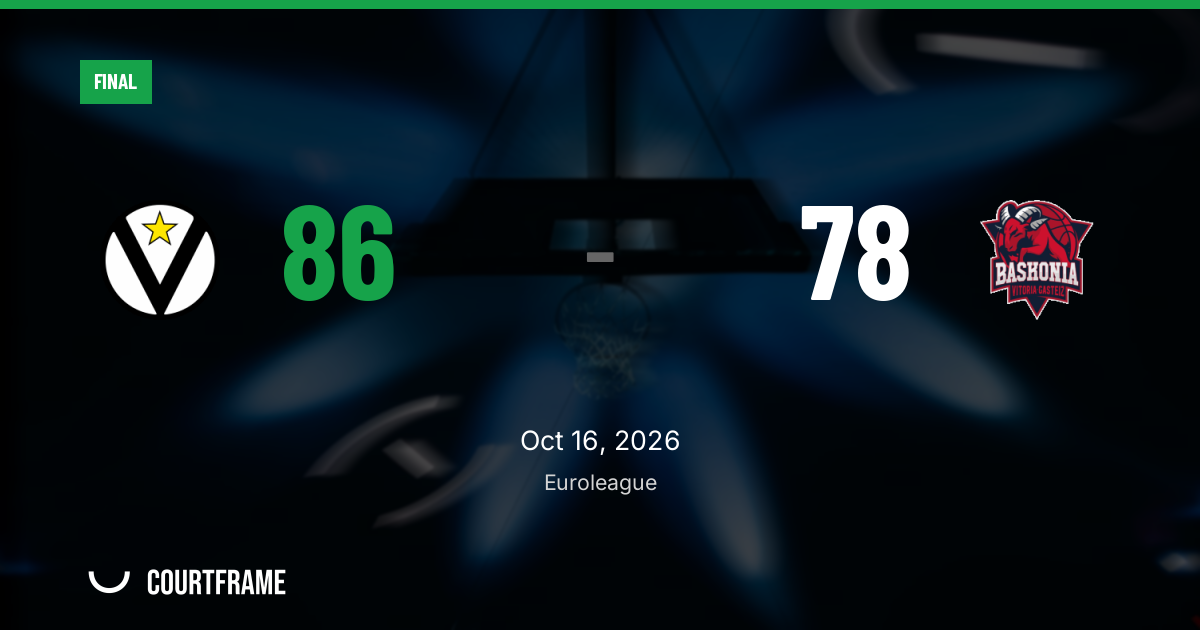
Virtus Bologna defeated Baskonia 86-78 on October 16, 2026, at Segafredo Arena in Round 6 of the regular season, improving to 4-2 while Baskonia dropped to 1-5.
The game was shaped immediately by Virtus' opening quarter. The home side led 24-12 after 10 minutes, then matched Baskonia 22-22 in the second quarter and 22-19 in the third. Baskonia won the fourth quarter 25-18, but the early deficit left too much work against a Virtus team that entered the night with stronger indicators on both ends.
Virtus wins with shot quality and free throws
Virtus did not produce a clean ball-security game, committing 18 turnovers, but its shooting profile carried the result. Bologna made 30 of 59 field goals and 20 of 28 free throws, giving it a more efficient scoring base than Baskonia, which finished 24 of 69 from the field and 18 of 26 at the line.
The contrast was clearest inside the arc. Virtus attempted only 17 three-pointers and made six, while Baskonia took 32 threes and made nine. Baskonia's volume from deep kept the game within reach, but its overall field-goal accuracy never matched Virtus' ability to convert two-point opportunities and get to the foul line.
The rebounding battle finished even at 35-35, which mattered because Baskonia entered with a lower rebound percentage than Virtus. Without a possession advantage on the glass, Baskonia needed cleaner offense than it produced. Its 19 turnovers erased much of the value from its nine steals and four blocks.
The first quarter matched the pre-game gap
Virtus entered at 4-2 with an 87.5 points-per-game average, a 56.9 true shooting percentage, a 52.5 effective field goal percentage and a positive 3.7 net rating. Baskonia came in at 1-5, scoring 84.2 points per game but carrying a 112.9 defensive rating and a minus-19.4 net rating.
Those profiles showed up in the opening stretch. Virtus established a 12-point lead in the first quarter, and Baskonia spent the rest of the night chasing a game state that favored the home team. Bologna's defensive base was also consistent with its season profile, as it held Baskonia to 78 points after entering with a 93.3 defensive rating.
Baskonia's offensive structure still generated assists, finishing with 17 compared with Virtus' 14, but it did not translate into efficient enough finishing. That aligned with its early-season shooting issues: Baskonia entered at 41.9 percent from the field and 27.3 percent from three, then shot 24 of 69 overall and 9 of 32 from long range.
Backcourt control without a clean turnover game
Marcus Carr entered as Virtus' leading scorer and primary creator at 14.7 points and 5.8 assists per game. Virtus did not need a high-assist team performance to win this matchup, finishing with 14 assists, because its shot-making and free-throw volume were enough to withstand turnover pressure.
Wendell Moore, Derrick Alston Jr. and A. Diarra gave Virtus a balanced pre-game scoring profile, with each averaging double figures through six games. That balance mattered in a game where Baskonia forced 18 turnovers and created nine steals, but could not turn disruption into a road win.
For Baskonia, A.J. Lawson entered averaging 14 points per game, with Chris Duarte, Tadas Sedekerskis, D.J. Stewart and K. Faried forming the next scoring tier. The visitors had no significant injuries reported, but their offensive output remained below both their season scoring average and Virtus' season scoring average allowed by profile.
Home-court trend continues for Virtus
Virtus remained unbeaten at home, moving to 2-0 at Segafredo Arena after entering with a 91-point home scoring average. Baskonia stayed winless away from home at 0-2, despite scoring close to its 83-point road average.
The result also tracked with the broader pre-game indicators. Virtus carried a 72.89 CourtFrame Power Index, ranked seventh, while Baskonia was ranked 20th with a 0.00 mark. The market implied probability also favored the home side at 66.4 percent.
The scheduling context made the win more notable for Virtus. Bologna played on one day of rest in a back-to-back setting, while Baskonia had three days of rest and had played two games in the previous seven days. Even with that rest disadvantage, Virtus created the game's decisive separation in the first quarter and protected it through a less efficient fourth.
For Virtus, the 86-78 result reinforced the same early-season formula: efficient scoring, enough defensive resistance and strong home performance. For Baskonia, the loss extended a start defined by defensive slippage, turnover volume and inefficient shooting, all of which were present again in Bologna.