

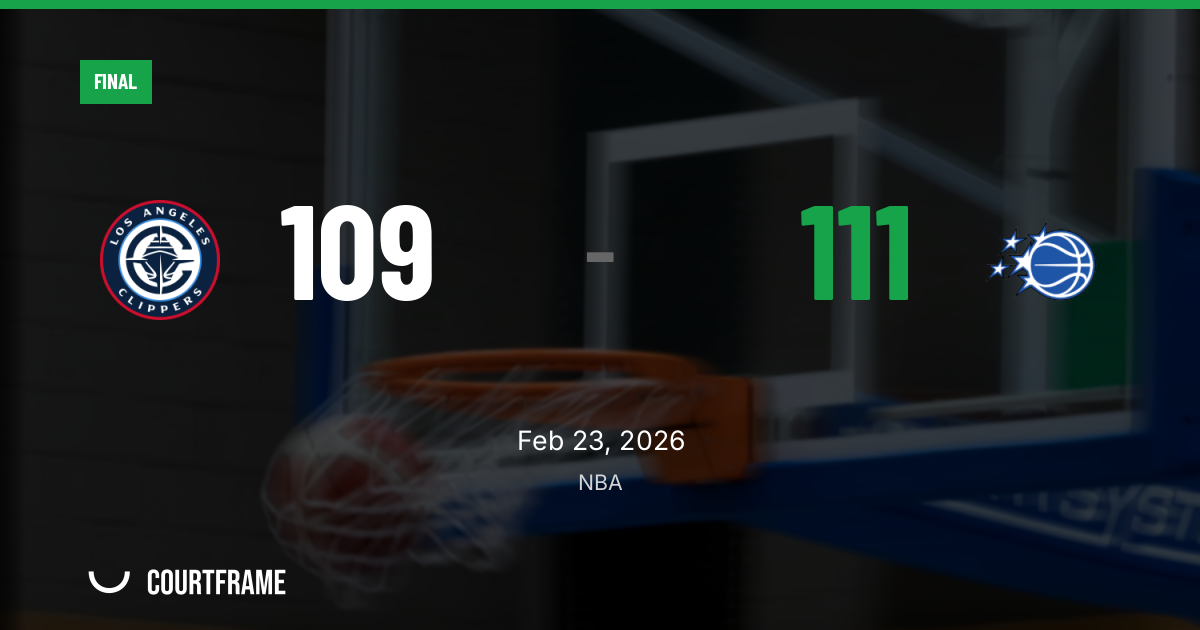
Orlando walked into Intuit Dome and left with a statement road win — not with a knockout punch, but with control. The Magic held off the Los Angeles Clippers 111-109 on Feb. 23, 2026, surviving the Clippers’ third-quarter burst and a fourth-quarter grind that turned into a two-point finish.
The game swung on margins: Orlando’s steadier quarter-to-quarter execution, and a ball-movement edge that showed up in the final box score. The Magic finished with 25 assists, outpacing the Clippers’ 18 in a game where every empty possession mattered.
How it happened
Orlando set the tone early, taking the first quarter 29-25 and matching Los Angeles’ second-quarter response with a 28-28 split. At halftime, the Magic had done what good road teams do: keep the pace under control, avoid a momentum avalanche, and put pressure on the home side to win the possession battle.
The Clippers made their move coming out of the break. Los Angeles ripped off a 36-point third quarter — the highest-scoring frame by either team — while Orlando still produced 31. That five-point swing flipped the game and briefly put the Clippers in the driver’s seat.
Then the finishing quarter belonged to Orlando. The Magic held the Clippers to 20 points in the fourth while scoring 23 themselves, reversing the third-quarter momentum and edging back in front just in time. When the game tightened late, Orlando’s ability to generate assisted looks helped them survive the final possessions.
Turning point: Orlando wins the fourth-quarter math
The Clippers’ third-quarter surge looked like the separator — until the fourth quarter turned into a half-court test. Orlando’s 23-20 edge in the final period was enough to erase the damage from the third and steal the game back. In a two-point finish, that three-point fourth-quarter margin was the difference between a home win and a missed opportunity.
Team notes: Assist gap tells the story
Orlando’s 25 assists to the Clippers’ 18 was one of the clearest signals of how the game played. The Magic created more offense through connection, while Los Angeles had to rely more heavily on individual shot-making. In a matchup this tight, the team that can consistently manufacture quality looks — especially late — usually gets to the finish line.
What it means going forward
For Orlando (now 31-26), this was the kind of road win that travels: win the early minutes, absorb the opponent’s best punch, and close with defensive resistance and organized offense. The Magic’s alternating form entering the night (WLWLW) got another positive result.
For the Clippers (now 27-31), the loss stings because the pathway was there. A 36-point third quarter should be enough to tilt a close game, but the fourth-quarter slowdown — just 20 points — reopened the door. With Los Angeles coming in at 27-30 and in uneven form (LLWWL), this was another reminder that late-game execution has to match the energy of their best stretches.