

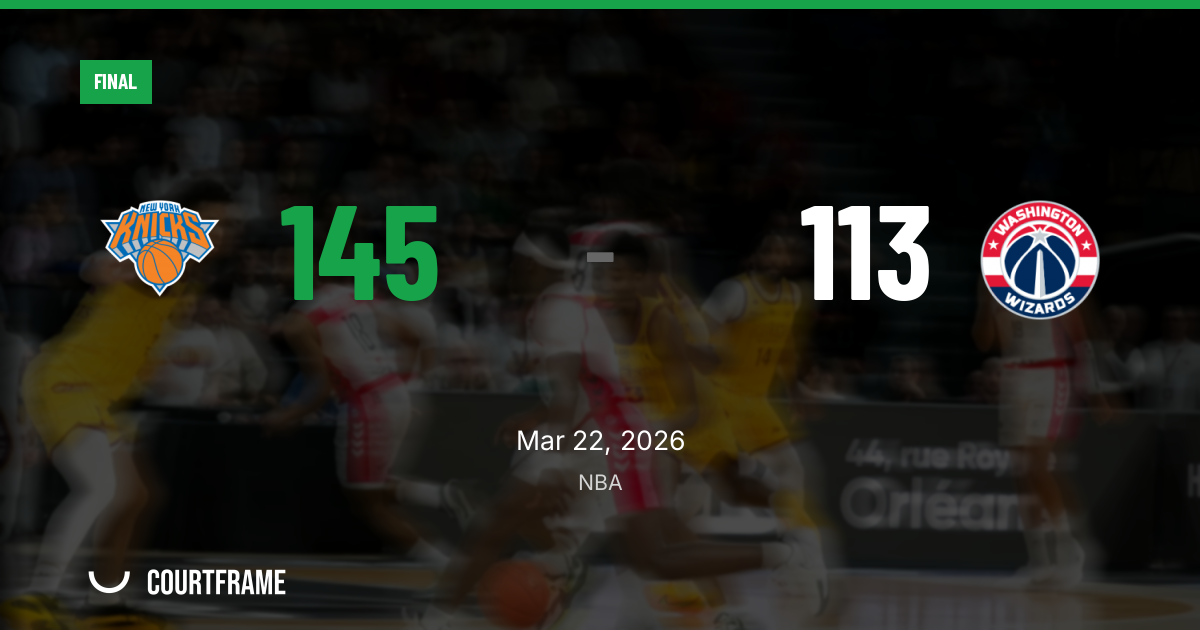
Madison Square Garden looked like a mismatch on paper, then played like one on the floor. The New York Knicks, entering at 47-25 and riding a five-game heater, overwhelmed the Washington Wizards 145-113 on March 22, 2026, turning four quarters into a steady climb that never flattened.
Game flow: New York’s lead kept expanding
The Knicks set the tone immediately, taking the first quarter 32-27, then separating with a 36-25 second quarter to carry a 68-52 advantage into halftime. Any thought of a Wizards response got met with more pace and more scoring: New York won the third 37-29 and closed with a 40-32 fourth, finishing with 145 points without needing overtime.
Ball movement: Knicks win the creation battle
New York’s offense didn’t just score—it connected. The Knicks logged 32 assists, outpacing Washington’s 25, a gap that mirrored the difference in shot quality and rhythm across the night. With the ball popping side-to-side, New York repeatedly forced Washington into rotations and kept the Wizards chasing possessions rather than controlling them.
Turning point: the second-quarter squeeze
The game’s decisive stretch came before the break. New York’s +11 second quarter (36-25) transformed a manageable early margin into a firm halftime cushion, and the Knicks never allowed Washington to shrink the window. From there, the math became brutal: every Wizards push was met with an immediate Knicks counterpunch.
What it means going forward
For New York, the result is as much about process as it is about points. At 47-25 with a now six-game winning streak, the Knicks continue to pair high-end scoring with high-level connectivity—an identity that travels and scales in postseason environments.
For Washington, the losses keep stacking. The Wizards fell to 16-55 and extended a five-game losing streak, and the inability to slow New York’s incremental quarter-by-quarter climb underscored how thin the margin is when the offense can’t consistently dictate terms.