
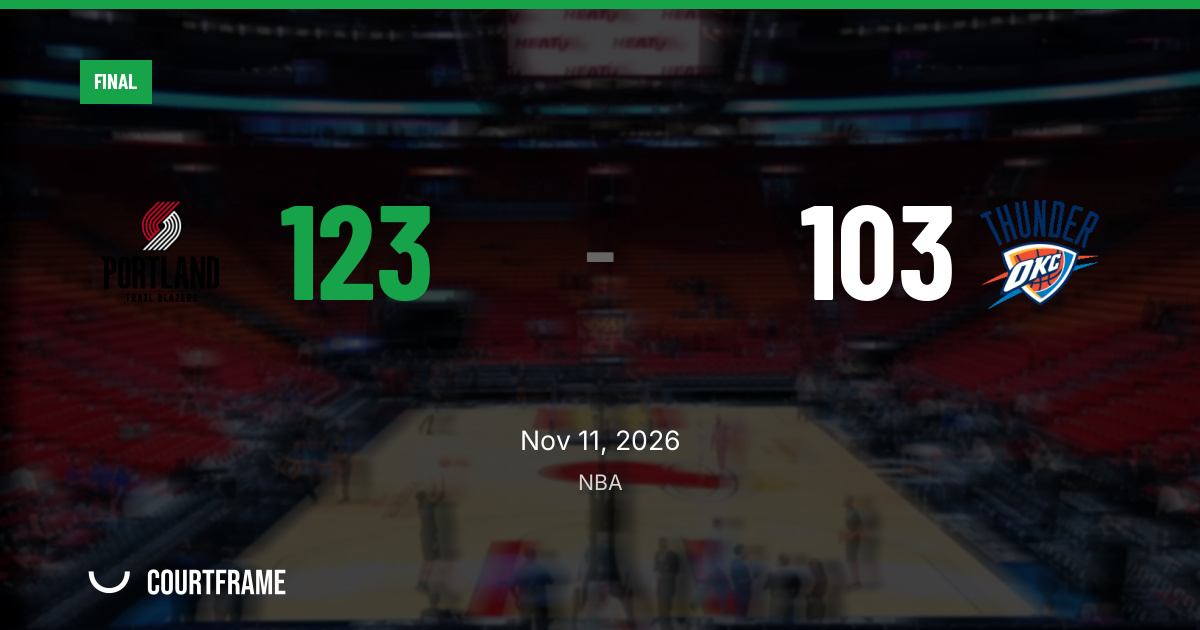
The Portland Trail Blazers beat the Oklahoma City Thunder 123-103 on November 11, 2026, at Moda Center, using a 38-point third quarter to flip a tight game into a controlled home win in the regular season.
Oklahoma City led 27-26 after the first quarter and the teams played an even 33-32 second quarter, sending the Thunder into halftime ahead 59-59 by quarter flow but tied on the scoreboard at 59-59. Portland created the separation after halftime, outscoring Oklahoma City 38-21 in the third quarter before closing the fourth 26-23.
The result moved Portland to 6-3 and dropped Oklahoma City to 8-2. It also ran counter to the pregame indicators: Oklahoma City entered with the stronger CourtFrame Power Index profile at 89.70, ranked sixth, while Portland entered at 71.89, ranked 14th. The Thunder also carried a 53.7 percent implied probability before tipoff.
Portland’s perimeter volume decided the game
Portland’s shot profile gave the Thunder a math problem they did not solve. The Trail Blazers made 19 3-pointers on 50 attempts, pairing extreme perimeter volume with enough free-throw accuracy to keep the scoreboard moving. Portland also went 24-for-26 at the line.
The Trail Blazers entered the night with a 50.7 three-point rate, and that identity showed up clearly. Oklahoma City made 8 3-pointers on 22 attempts, which left the Thunder chasing a large possession-value gap even while staying competitive on the glass.
Portland finished with 26 assists against only 9 turnovers. That ratio mattered against an Oklahoma City team that came in with a 97.0 defensive rating and a 13.2 net rating through 10 games. The Thunder’s defense had been the more reliable unit entering the matchup, but Portland’s ball security and spacing kept Oklahoma City from turning the game into a transition-heavy defensive performance.
The third quarter changed the terms
The decisive stretch came immediately after halftime. Portland’s 38-point third quarter was the highest-scoring period of the game and turned a 59-59 halftime score into a 97-80 lead entering the fourth.
That 17-point swing was especially significant because both teams entered with identical rest profiles: three days rest and three games in the last seven days. Fatigue did not create an obvious scheduling edge. Portland simply executed better in the first quarter after halftime, and Oklahoma City could not match the scoring pace.
The Thunder scored 21 points in the third quarter and 23 in the fourth. Portland did not need another surge after the third because the Trail Blazers had already built enough margin to manage the final period.
Injuries shaped both rotations
Portland played without Vit Krejci, Ja Morant and Shaedon Sharpe. Morant’s absence removed a guard who had averaged 15.8 points and 5.5 assists in four games, while Sharpe remained out after right meniscus surgery.
The Trail Blazers still had established production from Deni Avdija, Damian Lillard, Toumani Camara and Jrue Holiday entering the game. Avdija came in averaging 22.5 points, 6.5 assists and 6.3 rebounds, while Lillard entered at 20.0 points and 4.3 assists. Portland’s 26 assists reflected a collective creation structure rather than a single-player burden.
Oklahoma City’s injury list was longer and hit multiple frontcourt and wing spots. Chet Holmgren, Thomas Sorber, Cason Wallace, Jalen Williams and Jaylin Williams were all out. Holmgren had averaged 11.3 points and 9.0 rebounds in three games, while Jalen Williams had averaged 13.7 points, 4.7 rebounds and 3.3 assists in three games.
Those absences mattered against a Portland team that forced the Thunder to defend in space and cover repeated 3-point attempts. Oklahoma City still finished with 45 rebounds to Portland’s 44, but the Thunder did not generate enough perimeter scoring or playmaking to offset Portland’s shooting volume.
Thunder could not match their usual efficiency profile
Oklahoma City entered with a 110.2 offensive rating, 63.1 true shooting percentage and 12.7 turnover rate through 10 games. Against Portland, the Thunder scored 103 points, recorded 20 assists and committed 12 turnovers.
Shai Gilgeous-Alexander entered as Oklahoma City’s primary offensive driver at 29.5 points, 4.7 assists and 4.3 rebounds per game. A. Mitchell had also supplied 18.2 points per game. But the Thunder’s team output never reached the level needed once Portland hit 19 shots from beyond the arc.
Portland entered with a 104.9 offensive rating and 104.9 defensive rating through 10 games, a profile that suggested balance rather than dominance. This game looked different because the Trail Blazers combined clean offense with a defensive second half that held Oklahoma City to 44 points after halftime.
What the result means
Portland’s win stood out because it came against an 8-2 opponent with the higher CourtFrame Power Index ranking and a stronger early-season net rating. The Trail Blazers also improved a home profile that had been split at 2-2 entering the night.
Oklahoma City’s loss did not erase its strong start, but it exposed how much the current rotation depends on shot creation from a narrower group while several rotation players remain out. The Thunder entered with a better defensive rating, lower turnover rate and higher true shooting percentage than Portland, yet the Trail Blazers controlled the game’s most important stretch through spacing, ball security and a decisive third quarter.
For Portland, the 123-103 win was its clearest example of how its high-volume 3-point approach can overwhelm an opponent when paired with low turnovers and strong free-throw shooting. The Trail Blazers did not win the rebounding battle, but they won the possession-quality battle decisively enough to turn a halftime tie into a 20-point final margin.