

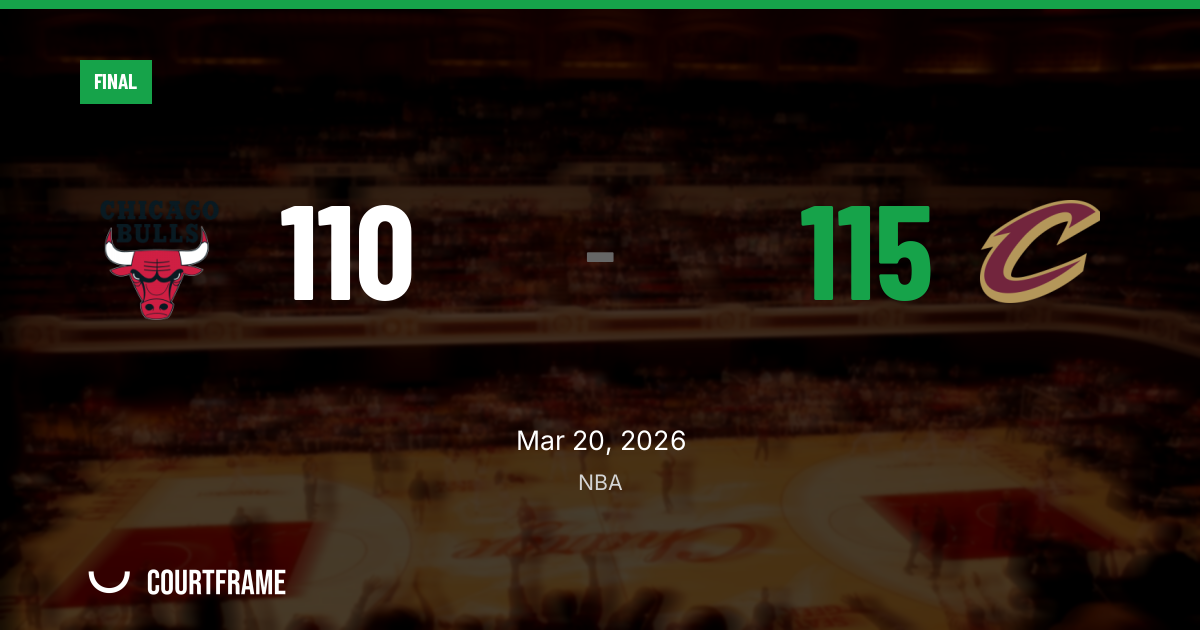
Cleveland did the damage early, Chicago made it interesting late — and the Cavaliers still walked out of the United Center with a 115-110 win Thursday night.
Behind a 32-point first quarter and another 32 in the third, Cleveland (43-27) built a lead that withstood Chicago’s best punch: a 37-point fourth quarter that turned a comfortable Cavaliers night into a closing-time grind. The Bulls (28-42) ultimately couldn’t erase the deficit created over the first 36 minutes.
Game flow: Cleveland’s cushion vs. Chicago’s final push
The script was clear by halftime. Cleveland opened with a 32-22 edge in the first and followed with a 29-23 second quarter to take a 61-45 lead into the break. The Cavaliers kept their foot on the gas after halftime, winning the third 32-28 to push the margin to 93-73.
Then Chicago flipped the game’s energy. The Bulls poured in 37 points in the fourth — their best quarter of the night — while holding Cleveland to 22. The rally tightened the finish, but the early hole was too deep, and Cleveland’s lead held to the final horn.
Turning point: the third-quarter reassertion
Chicago’s offense found more rhythm after halftime, but Cleveland’s third quarter was the separator. The Cavaliers matched the Bulls’ increased scoring with another 32-point period, preventing the game from tilting and keeping Chicago in a multi-possession chase entering the fourth.
Ball movement: slight edge, big impact
Neither team played in isolation. Cleveland finished with 26 assists, Chicago with 27 — a near-even playmaking profile that reflected two offenses capable of generating quality looks.
The difference was timing. Cleveland’s creation came in the first three quarters, when it stacked points and controlled the scoreboard. Chicago’s best stretch arrived late, but the Bulls were forced to play from behind, shrinking their margin for error on every empty trip.
What it means going forward
For Cleveland, this was a road win that reinforced its ability to bank results even when the closing minutes get uncomfortable. The Cavaliers didn’t match Chicago’s fourth-quarter pace, but the earlier execution — particularly the first-half separation and the third-quarter answer — carried them through.
For Chicago, the fourth quarter was proof the Bulls can generate high-end offense when the pressure rises. The problem was the first three quarters: spotting a 20-point deficit after three required a near-perfect finish. At 28-42, Chicago’s path forward starts with bringing that fourth-quarter urgency to the opening tip.