

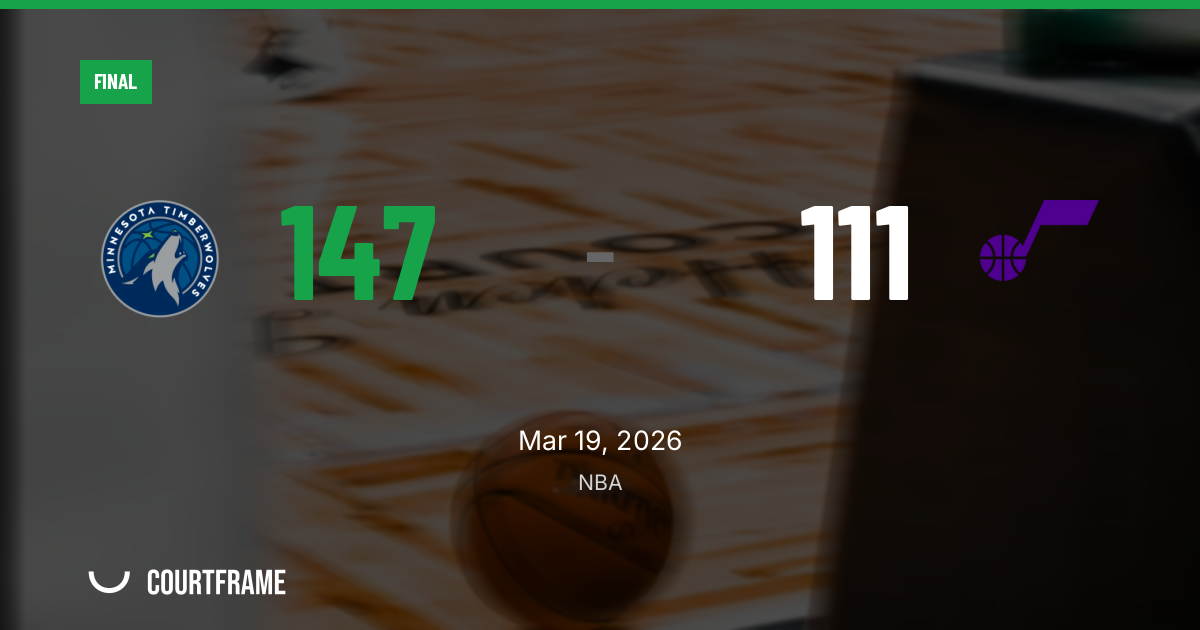
MINNEAPOLIS — The Timberwolves didn’t let this one breathe. Minnesota dropped 43 points in the first quarter, never looked back, and ran the Utah Jazz out of Target Center, 147-111, on Thursday night.
It was a blowout built on tempo and connectivity: Minnesota finished with 39 assists, a number that tells the story more cleanly than any single scoring run. Utah had 26 assists, but the Jazz spent most of the night playing catch-up after Minnesota’s opening punch.
Game flow: Minnesota’s early avalanche decided it
The separation came immediately. Minnesota’s 43-31 first quarter set the tone, and the Timberwolves kept stacking efficient periods from there: 29 in the second, 38 in the third, 37 in the fourth. Utah never won a quarter, scoring 31, 27, 26 and 27.
By halftime, Minnesota had already created a comfortable cushion behind a 72-58 advantage. The third quarter turned it from a cushion into a cliff — Minnesota put up 38 to Utah’s 26 — and the fourth quarter became a formality.
The defining stat: 39 assists and a spread-floor attack
When Minnesota is generating 39 assists, it’s usually a sign the Jazz are defending multiple actions in a single possession and eventually losing the chain. The Timberwolves consistently turned advantage into advantage — extra passes, quick decisions, and clean looks created by forcing Utah into rotations.
Utah’s 26 assists reflect some offensive organization, but they couldn’t keep pace with Minnesota’s shot volume and scoring bursts. In a game that finished 147-111, the Timberwolves’ ability to create offense without grinding possessions was the difference.
Turning point: the first quarter blitz
Utah’s path to an upset required slowing the game and avoiding early damage. Instead, Minnesota hit 43 in the opening frame. That kind of start doesn’t just change the scoreboard — it changes lineup decisions, shot selection, and defensive risk tolerance for the trailing team.
From there, Minnesota played downhill for three more quarters, repeatedly punishing any breakdown with rapid ball movement and immediate conversion.
What it means going forward
Minnesota improved to 43-27 and looked every bit like a team sharpening habits late in the season: fast starts, sustained pressure, and a pass-first identity that can translate when possessions tighten. Utah fell to 20-49, and the margin underscored how thin the Jazz’s error margin is against a top-tier opponent — especially when they allow the game to be decided in the first 12 minutes.