

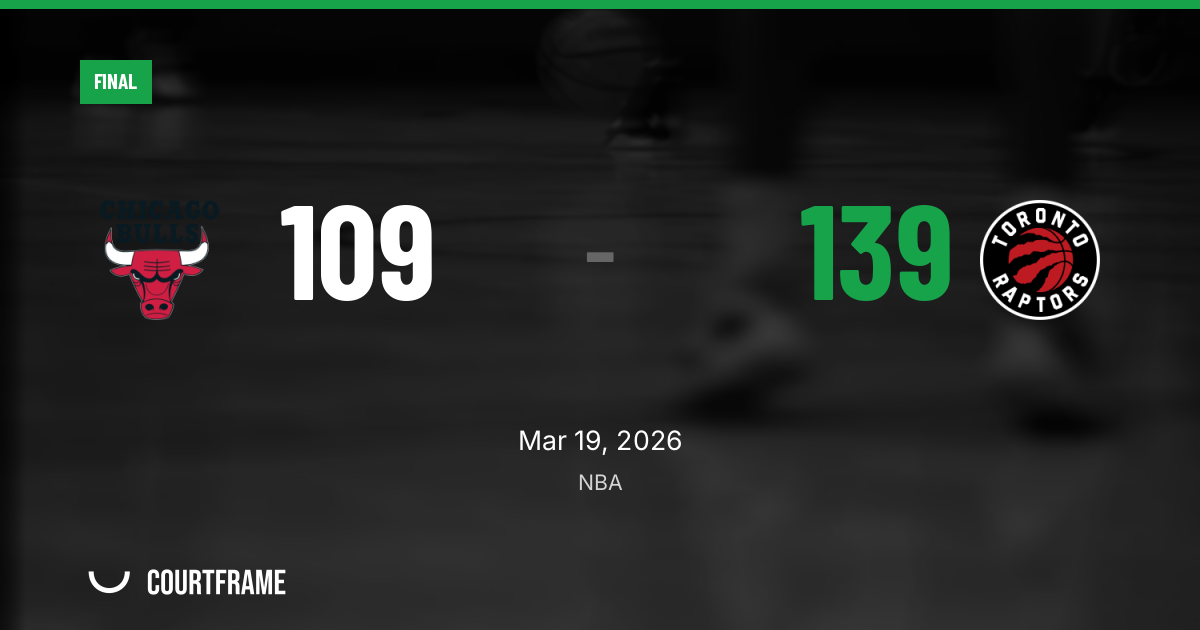
TORONTO — The Raptors didn’t just win at the United Center on March 19, 2026. They erased the margin for error in the first 24 minutes and turned the rest of the night into a formality.
Toronto (39-29) blitzed Chicago (28-41) with a 72-point first half and coasted to a 139-109 final, leading wire-to-wire in a game that was effectively decided by halftime. The Bulls came in on a LWLLW stretch; the Raptors arrived with a WWWLL run and played like a team intent on snapping back into shape.
Game flow: a first-half avalanche
The early math told the story. Toronto opened with a 32-17 first quarter, immediately putting Chicago into a hole that demanded perfect offense just to stabilize. Instead, the Raptors doubled down in the second, hanging 40 points to take a 72-45 lead into the break.
Any thought of a Bulls push was met with more pace and precision. Toronto posted 36 in the third to keep the gap wide, then closed with 31 in the fourth to finish at 139 — a four-quarter scoring profile that never dipped below 31 in any period.
Turning point: the second quarter
Chicago’s path back required winning the margins — stops, clean possessions, and a stretch of efficient half-court execution. The second quarter wiped that plan off the board. Toronto’s 40-point burst not only expanded the lead; it forced Chicago into a game state where every possession felt like a must-score, and the Raptors were comfortable trading points because they were generating them more easily.
Ball movement and control
The assist numbers underscore how Toronto created separation. The Raptors finished with 33 assists compared to the Bulls’ 24, a gap that reflected cleaner decision-making and more consistent shot creation within the flow. When Toronto was scoring at will across all four quarters, that kind of playmaking advantage functioned like a multiplier: more assisted offense, fewer empty possessions, and less volatility.
What it means going forward
For Toronto, this was the kind of comprehensive road performance that supports a 39-29 profile: fast start, sustained scoring, and a pass-first attack that never let the game tighten. For Chicago, now 28-41, the concern is the opening punch — a 15-point first-quarter deficit that turned the rest of the night into damage control rather than a competitive, possession-to-possession fight.
The Bulls did win the fourth quarter 33-31, but by then the structure of the game had already been set by Toronto’s first-half surge and its steady offensive pressure from start to finish.