

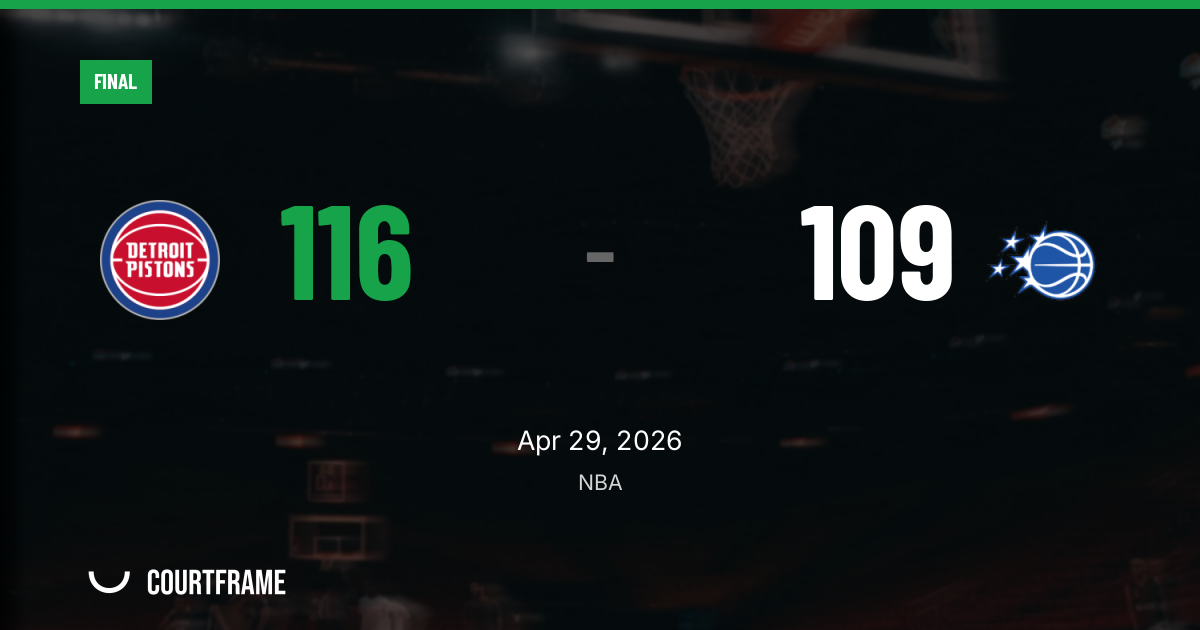
DETROIT — The Pistons were out of margin. They responded like a 60-win team.
Facing elimination in Game 6 of their first-round series, Detroit beat Orlando 116-109 on April 29 at Little Caesars Arena, turning a 3-2 series deficit into a winner-take-all Game 7. The result matched the broader pregame indicators: Detroit entered with the stronger season profile, a 76 percent market-implied win probability and a major CPI edge, then backed it up with the kind of physical, possession-based performance that plays in the postseason.
The Pistons set the tone immediately with a 38-point first quarter, building enough cushion to withstand Orlando’s 34-point second quarter and a late fourth-quarter push. Detroit won the third quarter 23-19, a critical stabilizing stretch after the Magic had trimmed into the early gap before halftime.
Detroit’s Edge on the Glass Changed the Game
The clearest separator was rebounding. Detroit finished with a 49-33 advantage on the boards, a margin that aligned with its pregame profile as the stronger rebounding team over the recent sample. The Pistons entered with a 53.9 rebound percentage across the last 10 games, ahead of Orlando’s 51.4, and that edge showed up in the moments that mattered.
That rebounding control helped Detroit absorb the type of mistakes that usually swing playoff games. The Pistons committed 17 turnovers, one more than the Magic, but their work on the glass and their pressure at the line gave them enough possession value to survive it.
Detroit also generated a major free-throw advantage, going 28-for-35 compared with Orlando’s 16-for-30. In a seven-point game, that gap was decisive. The Magic found volume from deep, but the Pistons’ ability to keep attacking and convert at the stripe gave their offense a more stable foundation.
Orlando’s Shooting Profile Wasn’t Enough
Orlando leaned hard into the perimeter game, making 17 3-pointers on 38 attempts. That was consistent with its recent identity: the Magic entered with a 61.9 three-point rate over the last 10 games, higher than Detroit’s 54.1. The shot profile created enough pressure to keep the game live, especially during the second quarter.
But the Magic could not pair that shooting with enough interior control or free-throw efficiency. Orlando went 16-for-30 at the line and lost the rebounding battle by 16. The Magic also finished with 16 turnovers, giving Detroit additional transition and pressure opportunities even on a night when the Pistons were not clean with the ball themselves.
The third quarter was Orlando’s biggest missed opportunity. After scoring 60 points in the first half, the Magic were held to 19 in the third. Detroit’s defense entered the matchup with a 106.5 defensive rating over the last 10 games, slightly better than Orlando’s 106.7, and that narrow pregame edge became meaningful in the game’s most important defensive stretch.
Pregame Indicators Pointed Toward Detroit — Barely
This was not a typical elimination setup. Detroit was the team facing elimination, but also the team with the stronger regular-season résumé: 60-22 overall compared with Orlando’s 45-37. The Pistons also carried a strong home split, entering 16-5 at home with an average of 119.9 points. Orlando’s road split sat at 11-12 with an average of 112.4 points.
The matchup data also leaned Detroit. The Pistons held a 76.71 CPI, ranked sixth, with a positive 2.3 trend. Orlando entered at 55.37, ranked 13th, with a negative 8.1 trend. The 21.3 CPI differential suggested a meaningful underlying gap even with the Magic leading the series.
That made Game 6 a collision between series leverage and season-long quality. Orlando had the 3-2 lead and a chance to close. Detroit had the stronger statistical base, home court and the better recent net rating over the provided 10-game sample. The Pistons’ 3.5 net rating compared with Orlando’s minus-0.1 pointed to a team better positioned to sustain two-way execution, and Game 6 largely followed that script.
Stars and Availability Framed the Night
Detroit’s core entered the game built around Cade Cunningham’s creation, Jalen Duren’s interior presence and Tobias Harris’ stability. Cunningham came in averaging 23.6 points and 9.8 assists, while Duren entered at 19.8 points and 10 rebounds. The broader outcome reflected the pressure those profiles place on a defense: Detroit lived at the line, controlled the glass and kept Orlando in rotation often enough to score 116.
For Orlando, Paolo Banchero and Desmond Bane remained the central offensive reference points, entering at 23.7 and 20.8 points per game, respectively. Franz Wagner’s status was a key pregame variable because of his right calf designation, while Jonathan Isaac was listed doubtful with a left knee issue. The Magic still produced enough perimeter offense to threaten, but their lack of control on the glass and at the foul line defined the loss more than any single scoring stretch.
Game 7 Now Decides It
The Pistons did not play a flawless elimination game. They turned it over 17 times and allowed Orlando to make 17 3s. But they won the possession battle where it mattered: rebounds, free throws and a third-quarter defensive stand that kept the Magic from taking control.
Detroit’s 116-109 win does more than extend the series. It resets the pressure. Orlando missed its first chance to close. Detroit, after playing with elimination pressure at home, now gets one more game to prove its regular-season profile can survive the volatility of the first round.