

New Orleans didn’t win pretty early — it won loud late.
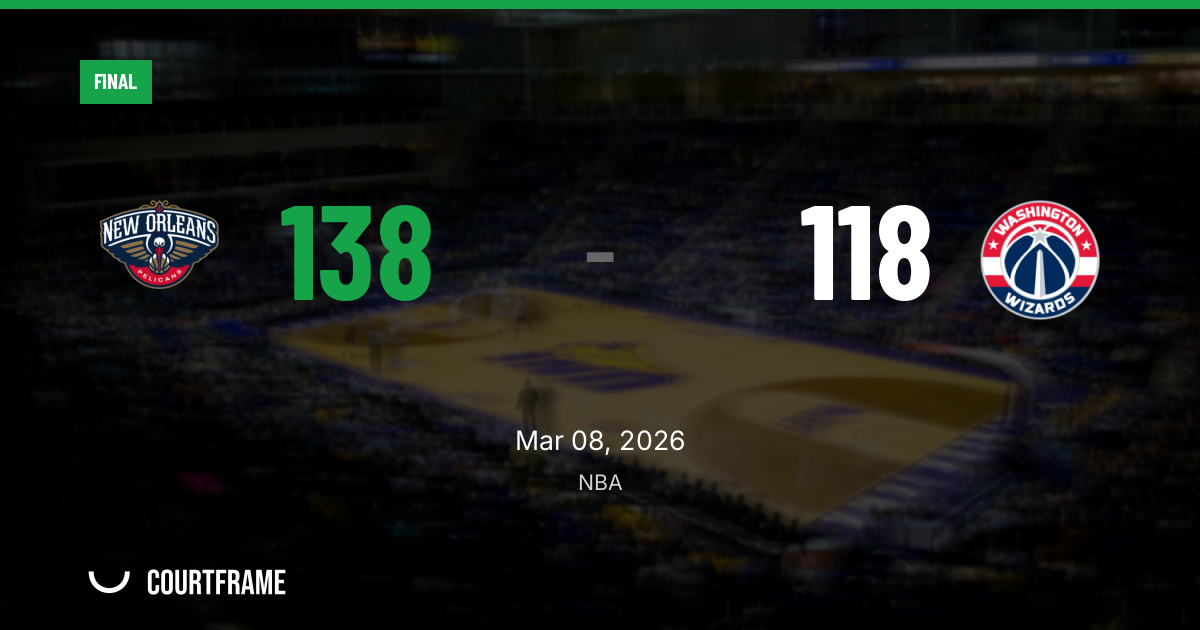
The Pelicans (21-45) outgunned the Washington Wizards (16-47) 138-118 on Sunday night at Smoothie King Center, flipping a first-quarter hole into a runaway by steadily cranking up the offensive pressure in each of the final three periods.
How it happened
Washington came out with pace and points, taking the opening quarter 35-32. That was the Wizards’ best punch — and the last time the game felt like it might stay within striking distance.
New Orleans answered immediately in the second, winning the quarter 35-30 to take a 67-65 halftime lead. From there, the Pelicans’ scoring profile only got more punishing: 35 points in the third and 36 in the fourth, turning a two-point edge at the break into a 20-point win.
Turning point: the post-halftime squeeze
The game pivoted in the third quarter. New Orleans matched its second-quarter output (35) while holding Washington to 28, creating the first real cushion and forcing the Wizards to chase offense for the rest of the night. By the time the fourth quarter arrived, the Pelicans had already established control — then widened it again with a 36-25 closing frame.
Ball movement, but New Orleans finished the job
Both teams generated offense through passing. Washington finished with 27 assists, while New Orleans posted 25. The difference was what happened after the ball moved: New Orleans kept stacking high-scoring quarters after halftime, while Washington’s output slid from 35 in the first to 25 in the fourth.
What it means going forward
For New Orleans, this was the cleanest kind of win in a difficult season: a steady climb from a slow start into a dominant finish, powered by consistent quarter-to-quarter scoring growth (32, 35, 35, 36). The Pelicans will look to bottle that second-half edge — the ability to raise their scoring level after the break — as they try to build momentum from a 21-45 record and a WLWLL stretch coming in.
For Washington, the loss extends a rough run (LLLLL entering the night). The Wizards showed early offensive spark, but couldn’t sustain it across four quarters, especially once New Orleans seized the lead late in the second and never gave it back.
Final
Pelicans 138, Wizards 118
Quarter-by-quarter
WAS: 35 | 30 | 28 | 25 — 118
NOP: 32 | 35 | 35 | 36 — 138