

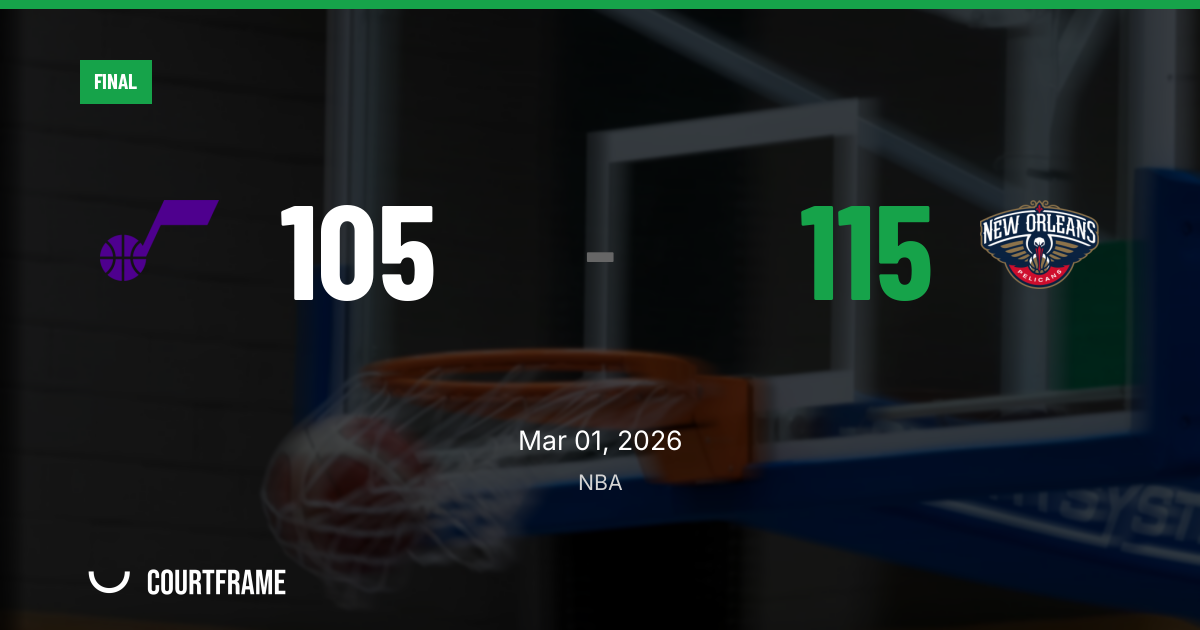
New Orleans didn’t wait around for a road win. The Pelicans detonated for 38 points in the second quarter and rode that burst to a 115-105 victory over the Utah Jazz on Sunday night at Delta Center, a result that pushed New Orleans to 19-42 and dropped Utah to 18-42.
The Jazz entered on a five-game skid (LLLLL) and, even with a much sharper second half, couldn’t fully erase the damage from a first-half collapse. New Orleans, coming in at WWWWL, controlled the game’s rhythm with clean, connected offense — finishing with 32 assists to Utah’s 24.
The game swung in the second quarter — and Utah never fully recovered
Utah’s start was manageable: New Orleans led 27-22 after one. Then the floor tilted. The Pelicans poured in 38 points in the second quarter while holding Utah to 18, turning a five-point edge into a 65-40 halftime lead.
That 25-point gap dictated everything that followed. Utah’s margin for error disappeared, and New Orleans could play from structure — valuing possessions, leaning into ball movement, and forcing Utah to score efficiently for long stretches just to make the math work.
Jazz make it interesting after the break
To Utah’s credit, the response was immediate. The Jazz won the third quarter 33-24, injecting pace and pressure into a game that had been one-sided. They carried that momentum into the fourth, taking the final period 32-26.
But the comeback required near-perfect sequencing — stops, quick scores, and no empty trips — and New Orleans had already banked too much from the first half. Even with Utah winning both second-half quarters, the Pelicans closed out the 10-point win.
Ball movement tells the story
The cleanest statistical separator available was playmaking. New Orleans finished with 32 assists, a clear indicator the Pelicans generated offense through advantage creation and quick decisions rather than isolation-heavy possessions. Utah had 24 assists, but the gap mirrored the game’s flow: New Orleans consistently produced higher-quality looks early, and Utah spent the second half trying to manufacture points against a set defense while chasing the scoreboard.
What it means going forward
For New Orleans, the win steadies the ship after a recent loss and reinforces a workable identity: when the Pelicans keep the ball moving, they can build leads that travel. For Utah, the second-half fight was real, but the larger issue remains the same — digging out of early holes is a fragile way to live, especially for a team already stuck in a losing stretch.
Final: Pelicans 115, Jazz 105.