
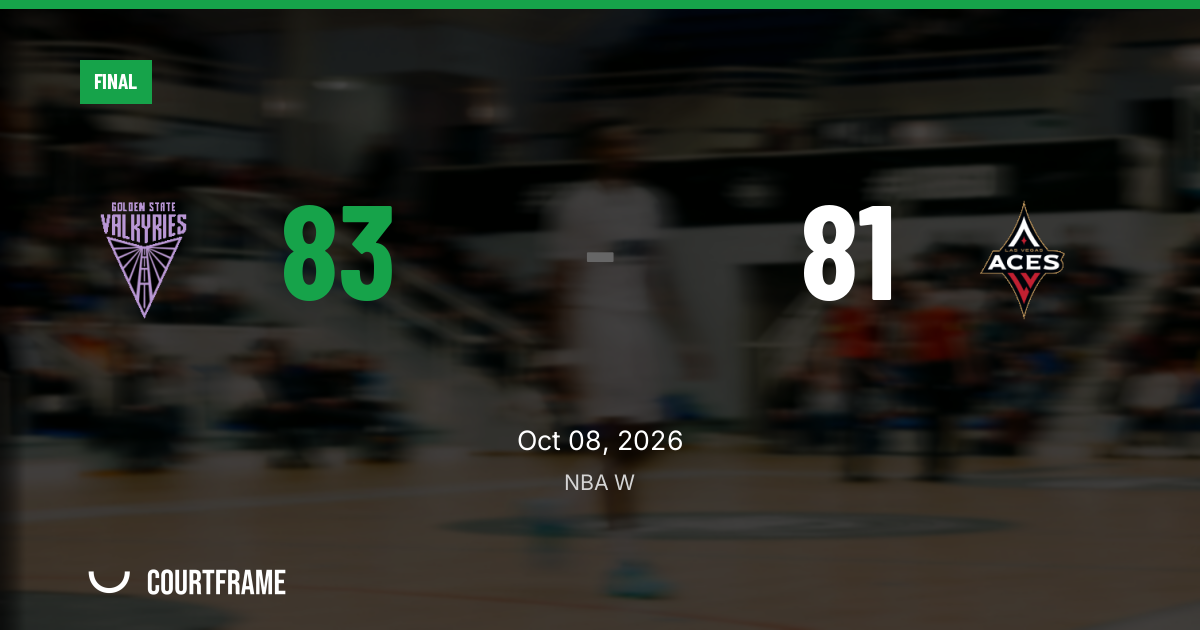
Golden State Valkyries W beat Las Vegas Aces W 83-81 on October 8, 2026, at Chase Center, turning a clean free-throw performance and early control into a two-point Semi-finals win.
Golden State led 19-11 after the first quarter and 42-31 at halftime, building the type of margin that mattered once Las Vegas found its offense after the break. Las Vegas scored 24 points in the third quarter and 26 in the fourth, but Golden State’s 24-point third quarter kept the home side from losing control before a lower-scoring final period.
The result aligned with Golden State’s home profile. The Valkyries entered 22-5 at home with an 81.5 win percentage and an average of 82.5 points at Chase Center, then finished with 83 points. Las Vegas entered with the higher season scoring average at 91.5 points per game and a 90.5-point road average, but Golden State held the Aces to 81.
Free throws and the glass separated the teams
Golden State went 25-for-27 at the free-throw line, while Las Vegas finished 23-for-25. In a game decided by two points, the Valkyries’ ability to generate and convert those trips gave them just enough margin despite committing more turnovers and producing fewer assists.
The Valkyries also won the rebounding battle 29-23. That edge reflected one of the clearest pre-game contrasts: Golden State had a 53.7 rebound percentage over its last 10 games, while Las Vegas was at 47.3. The Aces’ offensive profile carried more shooting efficiency entering the game, but Golden State’s rebounding advantage reduced the cost of its own uneven ball movement.
Las Vegas had the cleaner passing game with 19 assists to Golden State’s 12 and committed only 12 turnovers compared with the Valkyries’ 15. The Aces also had eight steals and two blocks, while Golden State had seven steals and no blocks. Those possession-pressure indicators helped Las Vegas erase much of the halftime deficit, but they did not offset Golden State’s free-throw volume and work on the boards.
Golden State survived Las Vegas’ second-half surge
Golden State’s best stretch came before halftime. The Valkyries held Las Vegas to 11 first-quarter points, then added 23 points in the second quarter to take an 11-point lead into the break. That first-half defensive work mattered because Las Vegas’ offense became far more productive after halftime.
Las Vegas scored 50 points in the second half, with 24 in the third quarter and 26 in the fourth. Golden State matched the Aces with 24 points in the third, which prevented Las Vegas from turning the game before the final quarter. The Valkyries then scored 17 in the fourth, enough to protect the lead despite Las Vegas’ strongest offensive period of the night.
The Aces shot 8-for-18 from three-point range, while Golden State went 10-for-29. Las Vegas was more selective from deep, but Golden State’s two additional makes from beyond the arc paired with its free-throw accuracy to create the scoring balance it needed.
Pre-game strengths showed up, but not evenly
Las Vegas entered with the stronger recent offensive profile, averaging 89.5 points over its last 10 games with a 97.4 offensive rating, 55.2 true shooting percentage and 56.2 effective field goal percentage. Golden State entered at 83.1 points over its last 10, with a 94.4 offensive rating and 54.1 true shooting percentage. The Aces’ late-game offense reflected that scoring ceiling, but Golden State’s defense and pace control kept the final total below Las Vegas’ usual scoring level.
Golden State’s recent defensive rating of 87.8 was better than Las Vegas’ 90.4, and that defensive edge was most visible in the opening quarter. Holding Las Vegas to 11 points created a game script that forced the Aces to chase for the remaining three quarters.
The matchup also carried a CourtFrame Power Index edge for Golden State, which entered at 90.82 and ranked No. 2, compared with Las Vegas at 82.17 and ranked No. 5. The 8.6-point differential pointed toward a Golden State advantage even with Las Vegas bringing the league’s more explosive scoring baseline.
No injury caveat in a narrow result
Neither team reported significant injuries, and both entered on equal rest with three days off and two games in the previous seven days. That removed the usual schedule and availability explanations from a game decided by execution margins.
Golden State leaned into the profile that had carried it at Chase Center: enough half-court defense, enough rebounding and elite foul-line conversion. Las Vegas brought the higher-scoring attack and a second-half response, but the Aces’ 81 points were not enough against a Valkyries team that turned 27 free-throw attempts into 25 points.