

Valencia walked into Radovic S. as the market underdog and left one win from the Euroleague title.
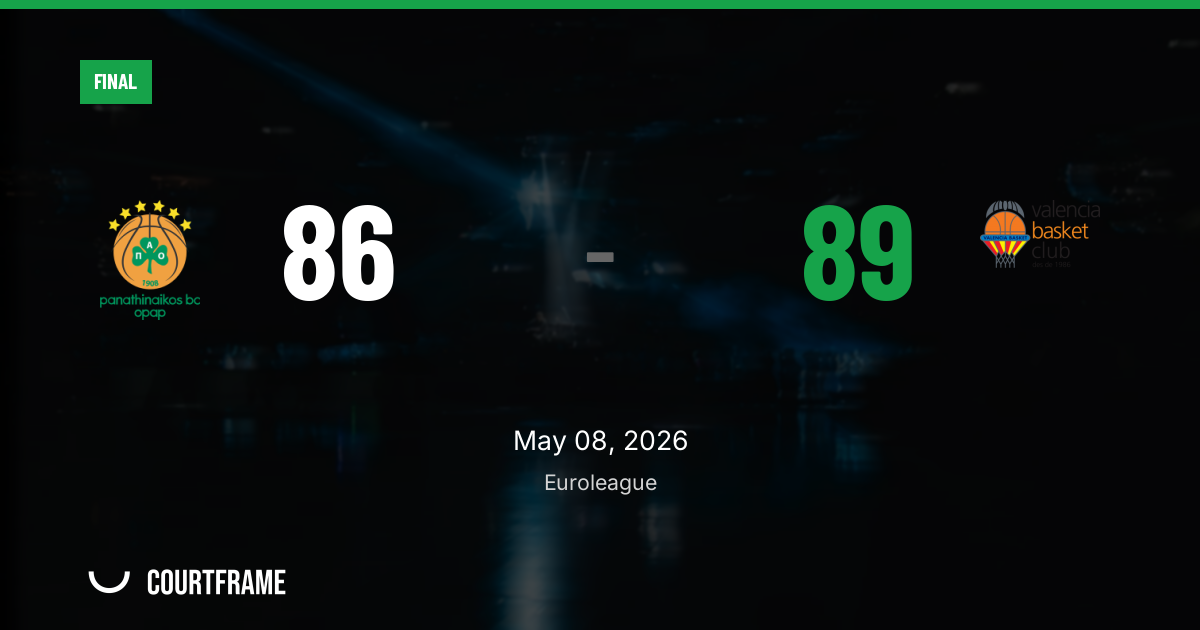
In a Finals game defined by swings, shot volume and late execution, Valencia beat Panathinaikos 89-86 on May 8, 2026, taking a 3-2 lead in the best-of-seven series. The visitors closed with 29 points in the fourth quarter, matching Panathinaikos’ late scoring burst and doing enough to survive a game the home side had every reason to believe it could steal.
The result cut against the betting market, which gave Panathinaikos a 67.1 percent implied win probability across 10 bookmakers. But it did not cut against the deeper indicators. Valencia entered with the better record at 25-13, the hotter form line at WWWWL, the stronger CPI profile, and a major advantage in recent net rating. In Game 5, that profile traveled.
Valencia’s Fourth Quarter Decides It
The game turned at the edges. Valencia opened with a 26-15 first quarter, immediately putting Panathinaikos into chase mode. The home team answered in the middle stages, winning the second quarter 22-18 and the third 19-16, trimming the margin and setting up a one-possession finish.
Then Valencia found the scoring burst it needed. After managing 16 points in the third quarter, the visitors erupted for 29 in the fourth. Panathinaikos was excellent late as well, scoring 30 in the final period, but the early deficit proved too expensive. Valencia’s opening punch and closing response were the difference in an 89-86 final.
That balance was consistent with Valencia’s season-long scoring profile. The visitors entered averaging 89.9 points per game, ahead of Panathinaikos’ 87.2. Away from home, Valencia had gone 6-3 with 94.9 points per game. This was not a low-ceiling offense catching fire out of nowhere. It was a high-output team delivering in the exact environment that usually compresses offensive rhythm.
Pre-Game Indicators Favored Valencia More Than the Market Did
Panathinaikos had home-court pricing, a 22-16 record and no significant injury concerns. Valencia had the same clean injury report, equal rest with two days off and one game in the previous seven days, and a more convincing statistical case.
The CPI matchup was especially stark. Valencia entered with a 91.96 CPI, ranked second, while Panathinaikos came in at 53.02, ranked seventh. The differential sat at -38.9 from Panathinaikos’ perspective. Valencia also had more playoff experience in the matchup, 8 to 6, and brought the stronger recent net rating: plus-15.1 over its last 10 games compared with Panathinaikos’ plus-0.5.
That gap mattered. Valencia’s recent profile showed an offense operating at a 116 offensive rating with a 100.9 defensive rating. Panathinaikos, by comparison, entered with a 114.1 offensive rating and 113.6 defensive rating. The home team’s offense was efficient enough to win, but its defensive baseline offered far less margin. Game 5 played out that way: Panathinaikos scored enough to compete, but not enough to control the result.
Shot Profile and Possession Battle
The team statistics showed an unusual split. Panathinaikos had more made field goals, shooting 27-for-48, while Valencia finished 19-for-34. Panathinaikos also had more assists, 20 to 19, and fewer turnovers, 12 to 15. On paper, those are winning indicators.
Valencia offset them with pressure plays and defensive activity. The visitors finished with 37 rebounds to Panathinaikos’ 35 and had five blocks to the home team’s one. Valencia also generated eight steals, while Panathinaikos had nine. In a three-point game, those marginal categories mattered.
The perimeter math also shaped the night. Valencia went 10-for-29 from 3-point range, while Panathinaikos finished 7-for-30. The difference was not just volume; it was timing. Valencia’s ability to sustain its offense late reflected a team that entered with a massive three-point rate of 86 over its last 10 games. Panathinaikos also leaned heavily into the arc, entering with a 61.9 three-point rate and attempting 30 in Game 5, but the home team did not match Valencia’s total makes from deep.
No Injury Caveat, No Fatigue Excuse
Both teams entered with no significant injuries reported. Both had two days of rest. Both had played once in the previous seven days. This was not a game tilted by availability or schedule imbalance.
That makes the outcome cleaner from an evaluation standpoint. Valencia won because its strengths held up: top-end shot-making, rebounding, rim protection and late-game composure. Panathinaikos lost despite getting enough offensive organization to finish with 20 assists and despite limiting turnovers better than Valencia.
For Panathinaikos, the issue was not a lack of creation. Kendrick Nunn entered as the team’s leading scorer at 17.3 points per game, with Nigel Hayes at 14.1 and Cedi Osman at 13. Kostas Sloukas’ 4.6 assists per game gave the home side another organizer. The structure was there. But Valencia’s defensive resistance and fourth-quarter scoring gave Panathinaikos too little room for error.
For Valencia, Jean Montero’s profile as a 17.5-point, 5.3-assist guard framed the matchup before tipoff. Brancou Badio, Nathan Reuvers, Kameron Taylor and Darius Thompson gave the visitors multiple rotation pieces capable of supporting a balanced attack. That depth aligned with a 23.8 average assist profile over the previous 10 games and showed up in the broader flow, even as the game tightened late.
Series Swings Toward Valencia
Game 5 was not an elimination game, but it changed the series. Valencia now leads 3-2 and has put Panathinaikos under immediate pressure. The home team entered with the market’s confidence and a 6-4 home split, averaging 90.2 points in those games. It still fell short.
That is the sharpest takeaway from Valencia’s win: the visitors did not need an ideal script. They committed more turnovers, had fewer assists and had to absorb a 30-point fourth quarter from Panathinaikos. They still won because their underlying advantages — stronger overall record, superior CPI, better recent net rating and a more durable two-way profile — showed up when the Finals game tightened.
Panathinaikos has been alternating results in recent form, entering at WLWLW. Valencia came in at WWWWL and now has the series lead to match its underlying momentum. One more win separates Valencia from the Euroleague title.