

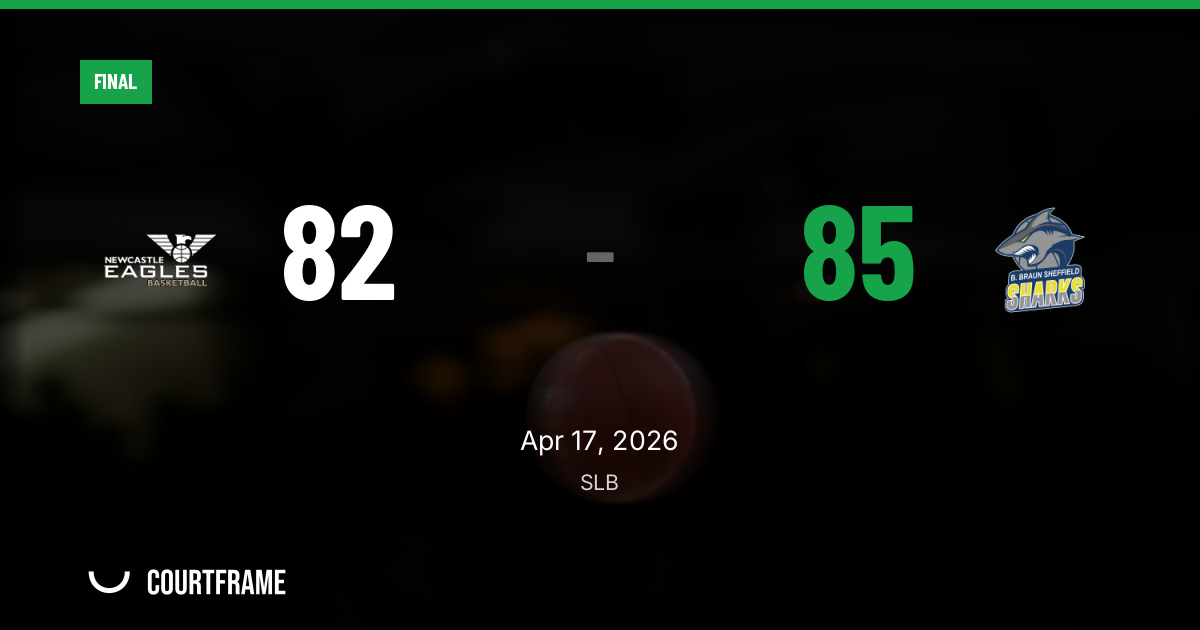
Sheffield walked into Vertu Motors Arena with the better record (16-13), better recent form (WLWWW), and a top-three CPI profile (66.98, rank 3). Newcastle, favored by the market (57.6% implied win probability) and coming off five days’ rest with no significant injuries on either side, still landed the first punch — and then couldn’t land another when the game tightened.
The Sharks outlasted the Eagles 85-82 on April 17, 2026, completing a comeback that was set up by Newcastle’s offensive freefall after halftime. Newcastle led 31-22 after one and 53-37 at the break, but Sheffield won the second half 48-29 and took control with a decisive 25-11 third quarter.
Game flow: Newcastle’s hot start, Sheffield’s cold-blooded finish
Newcastle’s opening quarter (31 points) looked like the version of the Eagles that has scored 96.8 points per game in its recent home split. The lead ballooned to 16 by halftime, with Newcastle adding 22 more in the second quarter.
Then the floor tilted. Newcastle managed just 11 points in the third — its lowest-scoring quarter of the night — while Sheffield put up 25. In a game that entered with totals priced in the low-to-mid 170s, the second half turned into a possession-by-possession scrap, and Sheffield was the team that kept generating enough offense to close.
Sheffield finished the comeback by winning the fourth 23-18, turning a 64-62 deficit after three into a three-point road win.
Why it flipped: Sheffield’s pressure points showed up when it mattered
Free throws and shot profile kept Sheffield afloat
Sheffield’s box score tells the story of a team that survived the early storm by staying connected to the game at the line and through ball movement. The Sharks went 18-for-28 at the stripe and recorded 24 assists, giving them a steady scoring base even as the jump shooting lagged (5-for-23 from three).
Newcastle, meanwhile, lived and died on the perimeter: 9-for-32 from three with 17-for-30 at the line. When the threes stopped falling after halftime, there wasn’t enough creation elsewhere to stabilize the offense.
Turnovers were messy — but Newcastle couldn’t turn disruption into separation
Newcastle forced 12 steals and won the turnover battle (12 turnovers vs. Sheffield’s 19). In theory, that’s the kind of edge that should protect a big halftime lead.
In practice, Sheffield’s offense still found enough structure — 24 assists — to survive the mistakes, while Newcastle’s 17 assists reflected a more stagnant second half. The Eagles’ defensive activity created chances, but the offense didn’t convert those extra possessions into a cushion once the pace and rhythm changed.
Rebounding and possession math: Sheffield’s extra chances mattered
Sheffield finished with a 37-32 rebounding advantage, a small but meaningful edge in a three-point game. That aligned with the Sharks’ recent profile (50.5 rebound percentage over their last 10 analyzed games) versus Newcastle’s (44.3). When Newcastle’s scoring dipped, Sheffield’s ability to secure stops and finish possessions grew in importance.
Pre-game indicators: the market leaned Newcastle, the broader profile leaned Sheffield
The betting market slightly favored Newcastle (home -1 ranges were common), reflecting home-court and the Eagles’ stronger recent home scoring split. But Sheffield’s CPI edge was significant (66.98 vs. 52.72), and the Sharks came in trending up (+15.3) compared to Newcastle trending down (-3.4).
What played out looked like that underlying gap: Newcastle’s best stretches were loud, but Sheffield’s baseline execution — enough free throws, enough assisted offense, enough rebounding — carried the closing minutes.
What it means
For Sheffield, it’s a road win that reinforces why its recent form has been one of the league’s best: it can win games even when the three-point shooting isn’t clean, as long as the process holds. For Newcastle (12-18), it’s another tight finish that got away — and a reminder that when the perimeter-heavy attack stalls, the margin for error shrinks fast.