

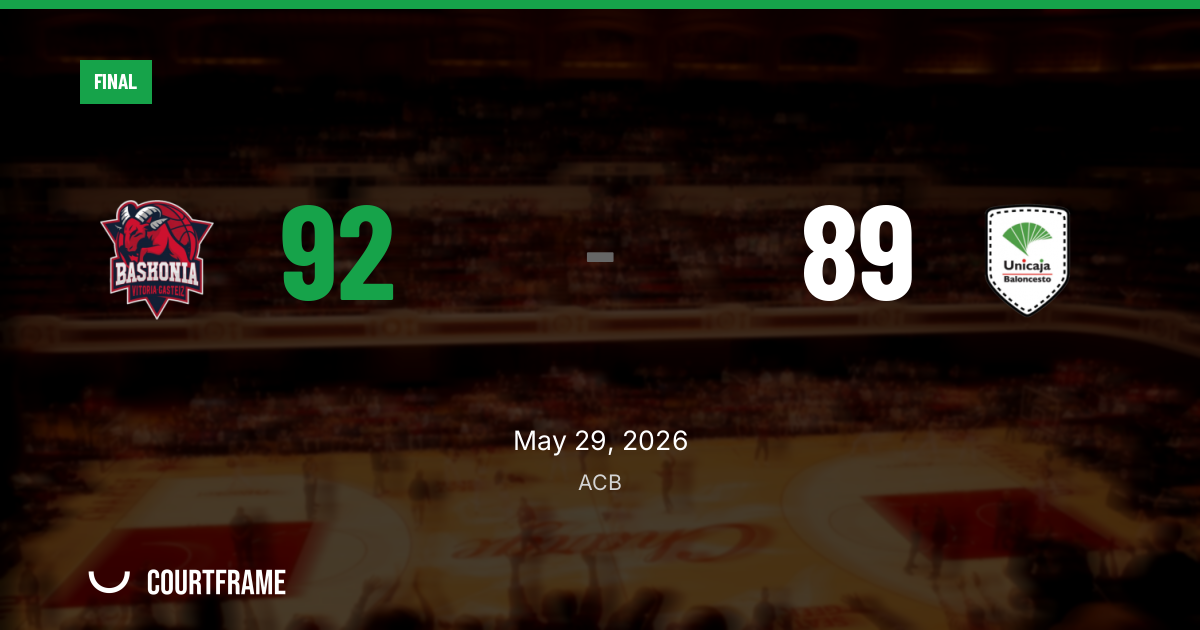
Baskonia did not get a clean one. It got the one that matters.
At Fernando Buesa Arena, the ACB’s No. 2 CPI team held off Unicaja 92-89 on May 29, pushing its best-of-seven series lead to 2-0. Baskonia entered with a 25-9 record, a five-game winning streak and a 9-1 home split. Unicaja arrived at 17-17, with losses in four of its previous five and a 2-7 away split. The gap showed early, then narrowed late.
Baskonia led 21-16 after the first quarter and 46-39 at halftime, establishing control before Unicaja’s best stretch. The visitors scored 30 in the third quarter, their most productive period of the night, but Baskonia still carried enough offense through the final quarter to close it out.
Baskonia’s profile held under pressure
The pre-game indicators pointed strongly toward Baskonia. The market implied a 72.3 percent home win probability across 10 bookmakers, and the CPI matchup was even more tilted: Baskonia entered with a 99.74 CPI, ranked No. 2, while Unicaja sat at 27.91, ranked No. 13. The differential was 71.8.
That edge did not produce a comfortable finish, but it shaped the game. Baskonia’s recent advanced profile — 122.6 offensive rating, 76 percent true shooting and 70.7 effective field-goal percentage over the analyzed sample — suggested a team capable of punishing mistakes with efficient offense. Even on a back-to-back with only one day of rest, Baskonia found enough scoring balance to reach 92 and protect home court.
The home split also mattered. Baskonia had averaged 98.1 points at home entering the game and came in with a 90 percent home win rate. This was below that scoring average, but still enough to extend the run.
Unicaja’s third-quarter response nearly changed the series
Unicaja did not play like a team content to trail 2-0. After scoring 16 in the first quarter and 23 in the second, it erupted for 30 in the third. That surge cut into Baskonia’s control and turned the fourth quarter into a possession-by-possession finish.
The visitors’ statistical identity also surfaced. Unicaja entered with a 96.7 assist rate in its recent sample and finished with 23 assists in the team statistics, compared with Baskonia’s 13. That ball movement helped Unicaja generate enough quality possessions to stay attached despite the road setting and the unfavorable pre-game form.
Unicaja also won key volume categories in the supplied team statistics, posting 41 rebounds to Baskonia’s 30 and committing 10 turnovers to Baskonia’s 12. But the larger game state still favored Baskonia: the home side built the early margin, avoided the decisive collapse and matched Unicaja’s late scoring just enough.
Efficiency and free throws helped separate the night
The game’s fine margins showed at the line and beyond the arc. Baskonia’s listed team statistics included 10 made 3-pointers on 23 attempts and 26 free throws on 31 attempts. Unicaja hit 8 of 26 from 3 and 19 of 28 at the line.
That difference mattered in a three-point game. Unicaja had more field goals listed and more assists, but Baskonia’s combination of perimeter makes and free-throw production gave it the scoring cushion it needed. It fit the pre-game trend: Baskonia entered with stronger shooting indicators, including 57 percent field-goal shooting, 36.6 percent from 3 and 82 percent at the line in the recent sample.
Unicaja’s recent efficiency profile was solid but less explosive: 50.3 percent from the field, 34.1 percent from 3 and 69.5 percent at the line. In a game decided by one possession, that separation was enough.
No injury excuses, just execution
Neither team entered with significant injuries reported, making this a clean read on form, matchup and execution. Baskonia had the tougher rest spot — one day of rest and a back-to-back designation — while Unicaja had three days of rest and two games in the last seven days. The schedule context made Unicaja’s late push less surprising, but it also made Baskonia’s close-out more valuable.
Forrest Trent, K. Simmons, Howard Markus, Timothe Luwawu-Cabarrot and Mamadi Diakite entered as Baskonia’s key scoring group, while Unicaja leaned on Kendrick Perry, Chris Duarte, James Webb, Aleksander Balcerowski and Nihad Djedovic. The result was not a blowout built on one mismatch. It was a playoff game decided by the broader team profile: Baskonia’s home efficiency against Unicaja’s road inconsistency.
What it means
Baskonia now leads the series 2-0 in a best-of-seven, with no elimination scenario yet on the table. The win keeps the pressure firmly on Unicaja, which showed enough in the second half to make the series uncomfortable but not enough to steal a road game.
For Baskonia, the takeaway is simple: it absorbed Unicaja’s best offensive quarter, played through a rest disadvantage and still protected Fernando Buesa Arena. For Unicaja, the path is clear but narrow. The ball movement and rebounding were there. The shooting and free-throw gap were not.
That is how a three-point playoff game becomes a 2-0 series lead.