

Basquet Girona needed a response. It got one in the third quarter.
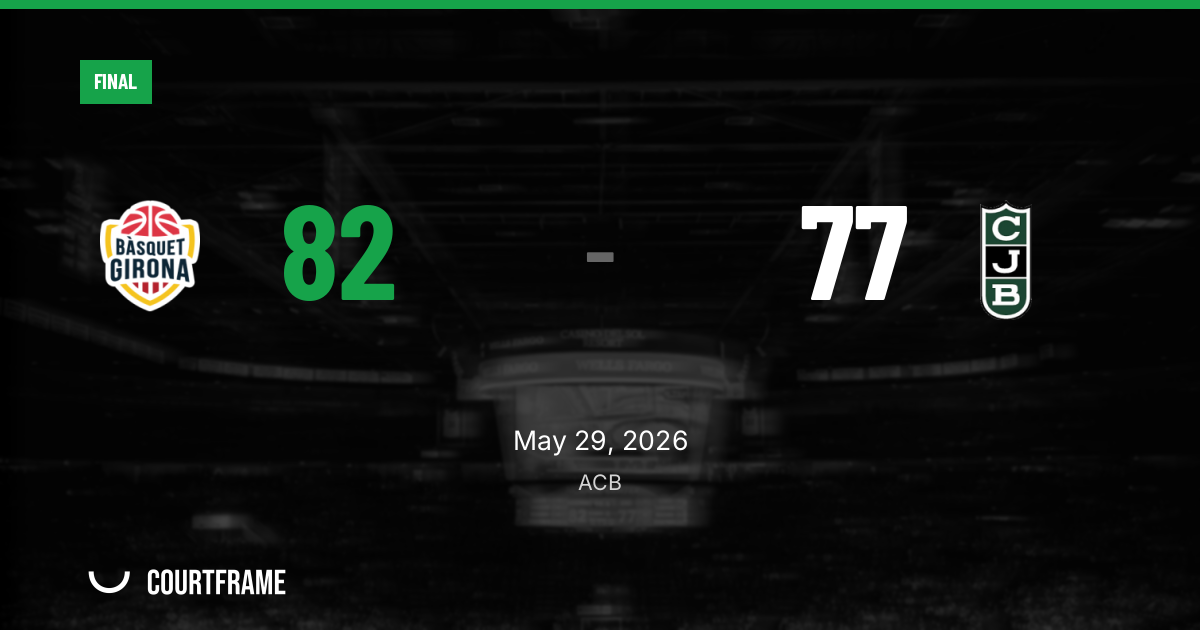
Girona beat Joventut Badalona 82-77 on May 29 at Pavello Fontajau, turning Game 2 with a 26-10 surge after halftime and surviving a late Joventut push. The result moved Girona to 14-20 and dropped Joventut to 22-12, but the standings were not the story. The way Girona won was.
Joventut entered with the stronger profile almost everywhere: a 77.87 CPI, No. 5 ranking, a 22-12 record, four wins in its previous five games and a 57.6 percent market-implied win probability. Girona, ranked No. 18 by CPI at 10.92, came in on a WLLLL form line and with a negative recent net rating. None of that carried through the middle of the game.
The third quarter decided it
Girona led 21-18 after the first quarter and 44-42 at halftime, but the separation came immediately after the break. The home side outscored Joventut 26-10 in the third quarter, the only stretch where either team fully imposed its terms.
That period changed the entire game script. Joventut, which had scored 42 points in the first half, managed just 10 in the third. Girona’s lead grew large enough to withstand a 25-12 Joventut fourth quarter, when Badalona finally restored its offense but ran out of possessions to complete the comeback.
The final margin reflected that swing: Girona won by five in a game where Joventut had been the market favorite and had the stronger advanced profile over the previous 10-game sample.
Ball security gave Girona the edge
The clearest statistical separator was turnover control. Girona committed only five turnovers, while Joventut had 11. For a Girona team that had carried a 25.4 turnover rate over its recent sample, that was a major departure from its trend and one of the biggest reasons the upset held.
Joventut’s recent profile suggested the opposite dynamic. Badalona had been operating with an 18.1 turnover rate and a superior 114.5 offensive rating, while Girona’s defensive rating sat at 117. But in this game, Girona’s pressure and discipline tilted the possession battle. Girona also finished with five steals to Joventut’s two.
That mattered because Joventut still created offense in stretches and finished with 18 assists. But Girona’s ability to limit empty possessions on its own end kept the game from becoming the type of rhythm contest Joventut usually prefers.
Rebounding and shot profile swung toward Girona
Girona also won the glass 40-34, another key point in a matchup where the recent rebounding data did not point to a major gap. Girona entered with a 52.2 rebound percentage over its recent sample, while Joventut was at 49.4. That edge translated.
The shooting profile was unusual. Girona made 16 3-pointers on 35 attempts, while Joventut went 9-for-32 from deep. Girona’s volume and conversion from the perimeter became the counterweight to Joventut’s interior and overall shot-making efficiency.
Joventut converted 19 of 30 on 2-point field goals and added 12 free throws on 18 attempts. Girona was less effective inside the arc, making 12 of 42, but the home team’s 3-point production and turnover advantage gave it enough structural support to win.
Pre-game indicators favored Joventut — Girona disrupted them
This was not a result that followed the broad pre-game model. Joventut had the better record, better form, better CPI, stronger recent net rating and more stable offensive markers. Over the last 10 games, Badalona’s offensive rating was 114.5 with a plus-6.6 net rating. Girona’s was 104.2 with a minus-12.8 net rating.
The market reflected that gap, giving Joventut a 57.6 percent implied probability. The total markets also leaned toward a higher-scoring environment, with a wide band of totals posted from the low 160s into the high 170s. The final combined score landed at 159, below those main scoring expectations.
Rest was one area that favored Girona. The home team entered with five days of rest and one game in the previous seven days, compared with Joventut’s three days of rest and two games in the same span. With no significant injuries reported for either team, availability was not the swing factor. Execution was.
Girona’s stars had the right platform
Girona’s profile coming in was built around Livingston Otis, who entered averaging 14.3 points and 5.5 assists, with Derek Needham at 11.9 points and Martinas Geben providing 11.4 points and 7.2 rebounds. The team did not need a track-meet game. It needed control, enough perimeter scoring and a possession edge.
That is exactly what the box score delivered. Girona had 15 assists and only five turnovers, won the rebounding battle and hit enough 3s to offset its struggles inside the arc.
For Joventut, the loss undercut the strengths it had carried into the matchup. Cameron Hunt and Ricky Rubio entered as matching 14.6-point scorers, with Rubio also averaging 4.8 assists. Jabari Parker, Michael Ruzic and Ante Tomic gave Badalona a deeper frontcourt scoring base. But the third-quarter drought and the turnover gap were too much to overcome.
What it means
Girona’s 82-77 win was not just a home upset. It was a game-plan win against a superior season-long opponent.
The home team slowed the game enough, protected the ball far better than its recent turnover profile suggested and turned the third quarter into the defining stretch. Joventut still had the fourth-quarter response, but Girona had already built the cushion.
In a best-of-seven setting with both teams listed at eight games of playoff experience, the result adds immediate pressure to Joventut. Girona entered Game 2 with a 1-0 series lead and now has another data point that this matchup may be closer on the floor than it looked in the pre-game indicators.