

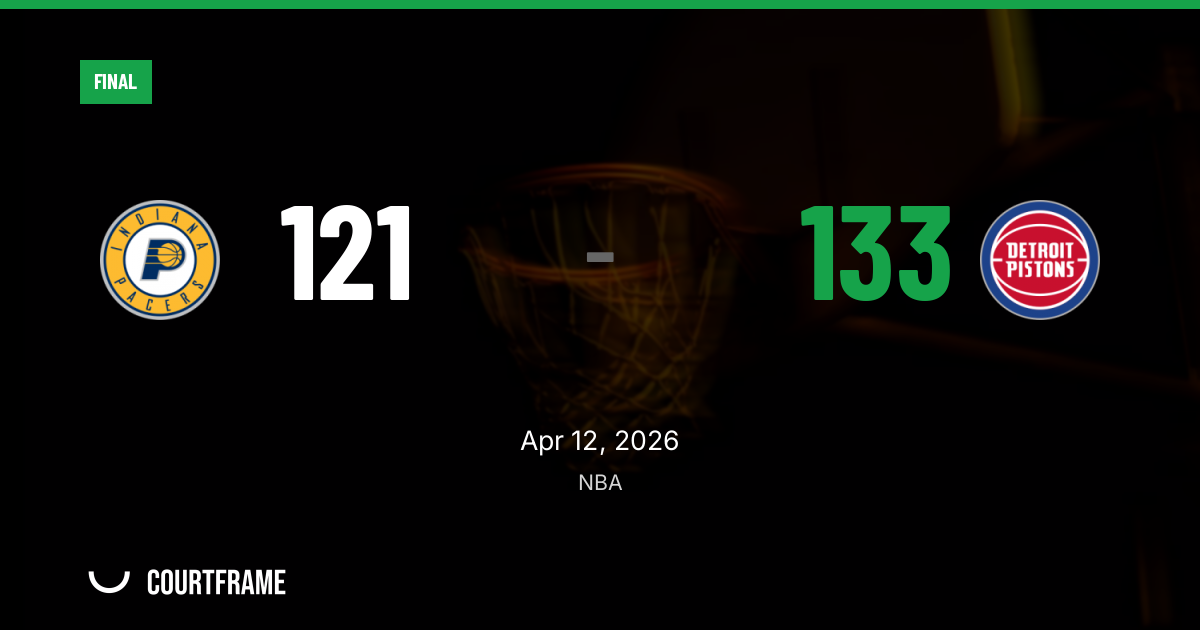
Detroit walked into Gainbridge Fieldhouse on the second night of a back-to-back and played like the team with the 60-22 record. The Pistons detonated for 41 points in the first quarter and 40 more in the second, building an 81-point first half that set the tone for a 133-121 win over the injury-ravaged Pacers on April 12.
Indiana (19-63) had enough offense to win a normal night — it scored 32 in the fourth and trimmed the margin late — but the game was effectively decided by Detroit’s shot-making and ball movement in the opening 24 minutes.
Game flow: Detroit’s first-half avalanche decided it
The quarter-by-quarter arc tells the story. Detroit won the first half 81-63 after putting up 41 and 40 in the first two quarters. Indiana steadied itself after halftime (26-27 in the third) and won the fourth (32-25), but the Pacers were chasing from the opening tip.
That early gap mattered because both teams were in schedule fatigue spots — each on a back-to-back with one day of rest — and Indiana’s margin for error was razor-thin given the availability list.
Detroit’s offense: threes, free throws, and a steady passing diet
Detroit’s team line was built on clean shot quality and efficient conversion: 35-of-56 from the field, 15-of-33 from three, and 18-of-22 at the line. That blend matched the Pistons’ recent profile: over their last 10 games, Detroit carried a 114.5 offensive rating, paired with a strong perimeter clip (42.3% from three) and a healthy 42.9 free-throw rate.
The ball moved, too. Detroit finished with 35 assists, aligning with the team’s 10-game trend of high-volume playmaking (32.1 average assists). When Detroit is generating shots via advantage creation rather than isolation, it’s difficult to keep them out of rhythm — especially against a short-handed opponent.
Possession battle: enough slippage to keep the door cracked
Indiana did force some chaos — the Pistons committed 18 turnovers and Indiana posted 15 steals — but Detroit’s shot efficiency and rebounding steadied the game. The Pistons won the glass 48-31, a key stabilizer when turnovers threaten to swing momentum.
Indiana’s reality: too many absences, too much to cover
The Pacers’ injury report was the headline before the game and became the reality during it. Indiana was without Tyrese Haliburton (right Achilles tendon), Pascal Siakam (left ankle), Andrew Nembhard (N/A), Aaron Nesmith (cervical), T.J. McConnell (bilateral hamstring), Ivica Zubac (rib), and Johnny Furphy (right ACL), with Kobe Brown (lumbar), Ben Sheppard (right hip), and Jarace Walker (left foot) listed questionable.
Against that backdrop, Indiana’s path required near-perfect offensive execution and a defensive performance above its recent baseline. Over the last 10 games, Indiana’s profile was essentially break-even (0.5 net rating) with a 117.8 offensive rating but also a 117.3 defensive rating and a high 21.6 turnover rate. The Pacers did generate activity (steals) and kept their own turnovers to 16, but they couldn’t consistently string together stops early enough to prevent the Pistons’ first-half surge.
What it means: result matched the pregame indicators
This outcome tracked with the pregame landscape. Detroit entered with the superior record (60-22), stronger recent two-way profile (last-10 +2.8 net rating), and a sizable CPI edge (Detroit 71.28 vs. Indiana 26.16, differential -45.1). Indiana’s home split (3-14) and the sheer volume of unavailable creators and stabilizers made the Pacers’ task steep from the start.
Detroit didn’t need a perfect night — it just needed to play to its identity: space the floor, share the ball, and convert efficiently. The Pistons did that early, banked a big cushion, and survived Indiana’s late run to close out a 133-121 win.