

PORTLAND — The game was even for 12 minutes. Then Portland hit the gas.
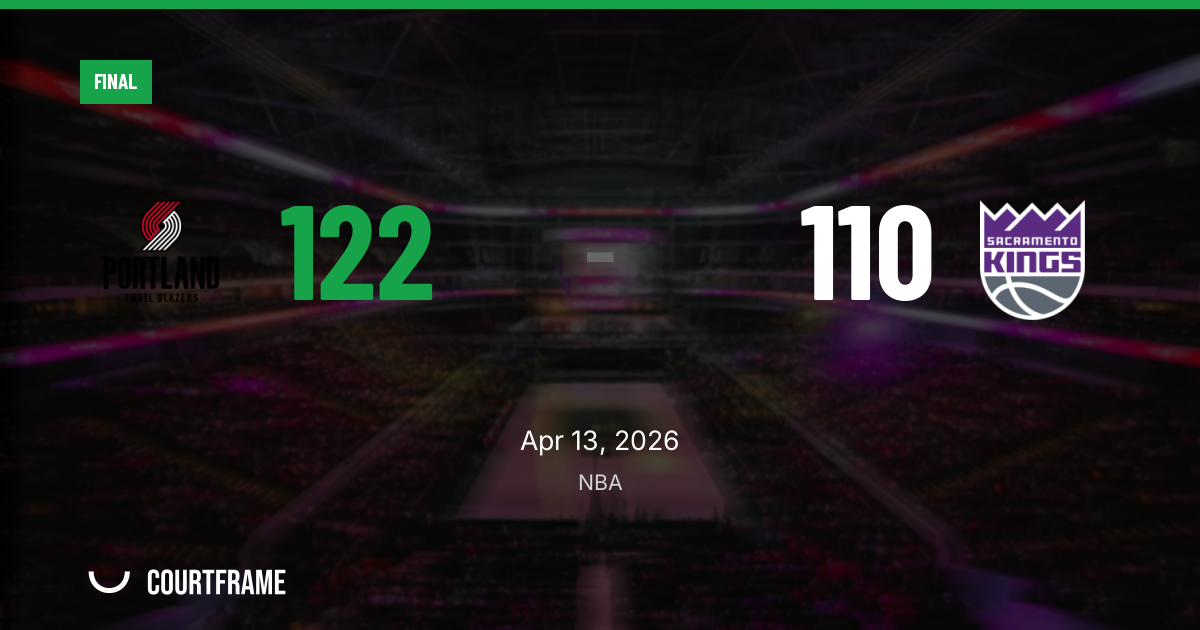
Behind a 44-point second quarter, the Trail Blazers rolled past the injury-ravaged Sacramento Kings, 122-110, Monday night at Moda Center. The win pushed Portland (42-40) through a back-to-back spot with the kind of clean offensive structure that has shown up in its recent profile: efficient shooting, strong assist totals, and enough defensive resistance to keep control once the lead was built.
Turning point: a 44-point second quarter that changed the math
After the teams traded 33-33 openings, Portland’s 44-24 second quarter created the margin that carried to the finish. Sacramento never matched that burst again, even while Portland’s offense cooled to 19 points in the third.
The shape of the game followed the scoreboard rhythm: Portland created separation with a single overwhelming stretch, then managed the rest of the night without letting the Kings’ free-throw pressure fully flip the script.
How Portland won: spacing, volume threes, and ball movement
Portland’s team numbers underline the identity of the win: 28 assists against 12 turnovers, plus 16 made 3s. The Blazers took 46 threes, a massive share of their 55 field-goal attempts, and it kept Sacramento’s defense stretched even as the Kings tried to hang around with physicality and trips to the line.
That approach aligns with Portland’s recent 10-game indicators: a high effective field-goal rate (71.8%) and true shooting (75.1%) paired with a strong net rating (+7.7). Even with Damian Lillard (left Achilles tendon) and Jerami Grant (right calf) out, the Blazers leaned into the same principles—quick decisions, drive-and-kick reads, and shot volume from deep—rather than trying to replace missing creation with isolation.
Why the assists mattered
Sacramento finished with 24 assists but also 17 turnovers. Portland’s 9 steals helped turn those mistakes into extra possessions, and the Blazers’ 12-turnover night gave them a cleaner possession ledger in a game where both teams were on one day of rest and playing their third game in seven days (back-to-back conditions for each side).
How Sacramento stayed competitive: free throws and rim pressure
Sacramento’s best counter was the foul line: 23-for-31 on free throws. The Kings also won the battle on the glass, 47-46, and protected the rim with 8 blocks. But that profile required near-perfect control elsewhere—and the turnovers and Portland’s 3-point volume made the climb too steep.
The Kings entered with a difficult baseline: 22-60 overall, 4-15 on the road (21.1 win percentage) with 107.6 points per game away from home, and a defensive rating of 124.1 over their last 10 games. On a night when the injury report removed much of their top-end shot creation and playmaking, the margin for error was thin from the start.
Injuries shaped the rotation—and the outcome
This matchup was defined by availability. Portland played without Lillard and Grant, while Sacramento was without DeMar DeRozan, Zach LaVine, Domantas Sabonis, Malik Monk, Keegan Murray, Russell Westbrook, De’Andre Hunter, and Drew Eubanks.
Portland’s ability to generate 28 assists and win the second quarter by 20 points stood out in that context: the Blazers found enough creation by committee to keep their offensive rating-level output intact, while Sacramento’s undermanned group couldn’t sustain four quarters of shot quality against a set defense.
By the numbers
Final: Trail Blazers 122, Kings 110
Quarter scores: 33-33, 44-24 Portland, 27-19 Sacramento, 26-26
- Portland: 28 assists, 12 turnovers, 16 made 3s (16/46), 9 steals
- Sacramento: 23/31 free throws, 47 rebounds, 17 turnovers, 8 blocks
What it means going forward
For Portland, this was the clean version of its formula: spacing, passing, and enough defensive playmaking to win the possession battle. The pregame indicators favored the Blazers as well—Portland’s CPI (48.15) carried a sizable edge over Sacramento’s (21.27), and the game played to that differential once the second quarter hit.
For Sacramento, the effort at the line and on the glass kept the scoreline respectable, but the roster depletion left too few ways to answer Portland’s 3-point volume and assist-driven offense over 48 minutes.