

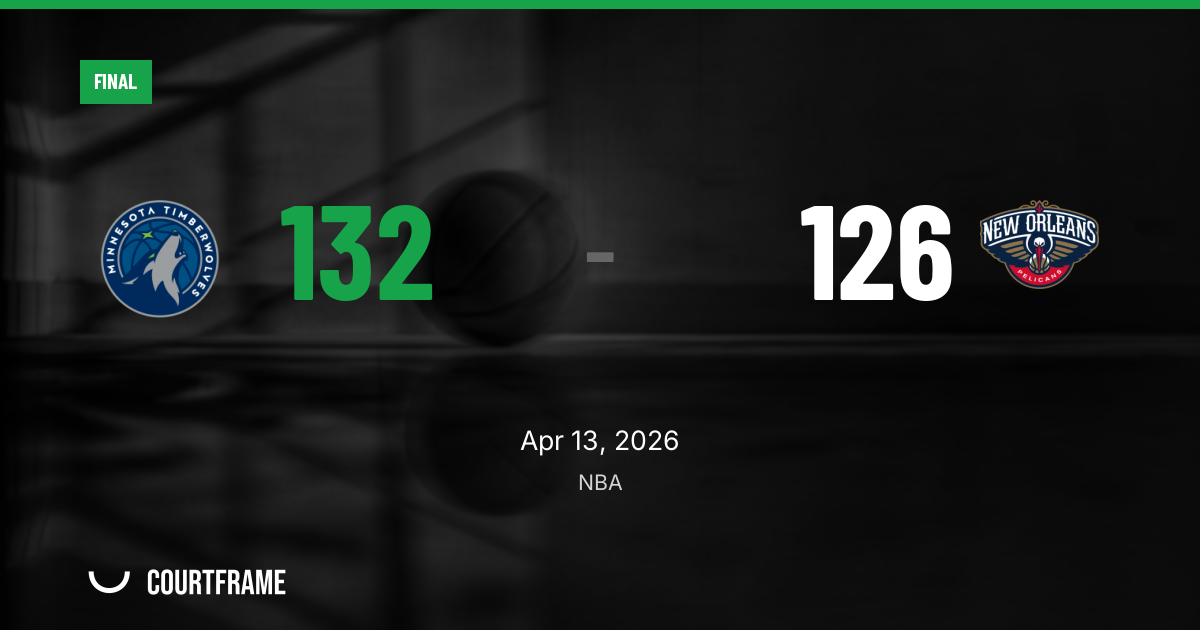
MINNEAPOLIS — The Timberwolves didn’t have the names that usually headline their offense, but they still had enough points — and enough stops at the rim — to finish off the Pelicans, 132-126, Monday night at Target Center.
Minnesota led 34-24 after one and 73-59 at halftime, then had to absorb a 36-point fourth quarter from New Orleans to close it. The Wolves answered with 35 of their own in the final frame to keep the margin intact.
Game flow: Minnesota’s first-half punch, New Orleans’ late surge
The Wolves’ best stretch came early: a 34-point first quarter set the tone, and a 39-point second quarter created separation. New Orleans steadied itself after the break — 31 in the third, 36 in the fourth — but Minnesota never fully surrendered control.
That shape matched the broader profile of the matchup. Minnesota entered with a +6.8 net rating over its last 10 games (115.3 offensive rating, 108.5 defensive rating), while New Orleans’ recent 10-game sample sat at -15.3 (109.2 offensive rating, 124.5 defensive rating). The Pelicans’ offense found enough late, but their defensive baseline left little margin.
The deciding factors
1) Minnesota’s efficiency and ball movement held up under pressure
Minnesota finished with 32 assists against 11 turnovers — a clean possession game that mattered as New Orleans ramped up its fourth-quarter pace. The Wolves’ recent profile pointed to that: an 84.6 assist rate over the last 10 games, paired with an 18% turnover rate. In this one, the ball security won out, and the passing translated into a steady stream of looks even as the Pelicans made their run.
2) Rim protection tilted the possession battle back to the Wolves
New Orleans won the rebounding count 52-47 and took far more field-goal attempts (40/86) than Minnesota (35/52), but Minnesota’s back line erased mistakes. The Wolves recorded 13 blocks, more than doubling the Pelicans’ six, and consistently forced New Orleans to finish through traffic.
3) A whistle-heavy night created a high-variance finish
Both teams lived at the line: Minnesota went 32/43, New Orleans 31/38. That volume kept scoring elevated and prevented either side from fully separating once the game tightened late. Minnesota’s ability to keep producing points in the fourth — matching New Orleans’ 36 with 35 — was the difference between a comfortable lead and a closing-time problem.
Injuries and context: a game defined by who wasn’t available
This was a regular-season matchup that looked nothing like a typical rotation night.
Minnesota played without Anthony Edwards (right knee), Rudy Gobert (unknown), Julius Randle (right hand), Jaden McDaniels (left knee), Naz Reid (right shoulder), Mike Conley (unknown), Ayo Dosunmu (right calf), Kyle Anderson (right knee) and Bones Hyland (right hip). New Orleans was missing Zion Williamson (right knee), Dejounte Murray (left hand), Trey Murphy III (right ankle), Herbert Jones (unknown), Saddiq Bey (unknown), Yves Missi (right hand/finger), Karlo Matkovic (low back) and Bryce McGowens (right small toe).
Even with Minnesota on one day of rest and on a back-to-back (three games in the last seven days), the Wolves’ underlying edge still showed up. The CPI matchup differential favored Minnesota (53.08 vs. 19.26), and the final reflected that — though not without stress.
What it means
Minnesota (49-33 entering the night) banked a win it was expected to control on paper, but the path mattered: the Wolves had to win with execution and interior defense more than star power. New Orleans (26-56) showed enough late shot creation to make it uncomfortable, yet the same issues that have defined its recent stretch — defense and containment — surfaced again in the first half, when the game effectively flipped.
Key numbers
Quarter scores: MIN 34-39-24-35 (132), NOP 24-35-31-36 (126)
Team stats: MIN 47 rebounds, 32 assists, 11 turnovers, 13 blocks; NOP 52 rebounds, 20 assists, 9 turnovers, 6 blocks
Free throws: MIN 32/43; NOP 31/38
Three-pointers: MIN 10/37; NOP 5/21