

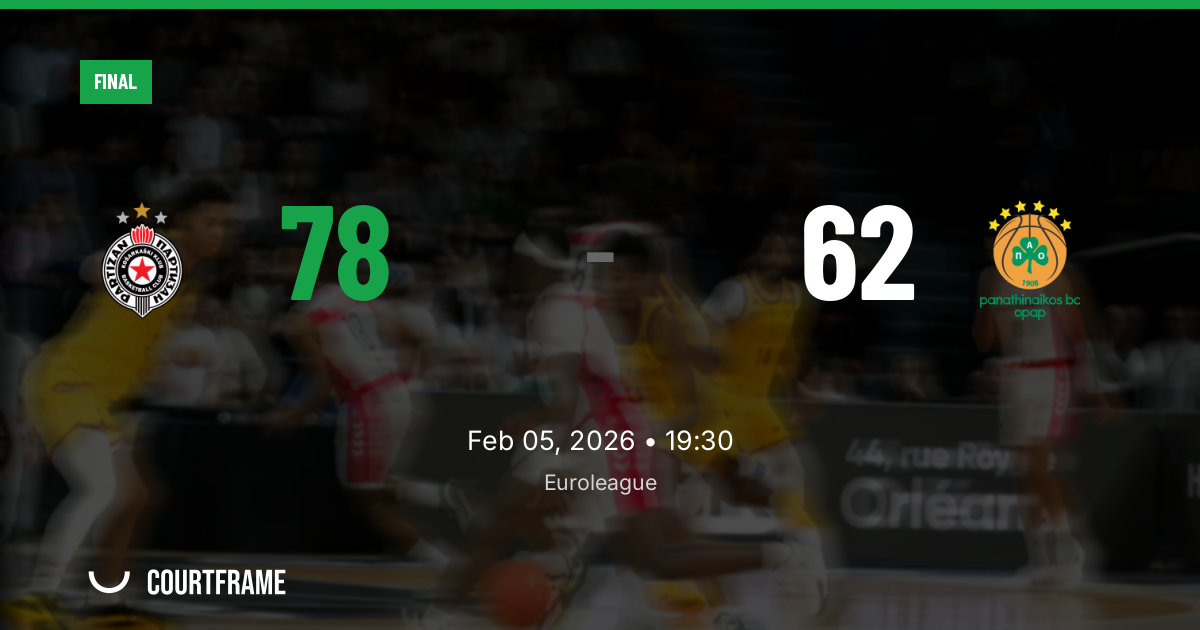
Partizan Mozzart Bet didn’t need late-game drama. They needed one sustained stretch of control — and they delivered it in the middle of the night.
Behind a second-quarter surge and a suffocating third, Partizan handled Panathinaikos 78-62 on February 5, 2026 at Beogradska arena, snapping the game open after a one-point first quarter and never letting the visitors back into striking distance.
How the game swung
The opening 10 minutes looked like it might track toward a tight finish: Partizan edged the first quarter 20-19. Then the floor tilted.
Partizan won the second quarter 25-14, turning a one-point edge into a 12-point halftime cushion. Any thought of a Panathinaikos response disappeared in the third, when Partizan outscored them 21-9 — the decisive sequence of the night. After three quarters, it was 66-42, a margin that effectively closed the game.
Panathinaikos did win the fourth quarter 20-12, but the damage was already done. Partizan’s earlier work created too steep a climb for a comeback.
Ball movement separated the teams
Partizan’s offensive structure showed up in the simplest indicator available: assists. They finished with 20 assists to Panathinaikos’ 13, a gap that mirrored the flow of the game — one team consistently generating organized looks, the other often forced into tougher possessions as the deficit grew.
In a matchup where the margin expanded rapidly during the second and third quarters, that disparity in creation and connectivity mattered. Partizan repeatedly turned possessions into advantage situations, while Panathinaikos struggled to match that level of cohesion.
Turning point: the third-quarter clampdown
If the second quarter cracked the door open, the third quarter kicked it off the hinges. Holding Panathinaikos to nine points in the period allowed Partizan to play from strength the rest of the way — controlling tempo, managing the scoreboard, and forcing the visitors to chase.
That nine-point quarter wasn’t just a cold spell; it was the moment the game’s competitive tension snapped. From there, Partizan’s priority shifted to protecting the margin, and they did.
What it means going forward
For Partizan (8-18 entering the night), this was a statement win — not because of a single late shot or a narrow escape, but because of the way they dictated the terms for 20 straight minutes. Their recent form had been uneven (LLWWL), and this performance offered a clear blueprint: win the possession battle through structure and ball movement, then lean on defense to stretch the margin.
For Panathinaikos (16-10 entering the game), the loss is less about the final 16-point gap than the third-quarter collapse that created it. They’ll take the fourth-quarter response, but the bigger issue is surviving the opponent’s run without letting it become a rout — especially on the road against a team playing freer once it seized control.