

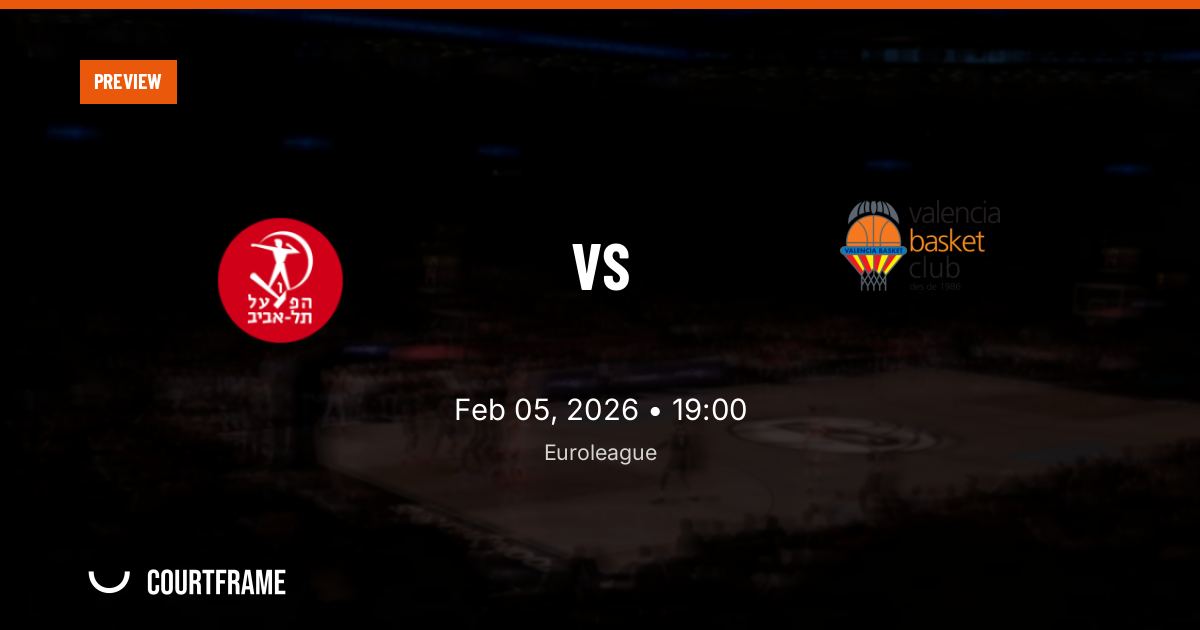
Game context
League: EuroLeague (2025 season)
Date: February 5, 2026
Venue: Pais Arena
Matchup: Hapoel Tel-Aviv (home) vs. Valencia (away)
Records, form, and what they imply
On paper, this is as close to a true coin-flip as EuroLeague scheduling produces: Hapoel Tel-Aviv enters at 16–9, while Valencia sits at 16–10. The marginal difference in the loss column matters in a standings sense, but the broader signal is parity—two teams operating in the same competitive band.
Recent form snapshot
| Team | Record | Last 5 | Momentum profile |
|---|---|---|---|
| Hapoel Tel-Aviv | 16–9 | LLLWW | Downturn followed by stabilization |
| Valencia | 16–10 | LWLWL | Alternating outcomes (high variance) |
Hapoel’s LLLWW sequence suggests a team that has recently found answers after a three-game skid—often a meaningful inflection point because it can indicate rotation tightening or a schematic adjustment that finally “sticks.” Valencia’s LWLWL pattern reads differently: less of a trend, more of a volatility signature. In probability terms, it’s the profile of a team whose game-to-game outcome is sensitive to a small number of swing factors—shot-making runs, turnover clusters, or foul trouble—rather than a stable baseline.
A simple expected-value lens: “Win Equity Index”
Without play-by-play or efficiency data, the cleanest preview tool is to translate records and recent form into a lightweight expected-value framework. Below is a custom metric designed specifically for this context.
Methodology
Win Equity Index (WEI) = 0.7 × (Season Win%) + 0.3 × (Last-5 Win%)
This weighting prioritizes the larger sample (season) while still accounting for current form. It’s not meant to be predictive in isolation; it’s a structured way to discuss baseline strength vs. short-term signal.
| Team | Season Win% | Last-5 Win% | WEI |
|---|---|---|---|
| Hapoel Tel-Aviv | 16/25 = 0.640 | 2/5 = 0.400 | 0.568 |
| Valencia | 16/26 = 0.615 | 2/5 = 0.400 | 0.551 |
The WEI gap is modest—0.568 vs. 0.551—which reinforces the macro read: these teams are tightly matched, with Hapoel holding a slight baseline edge via season performance. The identical last-five win rate (2–3) means recent results don’t separate them; instead, the story becomes how each team achieves its wins and why it loses—questions typically answered by efficiency splits and lineup data. In their absence, the preview shifts to game-theory fundamentals: controlling variance, optimizing shot quality, and winning the possession battle.
Matchup themes to watch
1) Variance management: who can keep the game in its preferred band?
Valencia’s alternating form (LWLWL) suggests a team that can look dominant one night and ordinary the next. In a single-game setting, that volatility can be an asset—high-variance teams are more capable of “stealing” wins when the shooting environment breaks their way. For Hapoel, the strategic goal is to reduce Valencia’s variance: force longer possessions, limit transition leakage, and prioritize clean defensive possessions that prevent quick momentum swings.
2) The possession economy: rebounds, turnovers, and free throws
When two records are this close, the most repeatable edge usually comes from what analytics calls the “Four Factors” ecosystem—especially turnover rate and rebounding share. Even without the specific numbers here, the tactical takeaway is clear: whichever team generates more shots (by protecting the ball and ending defensive possessions) increases its expected value over 40 minutes. In games with narrow baseline separation, the possession count often becomes the hidden scoreboard.
3) Home-court pressure at Pais Arena
With Hapoel at home in Pais Arena, the early-game segment matters. Home teams frequently benefit from a short-term lift—energy, whistle dynamics, and opponent communication stress. Valencia’s task is to survive the first wave: keep the game within one or two possessions through the opening stretches and avoid the kind of turnover clusters that can turn a neutral matchup into an emotionally tilted one.
Key players to watch
Specific player statistics and availability are not provided in the context, so the most actionable approach is role-based:
- Hapoel Tel-Aviv’s primary creators: The decision-making hub—late-clock shot quality and turnover avoidance will shape Hapoel’s offensive floor.
- Valencia’s shot-makers and secondary playmaking: In a volatility profile, the “swing” often comes from role players converting open looks and making the extra pass that turns a good possession into a great one.
- Rim protectors and defensive anchors on both sides: If either team can shrink the paint without overhelping, it raises the opponent’s difficulty curve and reduces high-value attempts.
What to expect
Expect a game with a narrow margin for error. The records (16–9 vs. 16–10) and the WEI split suggest Hapoel has a slightly higher baseline, but Valencia’s recent pattern indicates a team capable of producing a “spike” performance. The likely deciding variables are not exotic: shot volume (turnovers and rebounds), the ability to avoid empty trips, and which team can impose its preferred tempo and emotional texture.
If Hapoel can keep Valencia out of rhythm early and turn the contest into a half-court execution test, the home side’s small baseline edge becomes more valuable. If Valencia can manufacture a higher-variance environment—quick runs, confidence threes, and pressure possessions—the matchup becomes less about season profile and more about who rides the hot hand longer.