
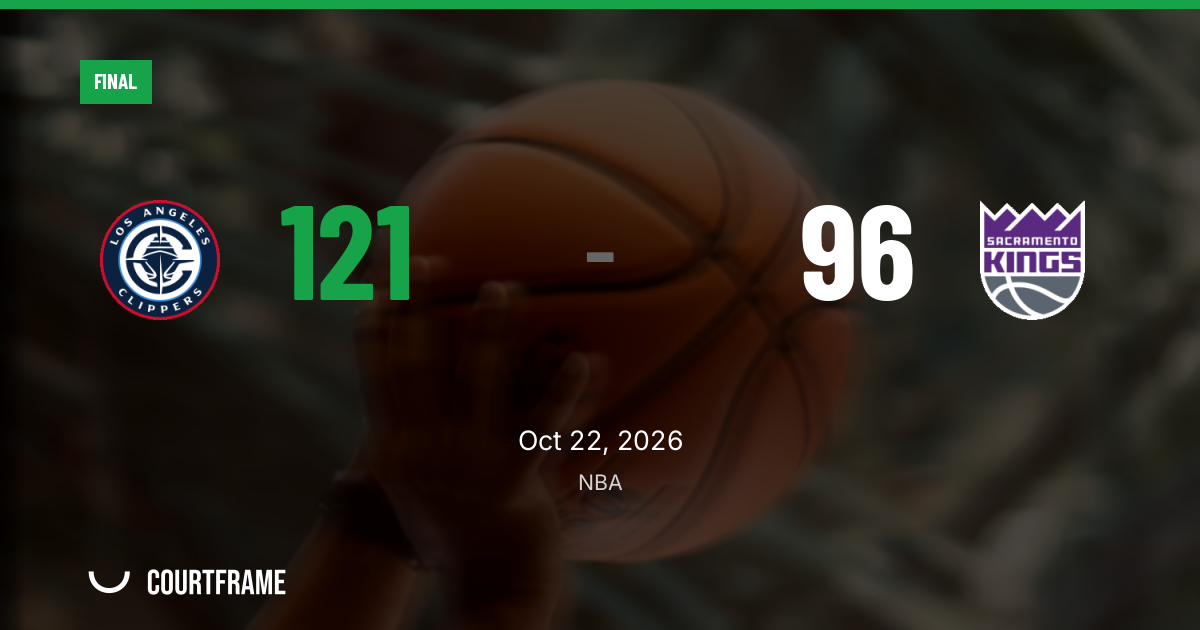
The Los Angeles Clippers began the regular season with a 121-96 win over the Sacramento Kings at Intuit Dome, turning a close second-quarter stretch into a comfortable opener behind superior shot-making, activity on the glass and disruptive defense.
Los Angeles entered with no significant injuries reported, while Sacramento was without Dylan Cardwell, Maxime Raynaud and Ben Simmons. Malik Monk was listed as questionable with left ankle soreness. The Kings’ thinner rotation showed most clearly in the second half, when the Clippers’ pressure and depth created separation after Sacramento had stabilized the game before halftime.
First-quarter burst set the terms
The Clippers scored 41 points in the first quarter, building an immediate 12-point lead after Sacramento opened with 29. That early margin mattered because the Kings briefly answered in the second quarter, holding Los Angeles to 20 points while scoring 25 to cut the halftime gap.
The game shifted again after the break. Los Angeles won the third quarter 32-16, the most important defensive segment of the night. Sacramento’s offense, which had generated 54 first-half points, managed only 16 in the quarter as the Clippers’ ball pressure and interior coverage tightened.
Los Angeles closed with 28 points in the fourth quarter, preventing Sacramento from building any sustained comeback after the third-quarter swing.
Clippers’ two-way statistical edge
The Clippers finished with a 49-42 rebounding advantage, a 29-22 edge in assists and a 14-8 margin in made 3-pointers. Those categories defined the result: Los Angeles created more connected offense, generated more perimeter value and controlled enough possessions to withstand 18 turnovers.
Sacramento committed 17 turnovers and was outscored by 25 points despite recording 10 steals. The Kings forced mistakes, but they did not turn that disruption into enough efficient offense. Their 8-for-28 shooting from 3-point range and 16-for-28 mark at the free-throw line left too many empty possessions in a game where Los Angeles repeatedly found cleaner looks.
The Clippers’ defensive activity was also more complete. They had 14 steals and five blocks, while Sacramento finished with no blocks. That difference reflected the way Los Angeles contested both passing lanes and finishes, particularly during the third quarter.
Garland leads a balanced Clippers attack
Darius Garland entered the opener as the Clippers’ leading scoring option after a 30-point performance in his first game of the season, and Los Angeles’ offensive structure again revolved around guard creation and spacing. The team’s 29 assists showed that the Clippers did not need to rely only on isolation scoring to separate.
Brook Lopez’s profile gave Los Angeles a frontcourt anchor after he opened the season with 17 points and 11 rebounds. K. Wagler added a two-way connector profile with 15 points, five assists and five rebounds in his first game, while Isaiah Jackson and Gradey Dick gave the Clippers additional scoring options after entering with 13 and 12 points, respectively.
The Clippers’ 14-for-35 night from 3-point range created the spacing advantage Sacramento could not match. Los Angeles also went 21-for-31 at the line, leaving room for improvement while still producing 121 points.
Kings could not support LaVine and Sabonis enough
Zach LaVine entered as Sacramento’s top scorer after a 28-point opener, while Domantas Sabonis brought a 14-point, 18-rebound, eight-assist profile into the matchup. Sacramento needed that combination to pressure the Clippers’ defense, but the team’s overall shot profile did not hold up over four quarters.
Precious Achiuwa, J. D. Acuff and E. Sharp were part of the Kings’ early-season scoring group, but Sacramento’s offensive balance never matched Los Angeles’ distribution. The Kings had 22 assists, seven fewer than the Clippers, and their lack of rim protection on the other end showed in the block column.
The frontcourt absences mattered. Cardwell’s left calf strain, Raynaud’s right patella subluxation and Simmons’ right Achilles tendon rupture removed size, defensive versatility and rotation options. Against a Clippers team that finished plus-seven on the boards and plus-five in blocks, Sacramento did not have enough available answers inside.
Result matched the pre-game lean
Los Angeles entered with a 62.6 percent implied win probability across nine bookmakers, and the final margin validated that pre-game lean more decisively than the narrow spread range suggested. The Clippers had seven days of rest and one game in the previous seven days, while Sacramento had five days of rest and one game in the previous seven days.
With both teams opening from 0-0 records and no recent head-to-head history, the matchup was less about trend lines and more about immediate execution. The Clippers’ 41-point first quarter and 32-16 third quarter supplied the two clearest answers: Los Angeles had more shooting, more defensive playmaking and more functional depth on opening night.