

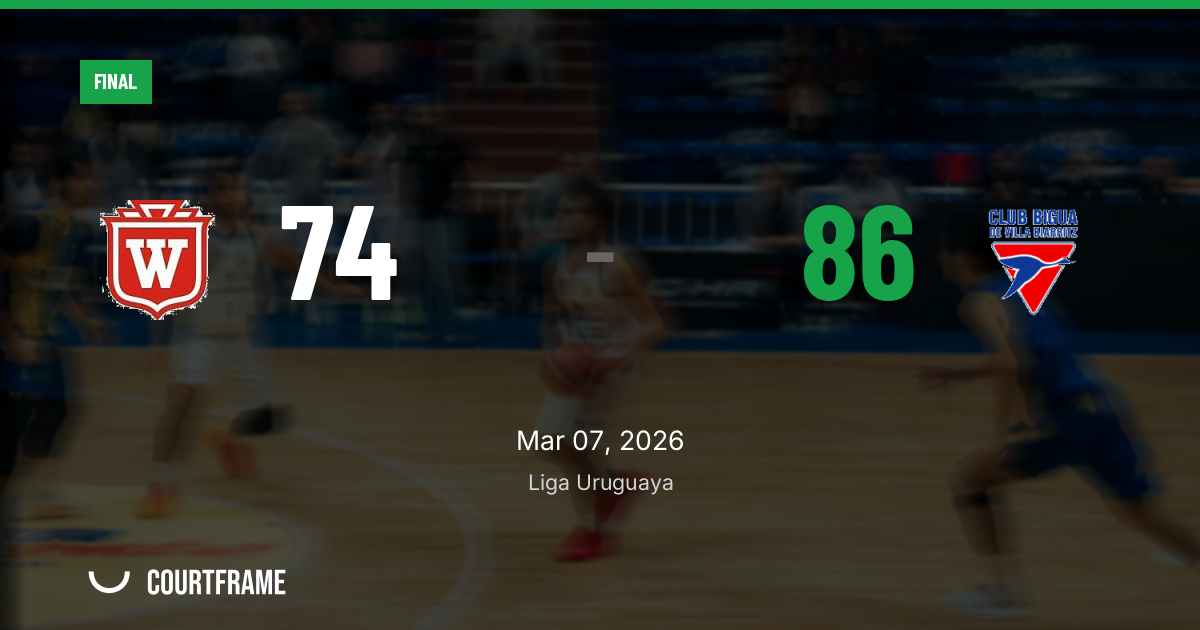
Bigua didn’t leave much room for drama in Montevideo. Behind a first-quarter avalanche and a more connected offensive performance, Bigua beat Welcome 86-74 on March 7, 2026 at Gimnasio Óscar Magurno in Liga Uruguaya’s 2025-2026 season.
The defining stretch came immediately: Bigua opened the game with a 24-8 first quarter, forcing Welcome to play uphill for the remaining 30 minutes. Welcome stabilized after that — even winning the fourth quarter 24-16 — but the early deficit and Bigua’s ability to answer each push kept the result from flipping late.
Game flow: the first quarter set the terms
Bigua’s best basketball came early, when it jumped out 24-8 and dictated tempo. Welcome responded with its most competitive period before halftime, taking the second quarter 22-21 to cut into the margin and bring some life back into the building.
Any momentum Welcome created was met after the break. Bigua won the third quarter 25-20, reestablishing separation and entering the fourth with control of the scoreboard. Welcome’s 24-point final period made the scoreline more respectable, but Bigua’s cushion — built across the first three quarters — held firm.
Ball movement advantage: Bigua’s 21 assists vs. Welcome’s 12
The cleanest separator in the team stats was playmaking. Bigua finished with 21 assists, a clear edge over Welcome’s 12. In a game where individual shooting and rebounding numbers weren’t provided, that gap still tells the story: Bigua consistently generated offense through shared creation, while Welcome had fewer assisted solutions when it needed clean looks to erase the early hole.
Turning points
1) The 24-8 opening quarter
Welcome’s margin for error was thin coming in at 4-18, and Bigua immediately squeezed it. The 16-point first-quarter gap shaped every decision after — from pace to shot selection — because Welcome had to chase.
2) Bigua’s third-quarter response
After Welcome nearly played Bigua even in the second, the third quarter became the answer period. Bigua’s 25 points in the third kept the game from tightening into a one- or two-possession grind, and it set up a fourth where Welcome’s late surge couldn’t fully threaten the result.
What it means going forward
For Bigua, the win moves them to 12-11 and reinforces a blueprint that travels: build an early lead, then lean on execution and ball movement to manage the middle of the game. For Welcome, now 4-19, the late push and the 24-point fourth quarter showed fight — but the opening quarter remains the glaring issue. Against a team willing to share the ball the way Bigua did, slow starts become too expensive.