
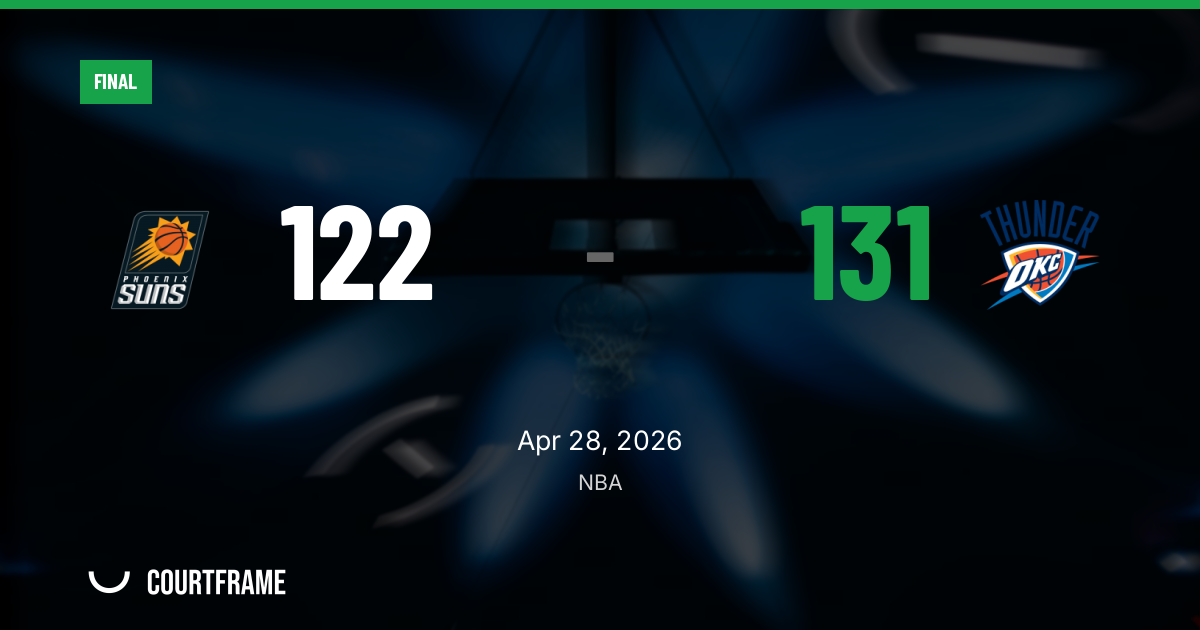
Oklahoma City entered the night with the profile of a contender and left Phoenix with the result to match it.
The Thunder defeated the Suns 131-122 on April 28 at Mortgage Matchup Center, using a 75-point first half to take control and close out the first-round series. Oklahoma City won the series 4-0, validating the gap that existed before tip: a 64-18 regular-season record, a No. 2 CPI ranking, and a market implied win probability of 79.7 percent.
Phoenix kept scoring long enough to make it competitive, but the Suns spent the night chasing. Oklahoma City won the first quarter 37-33, stretched the margin with a 38-34 second quarter and never gave back the cushion. The teams played even in the third, 31-31, before the Thunder managed the fourth quarter well enough to finish the job.
Oklahoma City’s offense traveled
The Thunder’s pregame indicators pointed to an elite offensive team, and the closeout game followed that blueprint. Over the previous 10-game sample, Oklahoma City carried a 128.1 offensive rating, 76.7 true shooting percentage and 74.0 effective field goal percentage. Against Phoenix, the Thunder again leaned into spacing and perimeter volume.
Oklahoma City shot 17-for-34 from 3-point range and 26-for-30 at the free-throw line. That combination mattered in a game where Phoenix actually created more defensive events, finishing with 10 steals and six blocks. The Suns generated pressure, but the Thunder’s shot quality and free-throw accuracy softened the impact of those plays.
The Thunder also finished with 28 assists, closely aligned with a recent profile built on ball movement. Their 99.3 assist rate over the previous 10 games was a clear differentiator entering the matchup, especially against a Phoenix team that had averaged 21.1 assists in that same span.
Suns scored, but the matchup problems remained
Phoenix did not lose because it failed to make shots. The Suns shot 34-for-51 from the field and 14-for-39 from 3-point range, with 24 assists and only 12 turnovers. That was enough offense to stay within range, especially after scoring 67 points in the first half.
The issue was defensive resistance. Phoenix entered with a 118.3 defensive rating over its previous 10 games and a minus-4.0 net rating. Oklahoma City’s shot profile exposed that weakness quickly, particularly in a first half when the Thunder scored 37 and 38 points in the opening two quarters.
The rebounding gap also tilted toward Oklahoma City. The Thunder finished with 39 rebounds to Phoenix’s 33, consistent with their stronger recent rebounding percentage. In a playoff closeout game, those extra possessions and completed defensive stands carried weight.
Injuries shaped the frontcourt and creation burden
Phoenix played without Mark Williams, who was out with a left foot third metatarsal injury. His absence removed a regular rotation frontcourt piece who averaged 10.8 points and 7.5 rebounds in 19 games, leaving the Suns thinner against a Thunder team with Chet Holmgren anchoring the interior.
Oklahoma City was also short-handed. Jalen Williams remained out with a left hamstring injury, a significant absence given his 18.2 points and 5.1 assists per game. But the Thunder’s broader creation structure held. Shai Gilgeous-Alexander entered as the primary engine at 29.1 points and 7.3 assists per game, and Oklahoma City’s collective passing again carried the offense.
The Thunder also continued to survive without Thomas Sorber, who was out with a right ACL injury. Their depth and balance mattered throughout the series, and this game reflected the same theme: Oklahoma City could absorb missing personnel without losing its identity.
The result matched the data
This was not an upset, and it was not a stylistic surprise. Oklahoma City had the better regular-season record, the superior road split at 15-5 with 117.6 points per game, the stronger recent advanced metrics and a massive CPI edge, ranking second compared with Phoenix at 21st.
Phoenix’s home split also hinted at vulnerability. The Suns entered 12-14 at home with an average of 109.1 points, and while they exceeded that scoring level, they could not bend the game toward their preferred terms. Oklahoma City dictated the efficiency battle and forced Phoenix into a track meet it could not win.
The Suns had enough shot-making to make the final score respectable. The Thunder had enough structure to make it decisive. In a first-round series defined by Oklahoma City’s broader two-way advantage, Game 5 served as the final confirmation.