
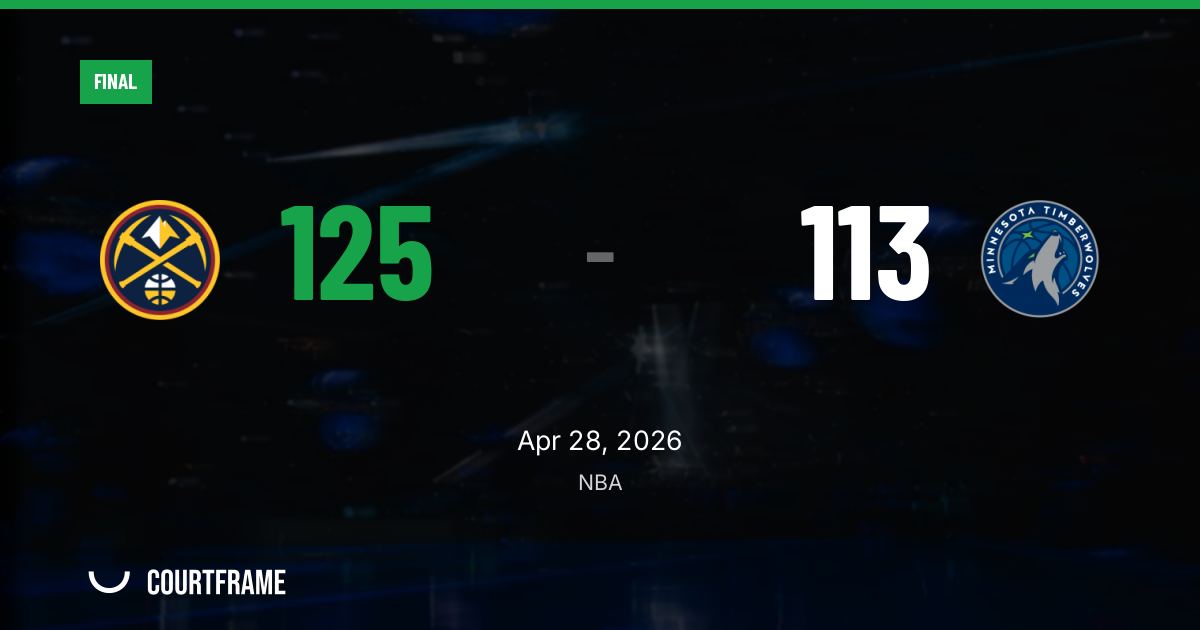
DENVER — The Nuggets had no margin left. Down 3-1 in the first round and facing elimination at Ball Arena, Denver answered with its cleanest offensive push of the series, beating the Minnesota Timberwolves 125-113 on April 28.
The result cut Minnesota’s series lead to 3-2 in the best-of-seven matchup and kept Denver’s season alive. The Nuggets entered with the market heavily tilted in their favor at an 80.6 percent implied win probability, and the game eventually followed that script: Denver controlled the middle quarters, punished a short-handed Minnesota team and turned a tight first half into a double-digit playoff win.
The decisive stretch came in the third quarter. Denver outscored Minnesota 37-24 after halftime, extending a 60-51 lead into a 97-75 advantage entering the fourth. Minnesota’s 38-point fourth quarter made the final margin more respectable, but the Wolves had already lost the possession-to-possession battle that defined the night.
Denver’s offense matched the moment
Denver came into Game 5 on a five-game winning streak and with the profile of a team built to generate efficient offense under pressure. Over its previous 10 analyzed games, the Nuggets carried a 122 offensive rating, a 71.6 true shooting percentage and a 92.7 assist rate. Those indicators mattered in an elimination setting where shot quality and execution often decide the game.
The Nuggets’ 125 points also landed above their regular-season home split of 121.1 points per game. That home strength has been one of their most reliable edges: Denver entered with an 18-6 home record in the provided splits, a 75 percent win rate, and it looked comfortable dictating terms from the opening quarter.
Denver scored 34 in the first quarter and 60 by halftime, establishing the rhythm early. The Nuggets then delivered the game’s defining burst in the third, when their half-court structure and shot-making created the separation Minnesota could not erase.
Jokic-Murray foundation holds under elimination pressure
The Nuggets’ series-saving win again ran through the team’s core offensive architecture. Nikola Jokic entered averaging 25.8 points, 13.5 rebounds and 10 assists across 36 games, while Jamal Murray entered at 25 points and 6.8 assists. In a game Denver had to have, that kind of top-end creation profile gave the Nuggets a clear path to stability.
Denver’s pregame statistical profile suggested exactly that: a team with elite assist volume, strong shooting efficiency and enough rebounding balance to survive long stretches against a physical Minnesota group. The Nuggets entered with a 50.6 rebound percentage over their last 10 analyzed games, compared with Minnesota’s 48.9, and the broader matchup tilted toward Denver’s ability to control shot quality more than tempo.
This was not a track meet by profile. Denver’s recent pace sat at 78, Minnesota’s at 77.6. The Nuggets did not need chaos. They needed execution, and the 37-point third quarter was the cleanest reflection of the gap between a full-strength Denver engine and a Minnesota team missing its primary star.
Minnesota felt Anthony Edwards’ absence
The Timberwolves entered Game 5 without Anthony Edwards, who was listed out with a left knee injury. That absence changed the shape of the series pressure. Edwards came in averaging 27 points, 5.2 rebounds and 3.5 assists, the most important scoring presence on Minnesota’s roster and the player most capable of bending Denver’s defense late in the clock.
Without him, Minnesota still found offense in the fourth quarter, scoring 38 points, but the Wolves could not sustain enough pressure across all four quarters. Their second quarter produced only 22 points, and their third quarter stalled at 24 as Denver built the lead that decided the game.
Donte DiVincenzo was also out with a right Achilles tendon injury, further narrowing Minnesota’s rotation and perimeter options. The Timberwolves entered with a strong recent efficiency profile — a 67.3 effective field goal percentage and 70.6 true shooting percentage over their last 10 analyzed games — but the missing shot creation mattered in the middle of the game, when Denver’s defense tightened and Minnesota needed a stabilizing answer.
Pre-game indicators pointed toward Denver response
The matchup was not as simple as the standings. Denver finished the regular season 54-28, Minnesota 49-33, and the Timberwolves arrived with a 3-1 series lead. Minnesota also carried a slightly better CourtFrame Performance Index profile, ranking ninth with a 66.33 CPI compared with Denver’s 65.18 and 11th-place rank.
But the Game 5 setup leaned Denver. The Nuggets were at home, on equal rest, and in better recent form. Both teams had two days of rest and three games in the previous seven days, removing fatigue as a clear differentiator. Denver’s home split and five-game winning streak became more relevant once the Wolves lost Edwards and DiVincenzo from the lineup.
The betting market reflected that combination, placing Denver at an 80.6 percent implied probability. The Nuggets justified it with a 12-point win that was built less on one late run and more on sustained control: 34 points in the first quarter, a nine-point halftime lead and a third-quarter surge that effectively forced Game 6.
Series shifts, but Minnesota still leads
Denver did what elimination teams must do: extend the series without needing perfection. The Nuggets scored 125, held serve at Ball Arena and cut Minnesota’s lead to 3-2.
For the Timberwolves, the math remains favorable, but the pressure changes. A 3-1 lead is now 3-2, and Denver’s offensive rhythm has reentered the series. Minnesota’s fourth-quarter push showed fight, but the Wolves’ middle-quarter issues without Edwards were too costly.
The Nuggets are still behind. But after a 125-113 response in Game 5, the series has life again — and Denver’s best indicators finally translated into an elimination-game performance.