
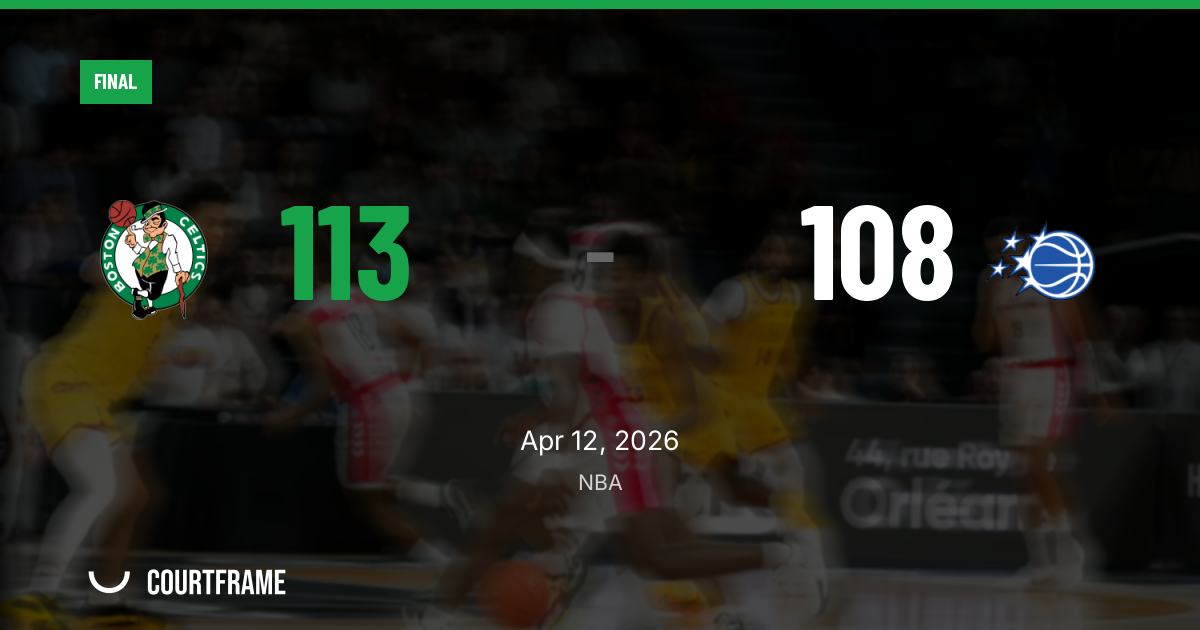
Boston didn’t have its stars. It still had the swing quarter.
Behind a 42-point third period, the Celtics overcame a nine-point halftime hole and outlasted the Orlando Magic 113-108 Sunday night at TD Garden. The game turned on one stretch of overwhelming shot-making and pace control — a classic Boston profile — even with Jaylen Brown (left Achilles), Jayson Tatum (right Achilles) and Derrick White (right knee) all sidelined.
Game flow: Boston’s third-quarter avalanche
Orlando owned the first half, winning the opening quarter 29-20 and taking a 61-52 lead into the break. The Magic were comfortable dictating tempo early, then Boston ripped the game open after halftime with a 42-20 third quarter that completely flipped the scoreboard. That surge built the separation Boston needed, because the fourth quarter swung back toward Orlando (27-19) — just not enough to erase what happened in the middle of the night.
How Boston won: shot profile + defensive playmaking
The Celtics’ win aligned with the identity their recent advanced trend points to: a heavy three-point diet and a high-end offensive ceiling. Over their last 10 games analyzed entering this one, Boston carried a massive three-point rate (88.1) with elite efficiency markers (78.2 true shooting percentage; 75.6 effective field-goal percentage) and a strong net rating (+12.7). The third quarter looked like that profile in real time — quick decisions, spacing, and a run that forced Orlando to chase.
Defensively, Boston created extra possessions with activity: 10 steals to Orlando’s six. That mattered in a game where both teams were loose with the ball — 17 Celtics turnovers and 19 Magic turnovers — and where each side was dealing with schedule fatigue (both teams on one day of rest in a back-to-back; Boston playing its third game in seven days, Orlando its fourth).
How Orlando let it slip: the third-quarter collapse and turnover tax
Orlando’s pregame indicators suggested a thinner margin: a -2.3 net rating over its last 10 games analyzed with a 20.6 turnover rate. Those cracks showed once Boston sped the game up after halftime. The Magic’s 20-point third quarter wasn’t just a cold spell — it was a failure to stabilize with clean possessions, and the 19 turnovers overall fed Boston’s transition chances and early-clock threes.
Orlando did enough late to make it uncomfortable, winning the fourth quarter by eight, but the third-quarter deficit was too steep.
Injuries and rotation reality
This was a Celtics win built in the margins. Boston entered with Brown, Tatum and White all out, plus Neemias Queta out (right toe) and multiple rotation pieces listed as doubtful (Sam Hauser, Payton Pritchard, Nikola Vucevic). Orlando’s report listed Jett Howard (left ankle) and Jonathan Isaac (left knee) as questionable.
In that context, Boston’s ability to manufacture a decisive quarter — while still producing 24 assists and forcing 10 steals — stood out as the stabilizing force. The Celtics’ home baseline also held: they came in 17-4 at TD Garden (81% win rate), and even a shorthanded version found a way to match that standard.
What the result says going forward
Pre-game CPI context framed this as a Boston-leaning matchup on paper (Celtics CPI 87.10 vs. Magic 52.81). The final score followed that script, but the path was anything but clean. Boston needed one elite, identity-driven quarter to overcome a slow start and a late fade — and got it.
Orlando, meanwhile, showed enough in the first half and the fourth to suggest it can win stretches against good teams, but the possession management issues (turnovers) and the inability to withstand one opponent run remain the separating line in games like this.