
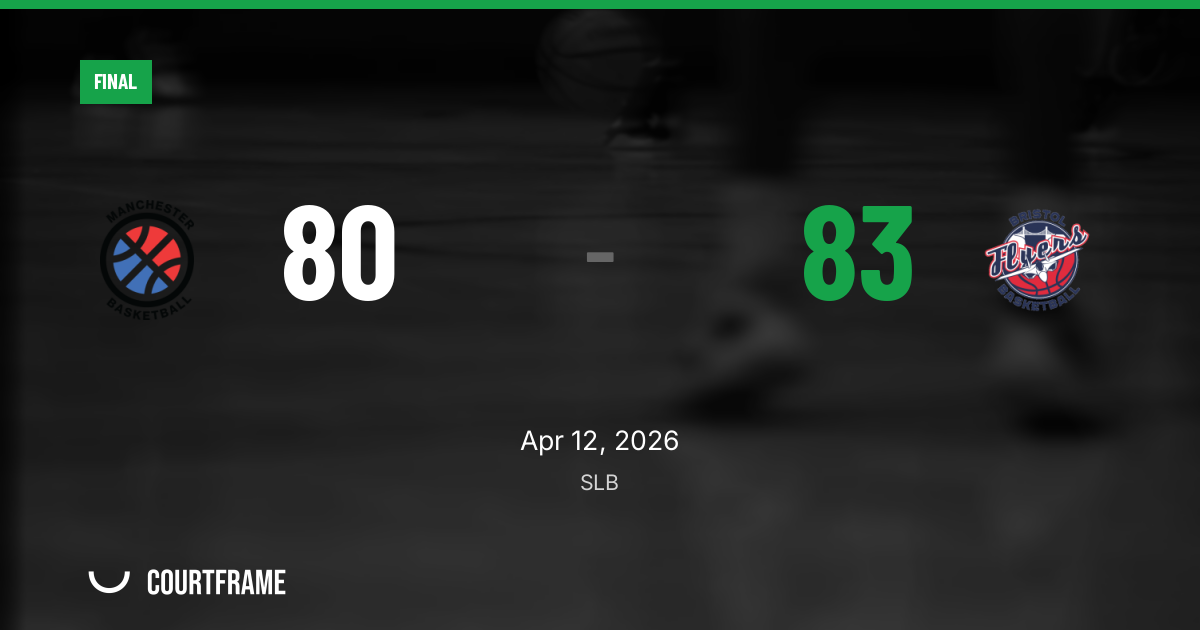
Bristol Flyers arrived in Manchester carrying a five-game losing streak and a steep pregame profile gap — but left with the result that mattered most. Behind a steady, incremental climb across the middle quarters and a decisive 23-18 fourth, Bristol closed out an 83-80 win over Manchester Basketball on April 12 at the National Basketball Performance Centre.
The upset came against the grain of the broader context. Manchester entered 17-11 with a WLWWW run, while Bristol was 12-16 and LLLLL. The CPI matchup differential was massive (Manchester 72.36 vs. Bristol 9.61), and there were no significant injuries reported for either side. Yet the Flyers found enough late-shot-making and ball movement to escape.
How the game swung
Manchester set the early tone, winning the first quarter 23-19. But Bristol stabilized immediately after, taking the second quarter 20-16 to narrow the gap at halftime. The third quarter mirrored the opener — Manchester edged it 23-21 — but the fourth belonged to Bristol, which won 23-18 to complete the comeback and steal the game late.
Shot profile vs. execution: Bristol’s threes carried the night
Bristol’s clearest separator was the three-point line. The Flyers hit 10-of-32 from deep, a volume-driven edge that allowed them to keep pace even without winning the glass (29 rebounds to Manchester’s 35). Manchester, by contrast, went 5-of-20 from three.
That shooting gap mattered in a game decided by three points. Bristol’s ability to generate perimeter attempts aligned with its recent offensive tendencies: over the last 10 games, the Flyers owned a 58.6 three-point rate. Manchester also leans into threes (60.7 three-point rate over its last 10), but the home side didn’t convert enough of those looks to create separation.
Possessions and pressure: turnovers kept the door open
Manchester’s 18 turnovers were the other pressure point. Bristol wasn’t pristine (16 turnovers), but the Flyers’ edge in ball security — and, crucially, their ability to turn possessions into assisted offense — showed up in the playmaking column. Bristol finished with 19 assists to Manchester’s 13, a meaningful gap in a tight, late-game environment.
That distribution advantage also tracks with Bristol’s recent profile: an 87.2 assist rate over its last 10 games. Manchester’s assist rate over that span (76.5) is strong, but it didn’t translate here at the same level, especially as the game tightened in the fourth quarter.
Fourth-quarter composure flipped the script
Manchester had navigated to a position of strength through three quarters, but Bristol’s final push was the difference. The Flyers’ 23-point fourth quarter outpaced Manchester’s 18, turning a narrow deficit into a narrow win. In a game without reported injury constraints, the finish read more like execution under pressure than availability.
Why this result didn’t match the pregame indicators
On paper, Manchester carried most of the signals: the better record (17-11), better form (WLWWW), and a far stronger CPI rating and rank (No. 3 vs. No. 8). Over the last 10 games, Manchester also posted a positive net rating (+9.4) compared to Bristol’s -14.8.
But single-game outcomes often hinge on a few controllable margins, and Bristol won two of the biggest ones: three-point makes (10) and assisted offense (19 assists). Manchester’s turnover count (18) compounded the issue, erasing the benefits of a rebounding edge and a strong start.
Context that mattered: fatigue and environment
Both teams were on one day of rest in a back-to-back setup, with Manchester playing one game in the last seven days and Bristol playing two. The win also came on the road for a Bristol team that, in its available away split sample, averaged 75 points with a 3-3 record.
What’s next
For Bristol, the win is a needed reset after the LLLLL stretch, and it came by leaning into the team’s identity — spacing, threes, and ball movement. For Manchester, the loss is a reminder that even with favorable pregame indicators, the late-game margins (turnovers and shot conversion from deep) can flip a night quickly.